The silence of the Rub' al Khali desert is not truly silent. It is a vibrating, low-frequency hum of industry, the sound of the world’s lungs breathing. At the Abqaiq processing plant in eastern Saudi Arabia, that hum represents the stabilization of nearly seven million barrels of oil every single day. To the engineers walking the steel catwalks, it is the sound of a steady heartbeat. To the rest of the planet, it is the invisible tether that keeps the lights on in London, the factories running in Shanghai, and the morning commute possible in Los Angeles.
Then came the swarm.
It wasn’t a thunderclaps of traditional warfare. There were no carrier strike groups on the horizon or heavy bombers overhead. Instead, there was a high-pitched, lawnmower whine that sliced through the desert air—the sound of eighteen drones and seven cruise missiles navigating by the cold logic of GPS.
When the first impact hit the stabilization towers, the heartbeat skipped. By the third, it stopped. In the span of a few minutes, 5% of the global oil supply vanished into a plume of black smoke that was large enough to be seen from the International Space Station. We often talk about the "global economy" as an abstract concept, a series of green and red numbers on a screen. That morning, the abstract became visceral.
The Anatomy of a Precision Strike
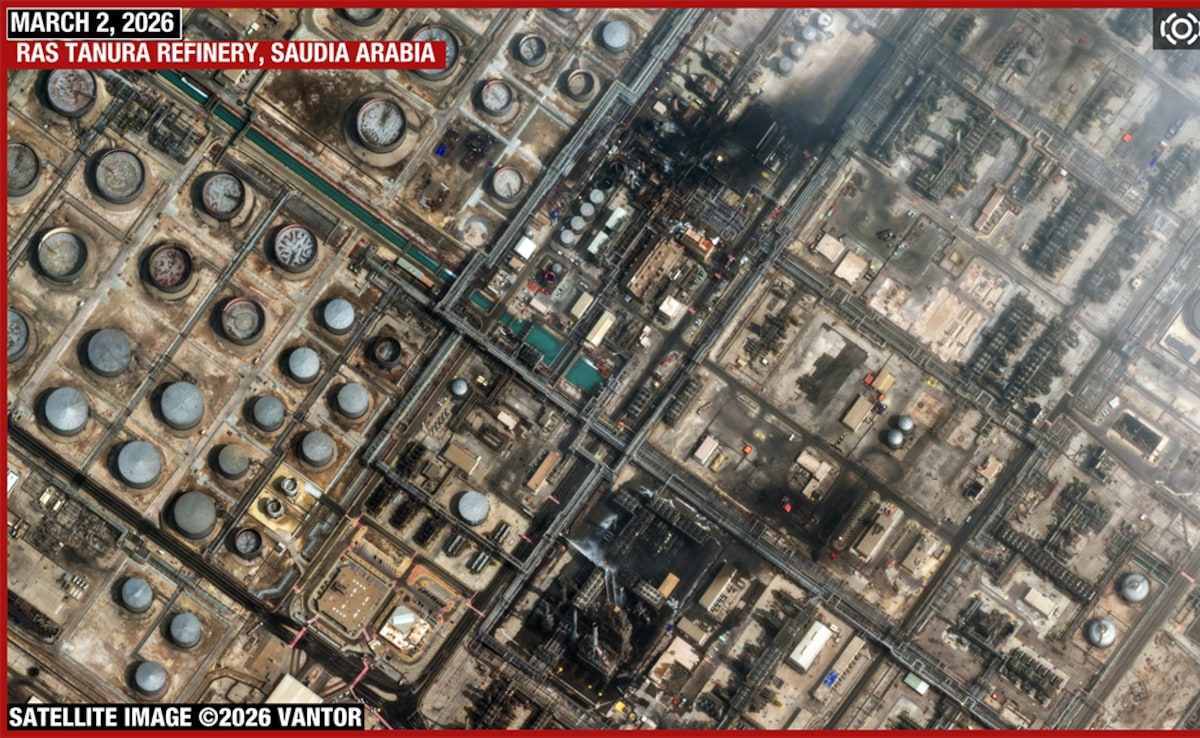
For decades, we believed that protecting critical infrastructure meant building thicker walls or deploying more soldiers. Abqaiq was one of the most heavily defended patches of earth on the peninsula. Yet, the satellite imagery released in the aftermath revealed a terrifying new reality of modern conflict.
The pictures didn’t show a scorched-earth carpet bombing. They showed surgical precision. Imagine a giant, five-story tall pressure cooker. Now imagine hitting the exact valve required to make it fail. That is what happened to the spheroids—the massive, bulbous tanks used to separate gas from crude oil. The drones didn't just hit the facility; they hit the specific "vitals" of the machinery.
Looking at the high-resolution "before and after" shots, you see seventeen distinct points of impact. It was a mechanical lobotomy.
This precision is the "democratization of destruction." In the past, only a superpower with a billion-dollar air force could pull off a strike this accurate. Now, a localized militia or a middle-tier power can achieve the same result with a handful of carbon-fiber wings and some off-the-shelf circuitry. The cost of the attack was likely in the hundreds of thousands. The cost of the damage, and the subsequent spike in global oil prices, was measured in the billions.
The Humans Behind the Heat Shields
Consider a hypothetical lead engineer at Abqaiq. Let’s call him Ahmed. Ahmed has spent twenty years learning the temperament of those stabilization towers. He knows that when the pressure spikes in Tower 4, you don't just turn a dial; you coax it back to life like a nervous animal.
When the drones struck, Ahmed wasn't thinking about the geopolitical tensions between Riyadh and Tehran. He was thinking about the sheer volume of pressurized gas beneath his feet. He was thinking about the fire suppression systems and the hundreds of workers who needed to be evacuated through a maze of pipes that were rapidly becoming a furnace.
The satellite photos show the holes in the tanks, but they don't show the heat. They don't show the frantic coordination in the control rooms as the world’s most sophisticated energy hub began to bleed out. When the fires were finally extinguished, the silence that followed was far more haunting than the explosion. It was the silence of a stalled machine.
The Fragile Web of the Everyday
Why should someone sitting in a coffee shop in Seattle care about a hole in a steel tank in the Saudi desert?
The answer lies in the terrifying efficiency of our modern world. We have spent the last thirty years "optimizing" everything. We removed the slack from the system. We created "just-in-time" supply chains that rely on the constant, uninterrupted flow of resources.
Think of it like a spiderweb. If you snap one outer strand, the web holds. But the Abqaiq facility is the center anchor. When that strand snaps, the entire structure sags. Within hours of the strike, traders in New York were shouting into phones. The price of Brent crude jumped nearly 20%, the largest one-day surge in history.
This isn't just about the price of gasoline. It’s about the cost of plastic for medical syringes. It’s about the cost of the fuel for the ship carrying grain to countries facing food insecurity. It’s about the fragility of our collective comfort. We live in a world where a few hobbyist-grade motors and a gallon of fuel can threaten the stability of the G20.
A New Geometry of Power
The Aramco strike changed the math of security forever. We are no longer in an era where "big" beats "small." We are in an era where "smart" beats "expensive."
A Patriot missile battery, designed to intercept high-flying jets and ballistic missiles, costs millions of dollars per shot. A drone costs less than the bumper on a Toyota Camry. When you have to spend $3 million to shoot down a $20,000 threat, you are losing the war of attrition before the first shot is even fired.
The wreckage in the desert proved that our old definitions of borders and front lines are obsolete. The front line is now anywhere a GPS signal can reach. It is the power grid in Texas, the water treatment plant in Florida, and the refinery in Abqaiq.
The physical damage at the refinery was repaired with impressive speed. Within weeks, Aramco claimed production was back to normal. But the psychological damage is permanent. The image of those scorched spheroids remains a memento mori for the industrial age. It is a reminder that the giants of the 20th century—the massive refineries, the sprawling power plants, the centralized hubs—are now the most vulnerable targets of the 21st.
The Ghost in the Machine
We often look at satellite photos and see static images of ruins. We see "extent of damage." We see "points of impact."
But if you look closer, you see a warning.
The drones that hit Saudi Aramco weren't just weapons; they were messengers. They delivered a memo stating that the age of the invulnerable fortress is over. We have built a world of incredible complexity and undeniable beauty, but we have built it on a foundation of precarious nodes.
As the sun sets over the Rub' al Khali, the hum of Abqaiq has returned. The towers are patched. The pipes are pressurized. The oil is flowing once more, pulsing through the veins of the global economy. But the engineers on the catwalks now look at the sky differently. They no longer see an empty blue expanse. They see a wide-open door.
The heartbeat of the world is steady for now, but it is no longer quite so certain. It is the sound of a system holding its breath, waiting for the next whine of a motor in the distance.