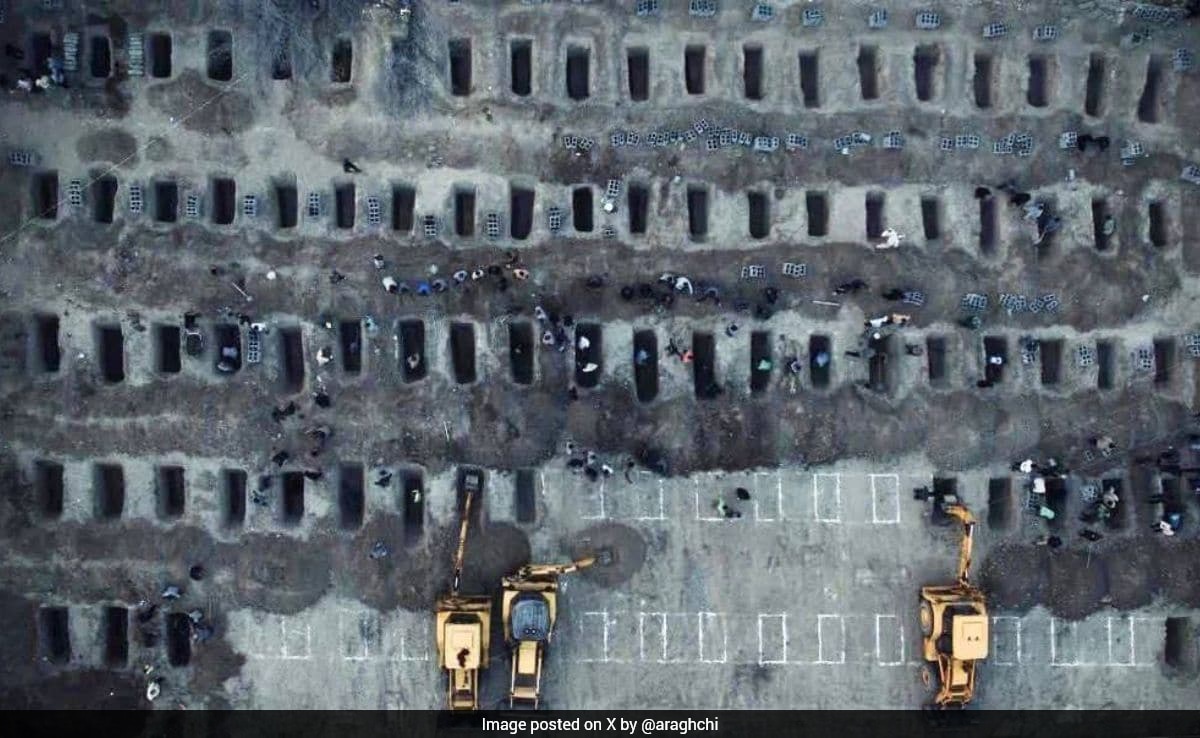
The Iranian government has pivoted from standard diplomatic condemnation to a visceral, morbid form of psychological warfare. By circulating images of mass graves in response to American "rescue" rhetoric, Tehran is not merely criticizing a policy; it is weaponizing historical trauma to ensure its domestic audience views any Western intervention as a death sentence. This strategy marks a significant escalation in the information war between the Islamic Republic and the United States, moving past the usual burning of flags into the realm of existential dread.
The core of this friction lies in the disconnect between Washington’s messaging of liberation and Tehran’s projection of catastrophe. When American leadership speaks of "rescuing" the Iranian people from their current regime, they rely on a framework of democratic transition. Tehran, however, views this through the lens of regional history—specifically the destabilization of Iraq and Libya. By showing the public images of trenches meant for the dead, the regime effectively changes the conversation from "Do you want freedom?" to "Do you want to survive?"
The Mechanics of State Sponsored Fear
Governments rarely use such grisly imagery unless they feel their back is against the wall. The decision to use mass graves as a visual rebuttal to American promises serves a dual purpose. First, it targets the middle class in Iran, those who might be unhappy with the current clerical rule but are terrified of the chaos that followed the Arab Spring. It is a cynical but effective play on the "stability at any cost" sentiment.
Secondly, it serves as a warning to the international community. The imagery suggests that any attempt at regime change will not result in a neat, clinical transition but in a bloodbath of unprecedented proportions. It is the visual equivalent of a scorched-earth policy communicated before the first shot is even fired.
To understand why this resonates, one has to look at the regional psyche. The Iranian leadership knows that their citizens have watched decades of conflict on their borders. They saw the sectarian violence in Baghdad and the slave markets in post-Gadhafi Libya. When the Islamic Revolutionary Guard Corps (IRGC) or state-aligned media outlets blast images of burial pits, they are reminding their people that "rescue" is often a synonym for "ruin" in the Middle Eastern vernacular.
The Failure of the Rescue Narrative
The American approach to Iran often suffers from a chronic lack of historical empathy. Policy planners in D.C. frequently operate under the assumption that a population under economic duress will naturally welcome an external savior. This ignores the fierce nationalist streak that defines Iranian identity, regardless of one's feelings toward the Supreme Leader.
By promising a rescue, the U.S. inadvertently plays into the regime's hands. It allows the hardliners to frame every protest, every strike, and every bit of domestic unrest as a foreign plot. The mass grave imagery is the ultimate punctuation mark on that sentence. It tells the Iranian public that the Americans are not bringing bread and ballots, but rather shovels and shrouds.
Consider the logistics of these propaganda campaigns. They are not haphazard. They are timed to coincide with specific policy shifts or rhetoric from the State Department. When a high-ranking U.S. official mentions "regime collapse" or "maximum pressure," the Iranian media apparatus shifts into high gear to show the physical consequences of such a collapse. They don't show burning tanks; they show the quiet, terrifying reality of mass casualties.
A Legacy of Skepticism
There is a deep-seated reason why the mass grave imagery sticks. Iran has a long memory. The 1953 coup, which saw the democratically elected Mohammad Mosaddegh ousted in a CIA-backed operation, remains a cornerstone of the national curriculum and the collective consciousness. For many Iranians, Western "help" has historically been a precursor to decades of authoritarianism or exploitation.
The regime doesn't have to work hard to find examples of Western intervention gone wrong. They simply have to point across the border. This makes the "rescue" promise seem not just hollow, but predatory. The hardliners argue that the U.S. doesn't want to save Iranians; it wants to remove a geopolitical obstacle, and if the Iranian people are caught in the crossfire, they will simply be another statistic in a mass grave.
The Role of Digital Despair
Social media has amplified this. In the past, state television was the primary vehicle for these messages, and its reach was limited by a lack of credibility. Now, these images are chopped into bite-sized content, memes, and short-form videos that circulate on Telegram and WhatsApp. They bypass the traditional filters of state media and land directly in the palms of the youth.
Even for those who despise the morality police or the economic mismanagement of the mullahs, the sight of a mass grave is a powerful deterrent. It triggers a primal survival instinct that often overrides the desire for political reform. The message is clear: the current system may be suffocating, but the alternative is literal extinction.
Analyzing the Counter-Arguments
Critics of the regime argue that these images are a desperate fabrication, a way to deflect from the fact that the government's own mismanagement is killing people through a failing healthcare system and environmental collapse. They suggest that the "mass graves" are often recontextualized photos from natural disasters or even other conflicts, used out of context to manufacture consent through terror.
While there is truth to the idea that the regime is deflective, the accuracy of the photos is almost secondary to their symbolic power. In the world of psychological operations, perception is reality. If a significant portion of the population believes that Western intervention leads to the grave, the U.S. has already lost the battle for hearts and minds, regardless of how many "Voice of America" broadcasts are beamed into the country.
The Economic Context of Morbidity
One cannot separate this dark imagery from the crushing weight of sanctions. The Iranian economy is in a state of permanent crisis, with inflation eroding the life savings of the working class. In this environment, the regime uses the threat of mass death to justify the current economic misery. They frame the sanctions as a slow-motion version of the mass grave—a deliberate attempt by the West to starve and kill the Iranian population.
This creates a "siege mentality" that is incredibly difficult to break from the outside. When a population feels they are being actively targeted for destruction, they tend to huddle closer to whatever power structure promises to defend them, no matter how flawed that structure might be. The mass grave imagery is the visual manifestation of this siege.
Tactical Miscalculations in Washington
The American side often fails to provide a concrete, believable alternative to the regime's "ruin" narrative. If the U.S. wants to counter the imagery of burial pits, it needs more than just rhetoric about "liberty." It needs a visible, tangible plan for what a post-transition Iran looks like—one that doesn't involve the dissolution of the state or the descent into sectarian militia rule.
As it stands, the lack of a clear post-regime roadmap allows Tehran to fill the void with its own nightmare scenarios. Every time a U.S. politician talks about "bombing Iran," they are effectively providing the captions for the regime's mass grave photos. It is a symbiotic relationship of escalation where the only losers are the civilians caught in the middle.
The Future of the Visual War
We are entering an era where the struggle for Iran will be fought through the optics of disaster. The regime has realized that they cannot compete with the West on the merits of economic prosperity or individual freedom. Instead, they have chosen to compete on the terrain of fear. They are betting that the fear of death is stronger than the hope for a different life.
This is a high-stakes gamble. If the regime pushes the morbidity too far, it can backfire, leading to a sense of nihilism where the population feels they have nothing left to lose. But for now, the images of mass graves serve as a grim reminder of the stakes involved. This isn't just about politics or oil; it's about the fundamental human terror of being discarded in a trench.
The next time a Western leader promises to "stand with the Iranian people," they should be aware that the response will not be a diplomatic note. It will be another series of photos showing the silent, dirt-filled pits that Tehran claims are being dug by American intentions. Breaking this cycle requires more than just better PR; it requires a fundamental shift in how the West engages with a nation that has been taught to see every hand reached out in friendship as a hand holding a shovel.
Instead of reacting to these provocations with more "maximum pressure," policy analysts should be looking at how to de-escalate the existential threat that the regime uses to maintain its grip. Until the Iranian people can envision a future that doesn't end in the imagery Tehran provides, the "rescue" promise will continue to be met with the silence of the grave. Check the historical outcomes of every "liberation" campaign in the last twenty years and ask if the skepticism isn't, at least partially, earned.