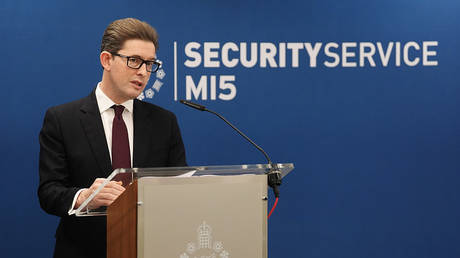
The intersection of national security and press freedom is governed by a friction-filled trade-off between the state's need for information and the journalist's requirement for source confidentiality. When the UK intelligence services are accused of targeting an Irish journalist, the incident moves beyond a simple privacy violation and enters the realm of a structural failure in the Legal Oversight Framework. This breach represents a breakdown in the "Three-Point Verification" system: legal necessity, proportional response, and democratic accountability.
The Architecture of Targeted Interception
State surveillance of a foreign national journalist is not a random occurrence; it is a calculated deployment of high-cost resources. To understand the mechanics of such an operation, one must deconstruct the Surveillance Lifecycle. This process begins with a specific intelligence requirement, likely originating from a perceived threat to national security or the prevention of serious crime, which then triggers a technical interception mandate.
The technical apparatus used generally falls into two buckets:
- Passive Interception: Harvesting data as it moves across telecommunications infrastructure. This involves tapping undersea fiber-optic cables (such as those connecting the UK and Ireland) or monitoring satellite uplinks.
- Active Intrusions: Specifically targeting a device with Remote Access Trojans (RATs) or Zero-Click exploits. This is more resource-intensive but yields higher fidelity data, including encrypted communications.
In the case of an Irish journalist, the UK's Government Communications Headquarters (GCHQ) would operate under the Investigatory Powers Act (IPA) 2016. While the IPA provides a legal veneer for domestic operations, its extraterritorial application creates a "Jurisdictional Grey Zone." The core of the accusation lies in whether the surveillance bypassed the "double-lock" mechanism—a process where both a Secretary of State and an independent Judicial Commissioner must approve a warrant.
The Cost-Benefit Function of Intelligence Gathering
Intelligence agencies operate under a budget of both financial capital and political risk. The decision to monitor a member of the press suggests that the perceived value of the information (the "Intelligence Yield") outweighed the potential blowback of a diplomatic crisis (the "Exposure Cost").
The Intelligence Yield in this context likely focused on:
- Source Mapping: Identifying the network of whistleblowers or internal state actors feeding information to the journalist.
- Narrative Pre-emption: Gaining prior knowledge of sensitive stories to prepare counter-narratives or legal injunctions.
- Network Analysis: Understanding the journalist's connections to organizations deemed adversarial to UK interests.
Conversely, the Exposure Cost involves the degradation of trust between the UK and Irish governments. Since the 1998 Good Friday Agreement, security cooperation between London and Dublin has been a cornerstone of regional stability. Unilateral surveillance of a sovereign neighbor’s citizens risks a "Intelligence Deficit," where the targeted state becomes less willing to share data through official channels, ultimately making both nations less secure.
The Breakdown of the Shielding Protocol
Journalistic privilege is not merely a professional courtesy; it is a structural necessity for a functioning information economy. When a state targets a journalist, it creates a Chilling Effect Loop.
- Surveillance Detection: The journalist or their organization identifies signs of compromise (e.g., unexplained device behavior, leaked details appearing in state-adjacent media).
- Source Attrition: Whistleblowers, fearing the state's reach, cease providing high-value information.
- Information Decay: The quality of investigative reporting drops as journalists shift to "Defensive Reporting" or self-censorship.
- Oversight Erosion: The public is less informed about state overreach, allowing the surveillance apparatus to expand without resistance.
The specific targeting of an Irish journalist by the UK also highlights the limitations of the European Convention on Human Rights (ECHR). Article 10 protects freedom of expression, which the European Court of Human Rights has repeatedly interpreted as including the protection of journalistic sources. However, the enforcement mechanism is reactive rather than proactive. By the time a case reaches the court, the intelligence has already been gathered and utilized, rendering the privacy "remedy" largely symbolic.
Algorithmic Bias and Automated Flagging
Modern surveillance is rarely about a human sitting in a room listening to phone calls in real-time. Instead, it relies on Heuristic Filters. These algorithms scan vast quantities of metadata for "Signature Behaviors."
A journalist investigating sensitive state topics—such as Northern Irish legacy issues or post-Brexit border security—will naturally trigger these filters. Their metadata (contacting known activists, traveling to specific locations, using encrypted messaging apps like Signal) mimics the profile of a "Threat Actor." If the surveillance system lacks a "Professional Exclusion" flag for journalists, the automation will escalate the case to a human analyst. The failure to filter out journalists at the algorithmic level is a design choice, not a technical error.
The Geopolitical Friction Points
The Anglo-Irish relationship is currently defined by a high degree of regulatory and political divergence. This creates a specific environment where intelligence gathering becomes a tool for political leverage.
The first friction point is Data Sovereignty. Ireland is a hub for major tech multinationals. If the UK is accessing data on Irish soil without a Mutual Legal Assistance Treaty (MLAT) request, it is bypassing the very legal structures it helped establish. This creates a bottleneck in international legal cooperation.
The second friction point is Security Policy Divergence. As the UK moves further away from EU-aligned security protocols, the "Equivalence" of their data protection standards comes into question. If the UK is found to be systematically targeting Irish journalists, the European Commission could theoretically revoke the UK's "Data Adequacy" status, a move that would have catastrophic implications for the UK’s service-based economy.
Strategic Recommendations for Institutional Resilience
The current situation requires more than a standard diplomatic protest. To restore the integrity of the information ecosystem, three structural changes are necessary:
- Mandatory Notification: Establish a legal requirement that when a journalist's metadata is "incidentally" collected, it must be purged immediately unless there is a high-threshold judicial finding of direct involvement in a violent crime.
- Third-Party Oversight: Intelligence oversight should not be a purely internal matter. A bilateral Anglo-Irish oversight committee could be empowered to review cross-border surveillance warrants involving sensitive professions (law, medicine, journalism).
- Technical Hardening: News organizations must move toward "Zero-Knowledge" infrastructure. If the organization itself does not hold the keys to its employees' data, the state cannot compel its production, and intercepting it becomes orders of magnitude more difficult and expensive.
The strategic play here is to increase the Targeting Friction. By making it legally, politically, and technically expensive to surveil a journalist, the state is forced to reserve such measures for actual existential threats rather than routine information gathering. The UK must reconcile its surveillance powers with its stated commitment to being a global leader in democratic values. Failure to do so creates a precedent that authoritarian regimes will inevitably cite to justify their own crackdowns on the press.
The immediate move for the Irish government is to demand a formal "No-Spy" agreement concerning journalists, mirroring the informal agreements that exist between some members of the Five Eyes alliance. This would move the protection from a vague moral plea to a concrete diplomatic obligation.
Would you like me to analyze the specific technical exploits commonly used in such state-level interceptions?