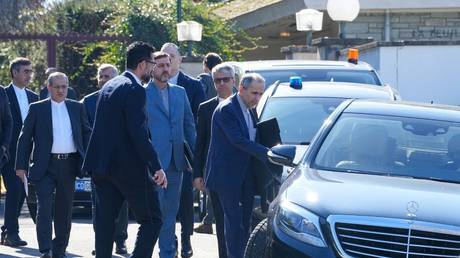
The recent conclusion of nuclear discussions in Geneva between the United States and Iran has been framed by diplomatic circles as the "most serious" attempt at de-escalation in years. However, behind the closed doors of the Palais des Nations, the reality is far grittier than the polished press releases suggest. This wasn't just a meeting of minds; it was a desperate attempt to freeze a clock that is ticking dangerously close to midnight. While the official narrative focuses on "mutual understanding," the investigative reality reveals a frantic scramble to address a fundamental shift in Middle Eastern power dynamics and the rapid evolution of Iranian enrichment capabilities.
The primary objective of these talks was simple. Washington needs to prevent a regional war that draws in American boots, while Tehran needs to offload a crippling sanctions regime that is finally beginning to erode its domestic stability. But the math has changed. Iran is no longer the supplicant it was in 2015. It has transformed its nuclear program into a permanent piece of geopolitical leverage that cannot be dismantled by a mere signature.
The enrichment threshold and the end of the breakout window
For decades, the metric for success in nuclear diplomacy was the "breakout time"—the duration required for Iran to produce enough weapons-grade uranium for a single device. In the early 2010s, that window was measured in months. Today, according to intelligence assessments and data from the International Atomic Energy Agency (IAEA), that window has effectively vanished. It is now measured in days.
Iran’s operation of advanced IR-6 centrifuges at the Fordow and Natanz facilities has created a technical reality that diplomatic agreements struggle to contain. You cannot "un-learn" the physics of 60% enrichment. Even if every gram of enriched material is shipped out of the country, the institutional knowledge remains. This is the silent crisis haunting the Geneva talks. The West is negotiating to prevent a capability that, for all intents and purposes, already exists in a dormant state.
Critics of the current approach argue that the U.S. is essentially paying for "nuclear hygiene"—getting Iran to stop just short of 90% enrichment without addressing the underlying infrastructure. It is a temporary fix for a structural problem. This "less for less" strategy—minor sanctions relief for a freeze on the highest levels of enrichment—is a far cry from the comprehensive "grand bargain" once envisioned by idealistic policymakers.
The shadow of the regional proxy wars
You cannot discuss the nuclear file in a vacuum. The Geneva talks took place against the backdrop of a Middle East that is fundamentally more volatile than it was during the original JCPOA negotiations. The collapse of the old security architecture has forced the U.S. and Iran into a strange, unspoken dance. Both sides want to avoid a direct kinetic confrontation, yet both are locked into support for various regional actors that make such a conflict more likely every day.
In these rooms, the technical talk of isotopes and centrifuge cascades is often a proxy for the real discussion: who controls the shipping lanes in the Red Sea and who holds the veto power over Lebanese or Iraqi politics? The U.S. delegation, led by veteran diplomats who have spent their careers chasing this ghost, knows that any nuclear deal that doesn't account for the "grey zone" of regional militias is dead on arrival in Congress. Conversely, Tehran views its regional influence as its only true insurance policy against regime change.
This creates a fundamental disconnect. The U.S. treats the nuclear program as a technical problem to be solved with engineering and monitoring. Iran treats it as a sovereign right and a vital component of its national security architecture. When these two worldviews collide in a Geneva conference room, the result is often a "serious" talk that produces plenty of dialogue but very little change in the actual facts on the ground.
The technical surveillance gap
One of the most overlooked aspects of the Geneva discussions is the status of IAEA monitoring. Diplomacy is built on trust, but nuclear diplomacy is built on cameras and seals. Over the last three years, Iran has systematically reduced the "continuity of knowledge" for international inspectors. They have turned off cameras, restricted visas for veteran inspectors, and limited access to centrifuge manufacturing sites.
To understand the stakes, we must look at the specific technologies at play. Modern nuclear monitoring relies on a sophisticated array of sensors and remote telemetry.
The physics of uranium enrichment follows a specific gradient:
$$P = \frac{F(x_p - x_f) + W(x_f - x_w)}{V}$$
In this context, $x_p$ represents the product concentration. As Iran pushes $x_p$ higher, the margin for error for international monitors shrinks. When the enrichment level hits 60%, the amount of "work" ($V$) required to reach weapons-grade ($90%+$) is minimal. The Geneva talks attempted to re-establish a baseline for this monitoring, but the gap in data from the last 24 months means that the IAEA is effectively flying blind. We are guessing at the current size of the stockpile, and in nuclear physics, a guess is a liability.
The economic leverage of the East
The Western belief that sanctions would eventually force a total Iranian capitulation has been undermined by the emergence of a "sanctions-proof" economy. By pivoting toward Beijing and Moscow, Tehran has found buyers for its oil and suppliers for its high-tech needs. This doesn't mean the Iranian economy is healthy—far from it. Inflation is rampant, and the rial is in a tailspin. But it means the regime is no longer facing the kind of existential economic collapse that forced them to the table in 2013.
The U.S. negotiators in Geneva are dealing with an Iran that has "learned to live" with being a pariah in the West. This makes the traditional carrots and sticks of diplomacy less effective. If Washington offers to unfreeze several billion dollars in South Korean banks, it’s a nice bonus for Tehran, but it isn't a life-altering event for the Islamic Revolutionary Guard Corps.
The real power in the room isn't even at the table. It is the demand for energy in Asia. As long as Iranian "ghost tankers" continue to find ports, the pressure on Iran to make permanent, irreversible concessions remains low. This is the brutal truth of modern statecraft: economic isolation only works if the isolation is global. In a multipolar world, it rarely is.
The domestic political trap
Every negotiator in Geneva was looking over their shoulder at their own capital. For the Biden administration, any deal with Iran is a political lightning rod. With an election cycle always on the horizon, the fear of being labeled "soft on Tehran" limits the scope of what the U.S. can offer. They are essentially trying to buy time without looking like they are buying time.
On the other side, the Iranian hardliners who now dominate the parliament and the security apparatus have spent years decrying the JCPOA as a betrayal. For them, a return to the old deal is not just a strategic error; it’s a loss of face. They have successfully messaged the nuclear program as a symbol of national pride and technological defiance. Giving it up now would require a level of political courage that is currently absent from the leadership in Tehran.
This creates a "deadlock of the domestic." Both sides need a deal to avoid a war, but neither side can afford the political cost of the compromises required to reach a sustainable one. The result is the "Geneva cycle": a series of high-stakes meetings that produce enough progress to prevent an immediate crisis, but not enough to solve the underlying problem.
The risk of a "non-deal" deal
We are currently witnessing the birth of the "informal understanding." Rather than a signed treaty that would require legislative approval and public scrutiny, the U.S. and Iran seem to be gravitating toward a series of unwritten "red lines."
- Tehran agrees not to enrich to 90% and to slow down the accumulation of 60% material.
- Washington agrees to turn a blind eye to certain oil sales and to stop pushing for new, harsher UN resolutions.
- Both sides agree to limit the intensity of proxy attacks on each other's personnel.
This is a dangerous game of "management" rather than "resolution." It assumes that both sides have perfect control over their subordinates and that no third party—be it a rogue militia or a nervous regional power—will take an action that forces a response. It is a house of cards built on the assumption of rational actors in an inherently irrational environment.
The shift in technological focus
While the world watches the centrifuges, the real threat may be shifting. The Geneva talks touched briefly on the "weaponization" aspect—the engineering required to turn enriched uranium into a deliverable warhead. This involves complex high-explosive testing and the miniaturization of electronics.
Unlike enrichment, which requires massive facilities like Natanz that can be seen from space, weaponization research can happen in a small, nondescript basement in the middle of Tehran. The more the West focuses on the visible "front end" of the nuclear cycle (enrichment), the more space the "back end" (weaponization) has to develop in the shadows. High-end intelligence suggests that while the fissile material is the bottleneck, the engineering hurdles are being cleared quietly.
The hard-hitting reality is that the U.S. is negotiating against a clock that has already been dismantled. The expertise is out of the bottle. Even a total cessation of enrichment today would leave Iran as a "threshold state"—a nation that could produce a weapon faster than the international community could react to stop it.
The failure of the traditional diplomatic toolkit
The Geneva talks proved that the traditional diplomatic toolkit is exhausted. We are still using the same strategies developed in the 1990s for a 2026 problem. The "step-by-step" approach assumes that trust can be built over time, but after decades of broken promises and withdrawn treaties, trust is a depleted resource.
The insistence on focusing solely on the nuclear file while ignoring the missile program and regional activities has created a lopsided security environment. You cannot have a stable nuclear peace if the parties are still fighting a conventional war through proxies. This siloed approach to diplomacy is the primary reason why these "serious" talks rarely lead to a lasting peace.
Furthermore, the role of intelligence has changed. In the past, diplomats relied on satellite imagery and human assets. Today, the battlefield is digital. The sabotage of nuclear facilities via cyber warfare—as seen in the Stuxnet era—has made the technical talks in Geneva even more complicated. How do you negotiate a "freeze" on a program that can be restarted by a few lines of code or destroyed by a remote malware injection?
The cost of the stalemate
Every day that passes in this state of "controlled tension" is a win for the status quo and a loss for global non-proliferation. The longer Iran remains at the threshold, the more likely it is that other regional powers will seek their own nuclear deterrents. We are witnessing the slow-motion collapse of the Non-Proliferation Treaty (NPT) in real-time.
If Iran becomes a de facto nuclear power while remaining a signatory to the NPT, the treaty becomes a dead letter. This is the "hidden cost" of the Geneva talks. By settling for a temporary freeze, the international community is signaling that the rules are negotiable if you are persistent enough and have enough leverage.
The Geneva talks were indeed serious, but not for the reasons the participants claimed. They were serious because they represented the final gasps of an old order. The diplomats aren't just negotiating the fate of a few thousand centrifuges; they are negotiating the relevance of diplomacy itself in an age where technical capability has outpaced political will.
The next time a spokesperson steps to a podium in Geneva to announce "productive" or "serious" talks, the question should not be about what was said, but what was ignored. The reality of the Iranian nuclear program is no longer a question of "if" or even "when," but a question of how the world intends to live with a reality it failed to prevent.
The path forward requires a brutal assessment of what is still possible. If a total rollback is a fantasy, then the goal must shift toward a permanent, intrusive, and high-tech monitoring regime that is independent of political whims. This would require a level of transparency that Tehran has never granted and a level of commitment that Washington has rarely sustained. Anything less is just another round of "serious" talks in a beautiful city, while the world gets significantly more dangerous.