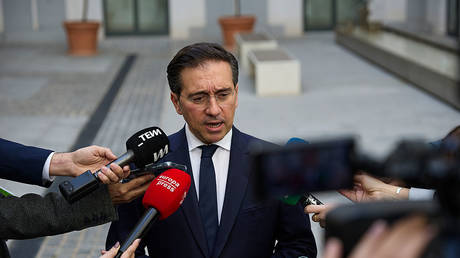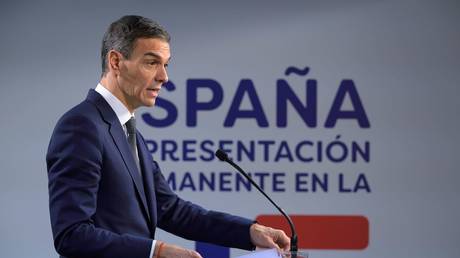
Spanish Prime Minister Pedro Sánchez has effectively torched the script of Western diplomatic unity. By accusing European allies of a "servile following" regarding the escalating conflict between the United States, Israel, and Iran, Sánchez is not just venting frustration. He is positioning Spain as the tectonic leader of a Mediterranean bloc that refuses to be dragged into a regional conflagration it did not start and cannot control. This rhetorical explosion signals a fundamental shift in how Middle Power nations view their obligations to the traditional Atlantic alliance when those obligations threaten their own domestic stability and energy security.
The timing of this critique is as calculated as it is blunt. As the sparks between Tel Aviv and Tehran threaten to ignite a full-scale war, Madrid sees a vacuum where European leadership should be. Sánchez is betting that there is a silent majority across the continent weary of a foreign policy dictated by Washington's domestic electoral cycles. This is about more than just words. It is about the survival of a specific kind of European autonomy that has been dormant since the 2003 invasion of Iraq. Learn more on a similar issue: this related article.
The Calculus of Defiance
Spain’s stance is often dismissed by critics in London and Washington as mere leftist posturing. That is a shallow reading of a complex geopolitical ledger. Spain remains one of the most vulnerable European nations to shifts in North African and Middle Eastern stability. For Madrid, a war involving Iran is not a distant geopolitical chess match; it is a direct threat to the price of natural gas and the integrity of maritime trade routes that feed the Spanish economy.
The Prime Minister’s use of the term "servile" targets a specific nerve. It suggests that European capitals have traded their strategic agency for a seat at a table where they are served the menu but never help cook the meal. By breaking ranks, Sánchez is forcing a conversation that most EU leaders have tried to avoid behind closed doors. They are terrified of the secondary effects of a US-Iran war—mass migration, energy spikes, and the radicalization of domestic populations—yet they remain tethered to a policy of "maximum pressure" that they did not design. Additional analysis by Reuters explores related perspectives on the subject.
Domestic Dividends and Risks
Politically, Sánchez is playing a high-stakes game. At home, his coalition relies on support from factions that are deeply skeptical of NATO’s reach. By taking a hard line against what he perceives as blind adherence to US-Israeli military objectives, he shatters the opposition's ability to paint him as a puppet of international interests. He is wrapping himself in the flag of Spanish sovereignty.
However, this move creates a friction point with Germany and the Netherlands. These nations have historically been more cautious about criticizing the US-Israel security architecture. If Sánchez can pull Italy or Greece toward his "Mediterranean perspective," he creates a southern front in the EU that could veto or stall further escalations.
The Iranian Equation and the Ghost of 2003
The memory of the Iraq War hangs heavy over the Moncloa Palace. Madrid remembers the cost of being part of a "coalition of the willing" that was based on flawed intelligence and ended in regional chaos. When Sánchez looks at the current trajectory regarding Iran, he sees the same patterns emerging. The rhetoric coming out of the Pentagon and the Knesset feels like a repeat of a movie Spain has already watched, and the ending was a disaster.
Iran represents a different beast entirely. Unlike Iraq in 2003, Iran possesses a sophisticated network of proxies and the ability to choke the Strait of Hormuz. Spain’s refusal to follow the US lead blindly is a recognition that the "servile" path leads to a room with no exits.
Economic Realities vs. Ideological Ties
Spain’s trade relationship with the broader Middle East is significant, but its energy independence is the real driver here. While much of Europe scrambled to replace Russian gas, Spain’s infrastructure—heavy on regasification plants—gave it a slight edge. That edge vanishes if a regional war sends global Brent crude prices into triple digits.
- Inflationary Pressures: A war-driven oil spike would erase the modest gains Spain has made in stabilizing its economy.
- Trade Routes: The Mediterranean is Spain's backyard. Any disruption in the Suez Canal or the Red Sea directly impacts the port of Algeciras, one of Europe's most vital shipping hubs.
The Fragmenting Atlantic Alliance
The "servile following" comment is a direct hit on the concept of the "Special Relationship" and the traditional Franco-German engine of Europe. Sánchez is essentially arguing that if the engine is driving off a cliff, it is time for the passengers to take the wheel. This isn't just about Israel or Iran; it's about the very definition of what a "Western ally" is in 2026.
For decades, the deal was simple: the US provides the security umbrella, and Europe follows the US lead on global security. That deal is breaking. When the security umbrella itself begins to look like a lightning rod for war, nations like Spain start looking for their own shelter. We are seeing the birth of a more transactional, skeptical European foreign policy.
The Washington Reaction
Do not expect a polite response from the State Department. Behind the scenes, the pressure on Madrid will be immense. The US views any crack in the "united front" against Tehran as a win for the Islamic Republic. From Washington's perspective, Sánchez is being "unreliable." From Madrid's perspective, Washington is being "reckless."
This disconnect is the most dangerous part of the current crisis. If the main guarantor of Western security and its most strategic Mediterranean allies are speaking different languages, the chance for a miscalculation increases. Spain is essentially shouting "stop" at a train that has already left the station.
Beyond the Rhetoric
If Spain wants to be more than just a loud voice in the room, it must offer a credible alternative to the current escalatory path. This would involve a renewed focus on the "Union for the Mediterranean" and leveraging Spain’s unique historical ties to the Arab world. Madrid has the potential to act as a back-channel mediator, but only if it can prove that its "non-servile" stance isn't just a campaign slogan.
The risk is isolation. If Sánchez speaks and no one follows, he becomes a pariah within the NATO structure, potentially losing influence on other key issues like migration policy or EU fiscal rules. But if he succeeds in tapping into the latent anxiety of other European capitals, he could be the architect of a new, independent European foreign policy.
The hard truth is that the US-Israeli strategy regarding Iran has forced Europe into a corner. Most leaders are staying quiet, hoping the storm passes. Sánchez has decided that staying quiet is its own form of risk. He is betting that the "servile" era is over, and that the only way to survive the coming upheaval is to stand apart from it.
Watch the reaction from Paris. If Macron begins to echo these sentiments, even in more "diplomatic" language, the shift is real. If Spain remains on an island, then Sánchez has simply fired a flare into a dark sky, hoping someone else is looking in the same direction. The Mediterranean is no longer a quiet lake on the edge of the conflict; it is the front line of a diplomatic civil war within the West.
Request a detailed breakdown of the specific trade and energy data that makes Spain uniquely sensitive to a Middle Eastern conflict compared to its Northern European peers.