Hezbollah isn't flinching. Despite the massive spike in aerial bombardments and the tightening grip of a regional conflict, the group’s leadership has made its position crystal clear. They view the current military pressure not as an isolated Israeli campaign, but as a joint Israel-U.S. project aimed at reshaping the Middle East. If you've been following the headlines, you've seen the standard reports on "escalations" and "retaliations." But those surface-level updates miss the actual psychological and strategic reality on the ground in Lebanon.
The group recently doubled down on its refusal to surrender. This isn't just typical wartime rhetoric. It’s a calculated message sent to both Washington and Tel Aviv. They’re betting that their grassroots support and deep-rooted military infrastructure can outlast the political patience of their adversaries. It’s a high-stakes game of chicken where nobody’s hitting the brakes.
The Myth of Regional Isolation
One of the biggest mistakes analysts make is treating Hezbollah as if it’s operating in a vacuum. It’s not. When the group talks about confronting "aggression," they’re referencing a specific ideological framework. In their view, Israel provides the kinetic force while the United States provides the diplomatic shield and the logistics. You can’t understand the refusal to step back without acknowledging this "unified front" mentality.
The U.S. has consistently moved carrier strike groups into the Eastern Mediterranean. While the Pentagon calls this "deterrence," Hezbollah and its allies see it as active participation. This perception fuels the "will not surrender" narrative. To them, giving in to Israel feels like giving in to the entire Western hegemony. That’s a non-starter for a group built on the foundation of "resistance."
History shows us that these groups often grow more defiant when they feel backed into a corner. We saw it in 2006. We’re seeing it again now. The more pressure applied from the outside, the more the internal ranks tighten. It’s a feedback loop that the West often fails to anticipate. They think more bombs lead to a white flag. Often, it just leads to more recruits and a more hardened command structure.
What Surrender Would Actually Look Like
Let’s be real for a second. What does "surrender" even mean in this context? For the Israeli government, it means Hezbollah pulling back beyond the Litani River and dismantling its long-range missile capabilities. For the U.S., it means the group decoupling itself from the "Axis of Resistance."
But for Hezbollah, these aren't just policy shifts. They’re existential threats.
- Loss of Deterrence: If they move back, they lose the tactical high ground that keeps northern Israel within easy reach.
- Political Suicide: Their entire brand is built on being the only force capable of "protecting" Lebanon. If they tuck tail, their domestic political rivals will pounce.
- Regional Domino Effect: A weakened Hezbollah in Lebanon weakens Iranian influence across Syria and Iraq.
Basically, the cost of surrendering is higher than the cost of continuing to fight, even under heavy fire. When you realize that, the "we will not surrender" speeches start to sound less like propaganda and more like a logical assessment of their own survival.
The Human and Economic Toll
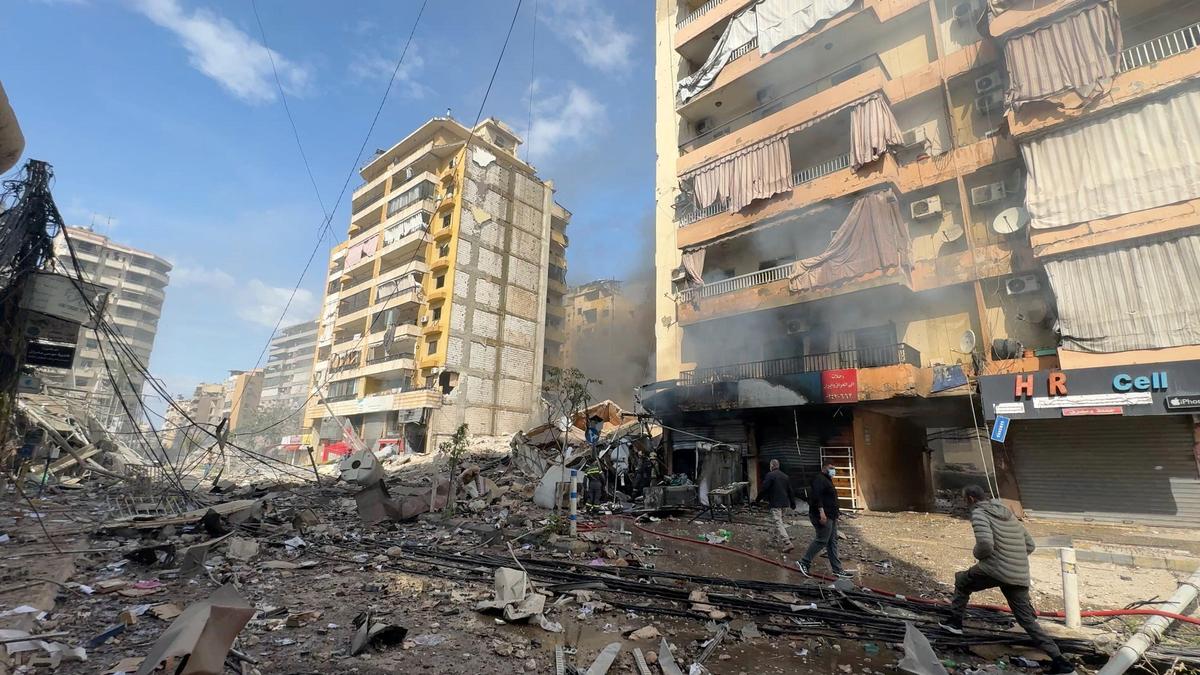
You can’t talk about this without mentioning the devastation in Southern Lebanon and Beirut’s suburbs. Thousands of people have been displaced. Entire villages are rubble. Honestly, it’s a mess. But here’s the kicker: Hezbollah has spent decades building a social services network. They pay for the rebuilding. They support the families of the "martyrs."
This creates a level of loyalty that’s hard to break with airstrikes. When your house gets blown up and the state government is nowhere to be found, but the local militia hands you a check to rebuild, who are you going to support? This social contract is the "secret sauce" of their resilience. It’s why the "aggression" they talk about often ends up backfiring by cementing local reliance on the group.
The Washington Connection
The U.S. role here is complicated. While the White House frequently calls for de-escalation, the steady flow of munitions tells a different story to those on the receiving end. Hezbollah’s leadership often points to the vetoes in the UN Security Council as proof that the U.S. is the "Great Satan" behind the scenes.
Is that an exaggeration? Probably. But in the world of Middle Eastern optics, perception is reality. As long as the U.S. provides the hardware, Hezbollah will keep framing this as a David vs. Goliath struggle against a global superpower. This framing works. it resonates with a significant portion of the Arab world that feels the Palestinian cause has been abandoned by the international community.
Why Military Might Has Limits
Israel has one of the most technologically advanced militaries on the planet. Their intelligence-gathering is legendary. They can take out high-ranking commanders with surgical precision. We've seen it happen repeatedly over the last few months. Yet, Hezbollah’s rocket fire continues.
Why? Because decentralized organizations don't die when you cut off the "head." They’re designed to function as a series of autonomous cells. You kill one commander, and two more are ready to take the job. It’s a "hydra" problem. This is why the rhetoric of "confronting aggression" remains so potent. They believe they can win a war of attrition simply by not losing.
If you’re looking for a quick resolution, don't hold your breath. The current trajectory points toward a long, grinding conflict. Neither side can afford to lose face. Israel needs to return its citizens to the north. Hezbollah needs to maintain its status as a regional powerhouse. These two goals are fundamentally at odds.
The Strategy of No Retreat
Hezbollah’s stance is a direct challenge to the idea that military superiority dictates political outcomes. They're betting on the fact that the international community will eventually tire of the images of destruction and pressure Israel into a ceasefire that doesn't require Hezbollah to fully disarm.
It’s a gamble. A massive one. But they’ve played this hand before. In their eyes, the "Israel-U.S. aggression" is a temporary storm they just need to weather. They aren't looking for a total military victory in the traditional sense. They’re looking for "divine victory"—which, in their dictionary, means still standing when the dust settles.
Keep a close eye on the border skirmishes and the diplomatic "shuttle' missions coming out of D.C. If the rhetoric from Beirut remains this defiant, it means the back-channel negotiations aren't gaining any real traction. The group has tied its fate to the broader conflict in Gaza, and until that fire is put out, the northern front will continue to burn.
The next logical step for anyone following this is to track the specific types of weaponry being introduced into the theater. If Hezbollah starts using more advanced anti-aircraft systems or precision-guided munitions in higher volumes, it signals they've moved past mere "confrontation" and into a full-scale defensive war. Look for shifts in Iranian supply lines through Syria as the primary indicator of how long this "no surrender" policy can actually last.