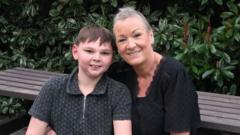
The physical memory of pain is a strange thing. It doesn’t fade into a soft-focus blur like a childhood summer or the smell of a grandmother’s kitchen. Instead, it sits in the bone. For Tony Hudgell, that memory is etched into the very way he moves through the world—on prosthetic legs, with a spirit that seems to defy the gravity of his own history.
When Tony was only forty-one days old, he was admitted to a hospital with multi-organ failure, several fractures, and sepsis. His birth parents had systematically broken him. They didn't just fail to protect him; they were the architects of a nightmare that resulted in the amputation of both his legs. In a system that often prioritizes the "rights" of biological parents over the sheer survival of the child, Tony was nearly a casualty of silence.
But the silence has finally been broken.
The Invisible Monster in the Waiting Room
Consider a hypothetical scenario that plays out in every city, every single day. A man walks into a primary school to pick up a child. He has a history of violent outbursts. He has spent time in prison for an offense that would make any parent's blood run cold. However, because his victim was a defenseless infant behind closed doors rather than a stranger on the street, his name doesn't appear on any easily accessible register. He is a ghost in the system.
This is the gap Tony and his adoptive family, the Hudgells, set out to close. They realized that while we track sex offenders with rigorous, high-tech scrutiny, those who commit horrific acts of cruelty against children often slip through the cracks of bureaucracy once their initial sentence is served.
Tony’s law—officially the campaign for a UK child cruelty register—is not about vengeance. It is about visibility. It is about the fundamental belief that a person who has proven themselves capable of shattering a baby’s limbs should not be allowed to fade into anonymity while their victims carry the physical and emotional weight of those actions forever.
The Weight of a Name
We often talk about "privacy" as if it is a holy, untouchable thing. But whose privacy are we protecting?
For years, the argument against a formal register was built on the idea of rehabilitation and the "burden" of monitoring. There was a sense that once a debt to society was paid, the ledger should be wiped clean. But a child is not a debt. A child’s life is not a transaction. When Tony’s birth parents were released from prison after serving only a fraction of their already lenient sentences, the injustice wasn’t just a legal technicality. It was a visceral punch to the gut of everyone who had watched Tony learn to walk on his new legs.
The campaign was born from that friction. It was fueled by the sight of a small boy raising millions of dollars for the hospital that saved him, walking kilometers on end despite the pain, while the people who caused that pain walked free and unmonitored.
The register, now a reality thanks to tireless lobbying, functions much like the sex offenders register. It ensures that authorities—police, social services, schools—have a centralized way to track those convicted of the most heinous acts of child cruelty. It turns the "invisible monster" into a known quantity.
The Math of Human Suffering
In the world of policy, we often look at numbers. We look at $60,000$ for a prison cell or $15$ years for a sentence. But the math of Tony Hudgell is different.
$$S = (I \times T) + R$$
If we were to look at a simplified model of the impact of this law, we might see $S$ as the total safety of the community, where $I$ represents the identification of high-risk individuals, $T$ is the transparency of the legal system, and $R$ is the resilience of the support networks surrounding the child. For too long, the $I$ in that equation was close to zero. By mandating a register, the government has effectively boosted the transparency variable, creating a higher sum of safety for every child in the country.
It is a logical deduction: you cannot mitigate a risk you cannot see. If a person has a documented history of extreme cruelty, the state has a moral obligation to ensure that person is not placed in a position of trust or proximity to the vulnerable. To do otherwise is not "fairness" to the offender; it is negligence toward the innocent.
Beyond the Paperwork
Critics sometimes argue that registers are just more "red tape." They claim that a list won't stop a determined abuser. They are partially right. A piece of paper, or a digital entry in a database, does not physically grab a hand before it strikes.
But think about how a lighthouse works. It doesn't calm the sea. It doesn't move the rocks. It simply illuminates the danger so the ship can steer a different course.
The child cruelty register is a lighthouse. It allows social workers to make informed decisions during home visits. It allows schools to vet volunteers with a level of certainty that was previously impossible. It creates a "hostile environment" for cruelty, making it harder for abusers to hide in the shadows of a new town or a different jurisdiction.
The Hudgells didn't just want a law; they wanted a cultural shift. They wanted a world where we stop asking "How can we forgive the abuser?" and start asking "How can we obsessively protect the child?"
The Cost of the Long Road
Tony’s journey has been one of public triumph, but the private reality is much heavier. There are the surgeries. There are the nights of phantom pain. There are the questions that will inevitably come as he gets older—the "why" that no register can ever fully answer.
Being an advocate for this cause required the Hudgell family to be vulnerable on a national stage. They had to relive the trauma of Tony’s infancy over and over to convince politicians that the status quo was deadly. They had to stand in front of cameras and explain why a five-year sentence for nearly killing a baby was an insult to the concept of justice.
Their persistence changed the UK’s legal landscape. In 2021, "Tony’s Law" increased the maximum sentences for child cruelty and neglect. But the register was the missing piece—the tool for prevention rather than just punishment.
It is easy to look at a success like this and feel a sense of completion. The bill is passed. The register is established. The campaign is won. But for the thousands of children currently living in homes where the air is thick with fear, the work is just beginning. The register is not the end of the story; it is the infrastructure of a safer future.
The Echo of the First Step
If you watch videos of Tony walking, you see something more than just physical movement. You see a rhythm. A determination. Each step with his prosthetics is a deliberate choice. He is not just moving forward; he is stomping on the idea that his past defines his limits.
His birth parents tried to break his body. Instead, they inadvertently sparked a movement that will protect generations of children they will never meet. There is a profound, poetic justice in that. The very child they discarded became the reason they—and others like them—will never be able to hide again.
The legacy of this campaign isn't found in the leather-bound books of the Parliament. It's found in the quiet, mundane safety of a child sleeping in a bed, protected by a system that finally decided to keep watch. It’s found in the fact that, for the first time, the "ghosts" have names, and those names are written in a place where they can be seen.
Tony Hudgell lost his legs, but he gave a voice to the voiceless. He took the jagged, broken pieces of his early life and forged them into a shield. And as he continues to walk, the echo of his footsteps serves as a warning to anyone who would harm a child: the world is watching, the names are recorded, and the silence is over.
The most powerful thing a victim can do is survive. The second most powerful thing they can do is ensure that no one else has to. Tony did both before he finished primary school.