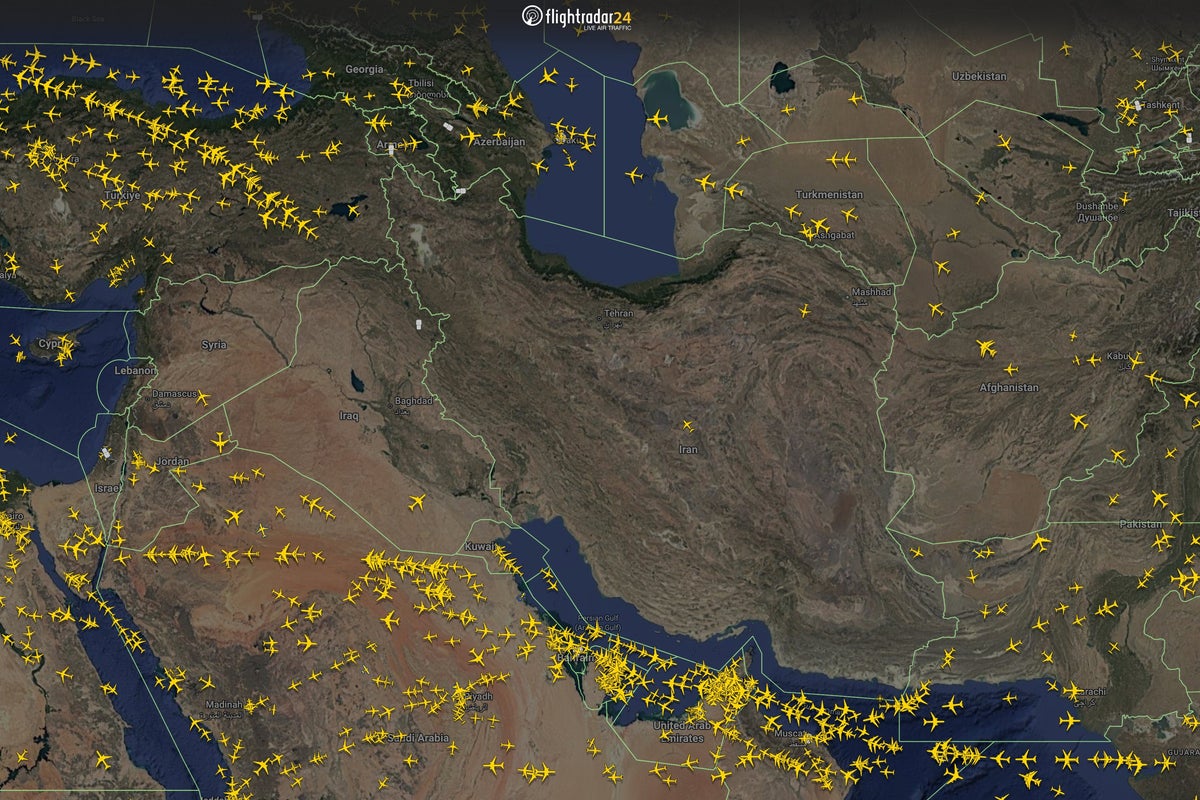
The closure of Iranian airspace following coordinated strikes by US and Israeli forces has triggered more than just a temporary scheduling headache. It has effectively severed one of the world’s most critical aerial arteries. Within hours of the initial kinetic exchanges, major carriers including Lufthansa, Emirates, and United Airlines scrambled to divert or ground flights, realizing that the "safe" corridors between Europe and Asia had vanished. This is not a simple logistical detour. It is a fundamental collapse of the global transit architecture that will keep ticket prices high and supply chains strained for the foreseeable future.
When the missiles fly, the insurance premiums follow. For the aviation industry, the immediate concern isn’t just the physical safety of an airframe; it is the instantaneous withdrawal of war-risk insurance coverage for specific coordinates. Once the US and Israel signaled the start of offensive operations, those coordinates expanded to include nearly the entire Persian Gulf and the Iranian plateau. Pilots were forced to perform mid-air U-turns, burning through fuel reserves to reach secondary hubs in Istanbul or Dubai, while ground crews faced the nightmare of tens of thousands of stranded passengers.
The Geography of Risk
Airspace is the most undervalued commodity in modern commerce. For decades, the "Silk Road of the Skies" has relied on the relative stability of Iranian and Iraqi corridors to move passengers from London, Paris, and Frankfurt to the economic engines of Delhi, Singapore, and Tokyo.
With Iran now a designated no-fly zone for Western and allied carriers, the remaining options are rapidly becoming congested. Traffic is being squeezed into a narrow funnel over Saudi Arabia and Egypt. This redirection adds between 90 and 150 minutes to long-haul flights. In the world of aviation, time is literally fuel. A Boeing 777-300ER burns approximately 7.5 tons of fuel per hour. Adding two hours to a flight doesn't just annoy the passengers in business class; it nukes the profit margin of the entire route.
The math is brutal.
If a carrier is forced to burn an extra 15 tons of fuel per trip across a fleet of 50 wide-body aircraft, the weekly operational deficit reaches into the tens of millions. These costs are never absorbed by the airlines. They are passed directly to the consumer in the form of "war surcharges" and "fuel adjustments." We are entering an era where the $1,000 transcontinental flight may become a relic of a more peaceful past.
The Hub Strategy Under Fire
For years, the "ME3"—Emirates, Qatar Airways, and Etihad—built their empires on the concept of the global pivot point. By placing a massive hub in the desert, they could connect any two cities on earth with a single stop. But that strategy assumes the desert remains a neutral transit zone.
The current strikes have exposed the fragility of the hub-and-spoke model. Dubai International Airport (DXB) and Doha (DOH) are now operating in the shadow of a high-intensity conflict zone. If the tit-for-tat escalations between Jerusalem, Washington, and Tehran continue, the very geography that made these airlines successful becomes their greatest liability.
We are seeing a shift in passenger behavior. Travelers are starting to opt for "The Long Way Around"—routes that bypass the Middle East entirely by flying over the Pacific or via North Pole tracks. While these routes are longer and traditionally more expensive, they offer a "certainty premium" that the current Middle Eastern corridors cannot match.
The Hidden Logistics Crisis
Beyond the passenger terminals, the grounding of flights has sent shockwaves through the belly-cargo market. Approximately 50% of global air freight is carried in the holds of passenger planes. When a route from Frankfurt to Mumbai is suspended, it isn't just people that get stuck; it’s semiconductors, pharmaceutical components, and high-value machinery.
The sudden removal of capacity from the Iranian corridor has sent air-freight rates skyrocketing. Logistics managers are now competing for limited space on dedicated cargo freighters, which are already booked to capacity due to the ongoing disruptions in Red Sea shipping lanes. We are witnessing a rare and dangerous "perfect storm" where both the sea and the sky are being constricted simultaneously.
Sovereignty and the Weaponization of Altitudes
There is a political dimension to these cancellations that goes beyond safety. Closing airspace is a form of soft power. By making it impossible for Western carriers to transit their territory, nations can exert significant economic pressure on foreign economies without firing a single shot.
However, in this instance, the closure was a reactive necessity. The US and Israeli strikes targeted high-value military infrastructure, but the "fog of war" makes civilian identification nearly impossible for local air defense batteries. History is littered with the tragedies of civilian airliners being misidentified during periods of high tension. No CEO is willing to risk a repeat of MH17 or PS752.
The Industry Response
The International Air Transport Association (IATA) has been vocal about the need for "deconfliction" protocols, but their pleas often fall on deaf ears when national security is at stake. The reality is that airlines are now forced to operate as amateur intelligence agencies.
They no longer rely solely on government NOTAMs (Notices to Air Missions). Instead, major carriers now employ teams of former military analysts to track missile telemetry and troop movements in real-time. If the internal data shows a 1% increase in the risk of a surface-to-air missile launch, the route is scrubbed. This hyper-caution is the new baseline.
The Economic Aftershocks
We must look at the long-term viability of certain secondary routes. If the conflict in the Middle East becomes a "frozen" or "semi-permanent" state of low-grade warfare—much like the situation in Ukraine—many airlines will simply abandon these flight paths.
- Route Attrition: Flights that were marginally profitable with short transit times will be cut entirely.
- Hub Displacement: Secondary hubs in Central Asia, such as Baku or Tashkent, may see an artificial boom as they become the new "safe" refueling stops for the few carriers still brave enough to skim the edges of the conflict zone.
- The Rise of Ultra-Long-Haul: We will see an accelerated investment in aircraft like the Airbus A350-1000ULR, designed to fly 20 hours non-stop, specifically to bypass geopolitical flashpoints entirely.
The "Peace Dividend" that allowed for cheap, globalized travel for the last thirty years has officially expired. What we are seeing in the wake of the US and Israeli strikes is not a temporary disruption; it is the first chapter of a restructured world map.
The sky is no longer a neutral commons. It is a contested territory where the price of entry is paid in jet fuel, insurance premiums, and the nerves of the flying public. Travelers should prepare for a world where the shortest distance between two points is no longer a straight line, but a jagged, expensive detour around the latest war zone.
Check your flight status, but more importantly, check the news. In this new landscape, the two are inseparable.
-Template-copy.jpeg?width=1200&auto=webp&trim=0%2C0%2C0%2C0)
.png?width=1200&auto=webp&trim=0%2C0%2C0%2C0)