The announcement came with the blunt force of a boardroom coup. On January 6, 2026, President Donald Trump declared that Venezuela would "turn over" between 30 and 50 million barrels of crude oil to the United States. This is not a standard trade agreement between two sovereign nations. It is a direct extraction, facilitated by a lightning military strike that saw the capture of Nicolás Maduro and the installation of a U.S.-backed "interim authority" in Caracas. By seizing this inventory—currently worth approximately $2.8 billion at market prices—the U.S. has effectively bypassed years of gridlocked sanctions in favor of immediate physical control.
This move aims to solve a pressing domestic problem: the need for heavy sour crude that U.S. Gulf Coast refineries were built to process, but which has been largely sourced from rivals like Russia or through expensive long-haul shipments since 2019. By bringing 50 million barrels directly to American docks, the administration isn’t just padding the Strategic Petroleum Reserve; it is attempting to dictate the floor of the global energy market. Don't miss our earlier post on this related article.
The Mechanics of the 50 Million Barrel Extraction
To understand the scale, one must look at the math. The U.S. consumes roughly 20 million barrels of oil per day. A 50-million-barrel transfer represents about two and a half days of total national consumption. While that sounds like a drop in the bucket, the significance lies in the crude quality. Venezuela sits on the world's largest proven reserves, mostly heavy, viscous oil that requires specialized refining.
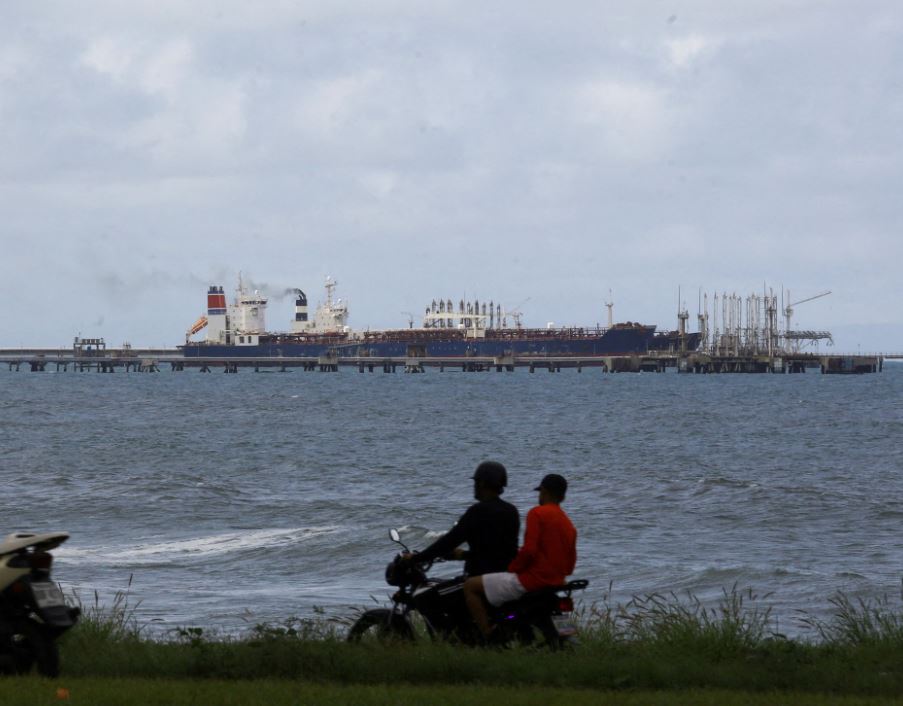
The "sanctioned oil" Trump referenced has been sitting in storage tanks and idling tankers for months, unable to move due to a naval blockade. By ordering Energy Secretary Chris Wright to execute the plan "immediately," the administration is clearing out this backlog. The first $500 million tranche of this oil has already been sold into the market, with the proceeds funneled into a U.S. Treasury-controlled account rather than the Venezuelan central bank. To read more about the background here, Business Insider provides an informative breakdown.
The Forced Pivot from Beijing to Houston
For the last decade, Venezuela survived on a life support system provided by China. Beijing took roughly two-thirds of Venezuelan exports as repayment for billions in loans. That era ended the moment U.S. special operations forces touched down in Caracas.
The new legal framework, specifically General License 46, effectively tells the global market that Venezuelan oil now belongs to the American sphere of influence. The administration has made it clear: oil production in Venezuela will only continue if the country severs all economic ties with China, Russia, Iran, and Cuba. This is a total realignment of Western Hemisphere energy security.
- China’s Loss: Beijing loses its primary South American energy foothold and a significant portion of its debt collateral.
- India’s Opportunity: New Delhi is already negotiating with Washington to buy Venezuelan crude under a "U.S.-approved framework."
- The U.S. Refining Boost: Refineries in Texas and Louisiana, which have struggled with the high cost of Canadian heavy crude, are being offered Venezuelan "Merey" blends at discounts of $6 to $7.50 below the Brent benchmark.
Rebuilding a Ruined Infrastructure
Seizing 50 million barrels is the easy part. The real challenge is the "drill, baby, drill" expansion the White House expects from private industry. Venezuela’s current output is a ghost of its former self, hovering around 800,000 to 1 million barrels per day (bpd), down from a 1990s peak of 3.5 million.
The infrastructure is in a state of advanced decay. Decades of mismanagement under the Maduro regime, combined with the flight of technical expertise, have left fields in the Orinoco Belt crippled. Experts from Rystad Energy estimate that it will take $110 billion in capital investment just to return production to 2 million bpd.
The administration is betting that American giants like Chevron, ExxonMobil, and ConocoPhillips will lead this charge. However, corporate memory is long. These companies haven't forgotten the asset seizures under Hugo Chávez. While the U.S. government is offering "guarantees" and "legal shields" through Executive Order 14373, the boardrooms in Houston and Irving remain cautious. They are asking for more than just military protection; they want ironclad indemnity against future nationalization once the U.S. military eventually draws down its presence.
The $50 Barrel Ambition
The ultimate goal of this intervention isn't just regime change—it's price control. The administration’s stated objective is to use the influx of Venezuelan crude to drive domestic oil prices down to $50 a barrel.
This is a high-stakes gamble. If the U.S. can successfully reboot Venezuelan production to 3 million bpd within the next few years, it would add enough supply to the global market to break the pricing power of the OPEC+ alliance. By controlling the world’s largest reserves, Washington isn't just an energy producer; it becomes the global swing producer, a role traditionally held by Saudi Arabia.
The Legal and Ethical Grey Zone
Critics and legal scholars are already pointing to the "piracy" of the situation. Under international law, the ownership of natural resources is a sovereign right. The U.S. justification—that the oil was "stolen" from American companies decades ago and is now being recovered—is a novel legal theory that has few precedents outside of wartime seizures.
Furthermore, the "benefit of the Venezuelan people" clause in the deal comes with a massive caveat. The proceeds from these oil sales, held in U.S. accounts, can only be used by the interim authority to purchase American-made products. This effectively turns the Venezuelan oil industry into a closed-loop subsidy for U.S. manufacturing. It is a modern-day version of the "company store" on a geopolitical scale.
The sudden influx of Venezuelan crude will likely hit the market in waves throughout 2026. As the initial 50 million barrels reach U.S. refineries, the immediate impact will be felt in lower gasoline prices across the American South and Midwest. But the long-term stability of this arrangement depends entirely on whether the U.S. can transition from a military occupier to a stable partner in a country that has been a graveyard for foreign investment for twenty-five years.
Would you like me to analyze the specific impact this deal will have on U.S. gasoline price projections for the upcoming summer travel season?