The coffee in your mug this morning traveled through a ghost story. You don't see it, and you certainly don't feel it, but the global economy is currently balanced on a razor's edge in a strip of water barely wider than the distance between Manhattan and Staten Island.
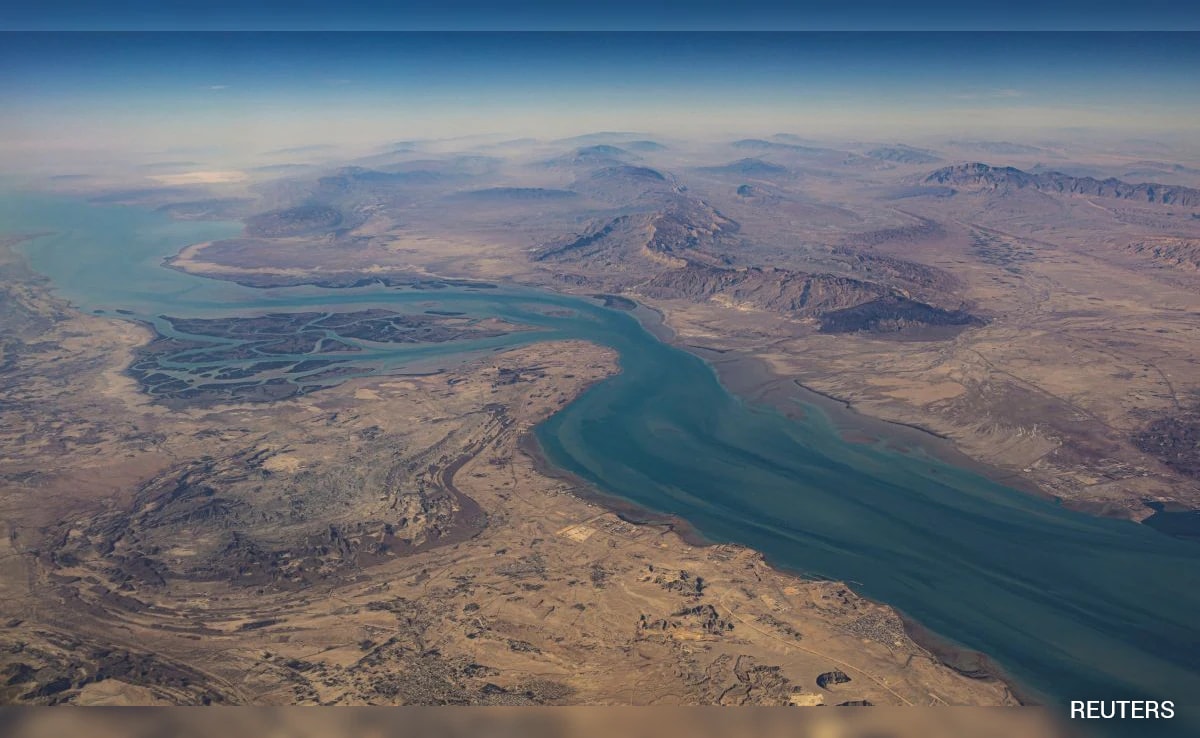
This is the Strait of Hormuz. It is a choke point, a wind-whipped corridor where the desert heat of Iran meets the jagged cliffs of Oman. To the uninitiated, it looks like nothing more than a stretch of turquoise sea. To the men and women who command the steel leviathans known as Very Large Crude Carriers (VLCCs), it is a gauntlet.
Imagine a young deckhand named Elias. He is twenty-four, far from home, standing on the bridge of a tanker carrying two million barrels of oil. He watches the radar sweep. To his left, the Iranian coastline looms—a jagged, silent spectator. He knows that at any moment, the silence could shatter. He knows that if Iran follows through on its vow to "close" this gate, his ship becomes a floating target, and your world becomes a lot more expensive.
The Mathematics of a Global Heart Attack
The numbers aren't just statistics; they are a pulse. Roughly one-fifth of the world’s total oil consumption passes through this single waterway every day. We are talking about $20$ million barrels of oil. To visualize that, imagine a line of oil drums stretching from Los Angeles to New York and halfway back again.
When Tehran issues a warning that "if anyone tries to pass, we will strike," they aren't just talking to naval commanders. They are talking to the gas station in Ohio, the shipping warehouse in Berlin, and the semiconductor factory in Taiwan.
The mechanics of the threat are deceptively simple. Iran doesn't need a massive, conventional navy to win this fight. They have perfected the art of "asymmetric" warfare. Think of it as a swarm of hornets attacking a bear. Hundreds of fast-attack boats, sea mines hidden beneath the chop, and shore-based missiles tucked into the limestone caves of the coast.
If the Strait closes, the supply chain doesn't just slow down. It breaks.
Consider the immediate ripple effect. Insurance premiums for shipping vessels would skyrocket overnight. Some captains would refuse to sail. The sudden disappearance of 20% of the world's oil supply would send prices toward $150 or $200 a barrel. It is a shockwave that starts in the Persian Gulf and ends in your grocery bill, your heating costs, and the stability of your retirement fund.
The Shadow of the 1980s
We have been here before, though the stakes have never been this high. During the "Tanker War" of the 1980s, Iran and Iraq turned the Gulf into a graveyard for merchant ships. Hundreds of vessels were hit. The U.S. Navy ended up escorting tankers under Operation Earnest Will, the largest convoy operation since World War II.
But today, the technology has evolved. The "hornets" are faster. The missiles are smarter. And the world is far more interconnected.
The tension isn't just about military posturing; it is about a desperate, high-stakes poker game. Iran views the Strait as its ultimate lever. When sanctions squeeze their economy, they reach for the lever. When diplomatic talks stall, they reach for the lever. They know that even the threat of closing the Strait is enough to make the world’s superpowers flinch.
It is a claustrophobic reality. The shipping lanes are narrow—only two miles wide in each direction, separated by a two-mile buffer zone. There is no room for error. If a single tanker is hit and sinks in the channel, the physical debris alone creates a maritime nightmare. If a minefield is laid, it takes weeks, if not months, to clear it under the constant threat of fire.
The Invisible Pressure
Let’s look at the perspective of a commodity trader in London. His name isn't important, but his anxiety is. He sits in a glass-walled office, staring at a screen where the price of Brent Crude flickers in red. He isn't looking at supply and demand in the traditional sense. He is looking at "geopolitical risk."
Every time a commander in Tehran makes a televised speech about "controlling the gates," the trader buys. He hedges. He bets on chaos. This speculation drives prices up long before a single drop of oil is actually blocked.
This is the "Fear Premium." You pay it every time you fill your tank, even when the Strait is perfectly calm. You are paying for the possibility of a catastrophe.
The irony is that Iran needs the Strait open as much as anyone else. Their own economy relies on the goods that flow in and the limited oil they can move out. Closing the Strait is a "Samson Option"—pulling the pillars of the temple down on everyone’s head, including their own.
But history is full of leaders who pulled the pillars down anyway.
The Cost of a Miscalculation
The real danger isn't necessarily a planned, strategic invasion. The real danger is a mistake.
A nervous young officer on an Iranian patrol boat misinterprets a maneuver by a U.S. destroyer. A stray missile during a "training exercise" hits a civilian vessel. A sea mine breaks loose from its moorings.
Once the first shot is fired, the logic of escalation takes over. It is a spiral that no one truly controls. The U.S. Fifth Fleet, based in Bahrain, is tasked with keeping these waters open. They have the firepower to win a direct confrontation, but "winning" a war in a narrow strait while trying to protect slow-moving, highly flammable tankers is like trying to win a shootout in a room full of gunpowder.
The human element here is often lost in the geopolitical analysis. We talk about "assets" and "denial of access." We forget about the thousands of sailors on those tankers—men like Elias—who are effectively human shields in a global energy war. They are the ones who will see the flash of light on the horizon first.
Beyond the Barrel
What happens if the vow is kept? If the "Anyone" who tries to pass is indeed met with fire?
The world would have to pivot, and quickly. Pipelines across Saudi Arabia and the UAE could bypass the Strait, but they can only carry a fraction of the volume. We would see a desperate scramble for alternative energy. The transition to electric vehicles and renewables, often discussed in decades, would suddenly become a matter of immediate national survival for dozens of countries.
It would be a moment of reckoning. We would realize just how fragile our "modern" existence truly is. We live in a world of cloud computing, artificial intelligence, and instantaneous communication, yet we are still physically tethered to a narrow strip of water in the Middle East. Our digital lives are powered by a physical substance that must pass through a two-mile-wide lane guarded by people who have threatened to set it on fire.
The sun sets over the Strait, casting long, golden shadows across the water. On the bridge of his tanker, Elias watches the Iranian patrol boats zip across the distance like water striders. They are small, almost insignificant against the scale of his ship.
But he knows better. He knows that the smallest spark can ignite the largest fire.
He checks the coordinates. He adjusts the heading. He waits for the twenty-one miles to pass, hoping that today is not the day the gate finally swings shut. He knows that if it does, the world he returns to will not be the same one he left.
The silence on the radio isn't peace. It's a breath being held.