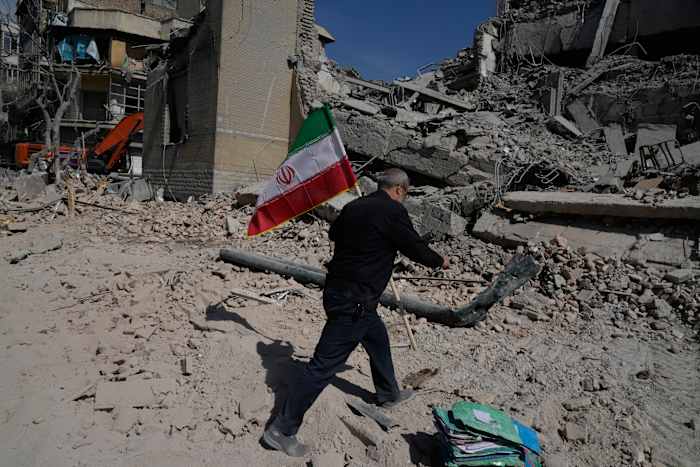
Donald Trump just flipped the script on how the U.S. handles regime change. After days of urging the Iranian people to "take back" their country, he's now suggesting that the next leader of Iran should actually come from within the current system. It’s a move that feels contradictory at first glance, but it reveals a cold, pragmatic calculation about the chaos of a power vacuum.
On Tuesday, while meeting with German Chancellor Friedrich Merz in the Oval Office, Trump admitted that "someone from within" the Iranian regime might be the most appropriate choice to lead once the dust settles. He’s trying to avoid what he calls the "worst case" scenario: replacing one tyrant with someone even worse. It’s a lesson he’s clearly drawn from the messy history of U.S. interventions in the Middle East.
The problem with a clean slate
The U.S.-Israeli military campaign has already decapitated much of Iran's leadership. Supreme Leader Ali Khamenei is dead. Many top officials are gone. When reporters asked Trump who he has in mind to take the wheel, his response was blunt: "Most of the people we had in mind are dead."
This isn't just a dark joke; it’s a massive logistical headache. If you kill everyone who knows how to run the water, the electricity, and the military, you end up with Iraq in 2003. Trump seems to realize that a complete collapse of the Iranian state could lead to a decade of civil war. By looking for an "insider," he’s betting on stability over a total democratic overhaul.
Why not the exiled Crown Prince?
For years, the loudest voice in the Iranian opposition has been Reza Pahlavi, the son of the last Shah. He’s been positioning himself as the natural successor to the theocracy. But Trump isn't sold. He told reporters that his administration hasn't considered Pahlavi "in depth."
Instead, Trump wants someone "currently popular" who is already on the ground. He’s looking for a pragmatist who survived the initial strikes—someone who understands the levers of power but is willing to play ball with Washington to save what’s left of the country.
Avoiding the five year regret
Trump’s biggest fear is the "revolving door" of dictators. He described a cycle where the U.S. helps someone take power, only to realize five years later that the new person is just as bad as the last. This happened in Libya. It happened in Iraq.
"You go through this, and then in five years you realize you put somebody in who was no better." — Donald Trump
By picking someone from the existing infrastructure, the hope is to find a "reformer" rather than a "revolutionary." It’s an "Obama-plus" strategy, as some White House officials have whispered. It suggests that even after all the fire and fury of the last week, the U.S. is still looking for a deal, not just a destruction.
The reality of the power vacuum
Israel has made its stance clear: whoever the Iranian Assembly of Experts picks next is a "target for elimination" if they continue the old path. This puts any potential "insider" in an impossible position. If they’re too close to the old guard, Israel kills them. If they’re too close to Trump, the Iranian street might see them as a puppet.
The current death toll of 48 top leaders has left a "third wave" of officials in charge. These are people who weren't supposed to lead for another decade. They are younger, perhaps more focused on survival than ideology. That’s the group Trump is likely targeting for outreach.
What this means for the war
The military campaign isn't over. Defense Secretary Pete Hegseth has projected weeks of continued strikes to finish off Iran's navy and missile programs. But the shift in rhetoric from "uprising" to "internal successor" suggests the U.S. is looking for an exit ramp.
If you're watching this play out, don't expect a sudden transition to a Western-style democracy. Expect a tense negotiation with a high-ranking military official or a "pragmatic" cleric who is tired of seeing their colleagues disappear in missile strikes.
Watch for any news regarding members of the Iranian Assembly of Experts who aren't on the "elimination list." If a name starts surfacing in White House briefings, that’s your likely "insider." Keep an eye on the rhetoric coming out of the State Department regarding "transitional stability"—that's the code word for keeping the old system's plumbing while replacing the faucet.