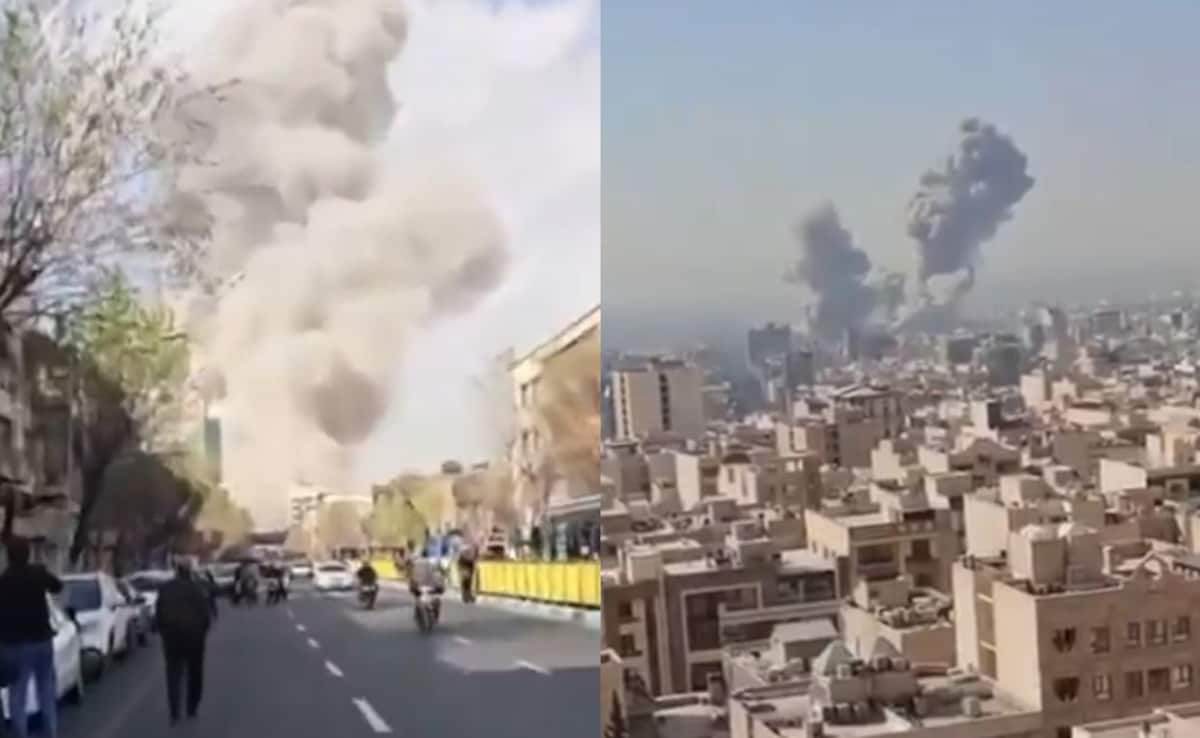
The sirens in Tehran did more than signal an incoming strike. They announced the end of a decades-old military doctrine. When Israeli jets conducted waves of precision attacks across Iran, the immediate visual evidence was clear: plumes of thick smoke rising from military complexes and a civilian population gripped by the sudden realization that their borders were porous. But beyond the panic on the streets lies a much grimmer reality for the Islamic Republic. This was not a random exchange of fire. It was a methodical dismantling of the Iranian integrated air defense system that has left the regime’s most sensitive nuclear and energy sites exposed to future destruction.
For years, Tehran relied on a strategy of "forward defense," using proxies in Lebanon, Gaza, and Yemen to keep the conflict far from its own soil. That buffer is gone. By striking deep within Iranian territory, Israel has demonstrated that it possesses the intelligence and the hardware to bypass Russian-made S-300 batteries with surgical ease. The psychological impact on the Iranian public is significant, but the strategic paralysis within the corridors of power is the real story. For another look, consider: this related article.
The failure of the S-300 and the myth of Iranian air sovereignty
The core of Iran’s defense rested on the prestige of its Russian-supplied hardware. For a decade, the S-300 was touted as an impenetrable shield. It failed. Reports indicate that multiple batteries were neutralized during the opening minutes of the operation, using a combination of electronic warfare and long-range stand-off missiles. This isn't just a blow to Iran; it’s a direct indictment of Russian military technology which has already been under scrutiny during the conflict in Ukraine.
When an air defense system is suppressed, it doesn't just stop working. It becomes a liability. The radar signatures that are supposed to track incoming threats instead become beacons for anti-radiation missiles. By the time the second and third waves of Israeli aircraft arrived, they were operating in what military analysts call a "permissive environment." They could pick their targets with leisure. This included drone production facilities, missile mixing plants, and critical logistics hubs. Similar reporting on this trend has been published by The New York Times.
The vulnerability of solid fuel production
One of the most devastating, yet underreported, aspects of the strikes was the targeting of planetary mixers used to produce solid fuel for long-range ballistic missiles. These are not items you can buy off a shelf at a hardware store. They are highly specialized, industrial-grade machines often subject to strict international sanctions.
If Iran cannot produce solid fuel, its ability to replenish its missile stockpile is frozen. Liquid-fueled missiles take longer to prep and are easier to spot via satellite before they ever leave the ground. By hitting the production line rather than just the storage depots, the strike effectively put a ceiling on Iran’s offensive capabilities for the next year or more. It was a move designed to win the next war before it even starts.
A civilian population caught in the crossfire of ideology
The panic observed in the streets of Tehran reflects a growing disconnect between the regime’s regional ambitions and its ability to protect its own citizens. For forty years, the narrative has been one of resistance and strength. Seeing the sky glow orange from explosions at the Parchin military complex shatters that illusion.
History shows us that when a revolutionary government can no longer provide basic security, the social contract begins to fray. The Iranian rial has already been in a freefall for years. Add to that the specter of a direct, conventional war with a technologically superior adversary, and the internal pressure on the Supreme Leader becomes immense. People aren't just afraid of the bombs; they are afraid of the instability that follows a perceived military humiliation.
The strategic silence from regional neighbors
Notice who didn't rush to Iran’s defense. While several Arab nations issued boilerplate statements condemning the "escalation," there was no mobilization of support. Behind closed doors, the calculation is changing. The "Axis of Resistance" is currently an axis of retreat. Hezbollah is reeling in Lebanon, and Hamas is operationally shattered in Gaza.
Iran is finding itself increasingly isolated, not just diplomatically, but militarily. Its neighbors are watching the effectiveness of Israeli and Western intelligence with a mix of awe and self-preservation. If Israel can fly through thousands of miles of contested airspace, refuel, strike, and return without losing a single pilot, the regional balance of power has shifted permanently.
The intelligence gap
How did the strikes find their targets so accurately? It wasn't just satellite imagery. This level of precision requires human intelligence on the ground. The Iranian security apparatus, particularly the Islamic Revolutionary Guard Corps (IRGC), has clearly been compromised.
- Targeting specific buildings within massive complexes suggests an intimate knowledge of internal blueprints.
- The timing of the strikes suggests a deep understanding of when personnel would be at their most vulnerable.
- The lack of effective interception indicates that the "eyes" of the Iranian military were blinded well in advance.
This level of infiltration is a nightmare for any intelligence agency. It means that every meeting, every shipment, and every secret bunker is likely already on a map in Tel Aviv or Washington.
The nuclear question remains the ultimate red line
While the recent strikes focused on conventional military targets, the shadow of the nuclear program looms over everything. Israel pointedly avoided striking the Natanz or Fordow facilities—this time. But the message was sent: "We can get to them whenever we want."
By removing the air defense systems surrounding these sites, the attackers have effectively left the door unlocked. Iran now faces a brutal choice. They can accelerate their push for a nuclear weapon, hoping it acts as the ultimate deterrent, or they can dial back their regional aggression to avoid a decapitation strike. The problem with the former is that it provides a casus belli for a much larger, much more destructive campaign that the Iranian military is clearly not prepared to fight.
The industrial fallout of precision warfare
The economic cost of these strikes will be felt long after the smoke clears. Rebuilding sophisticated military infrastructure under heavy sanctions is nearly impossible. Iran has spent decades building a domestic arms industry to bypass global embargoes. That industry is now in ruins.
When you lose a factory that produces high-end carbon fiber or specialized chemical precursors, you can't just fix the roof and restart the machines. You need specialized components that are currently blocked by every major trade authority in the world. This creates a cascading failure. Without the missiles, the proxies lose their bite. Without the proxies, the regime loses its leverage.
Why the "Day After" looks different now
We are no longer in a cycle of "tit-for-tat" exchanges. We have entered a period of systemic degradation. The goal is no longer to trade blows, but to remove the opponent's ability to throw a punch.
The images of traffic jams and people fleeing Tehran aren't just snapshots of a bad night; they are the visual evidence of a broken strategy. The regime in Tehran has consistently bet that its enemies were too risk-averse to strike the heart of the country. They lost that bet. Now, they must navigate a landscape where their defenses are down, their proxies are weakened, and their internal security is a sieve.
The next move won't be made on a battlefield, but in the darkened rooms of the Iranian high command. They have to decide if the pursuit of regional hegemony is worth the total destruction of their domestic infrastructure. Based on the precision of the latest strikes, that destruction is no longer a theoretical threat. It is a proven capability.
Verify the status of regional energy markets. If the rhetoric escalates, the next targets will likely be the refineries that keep the Iranian economy on life support.