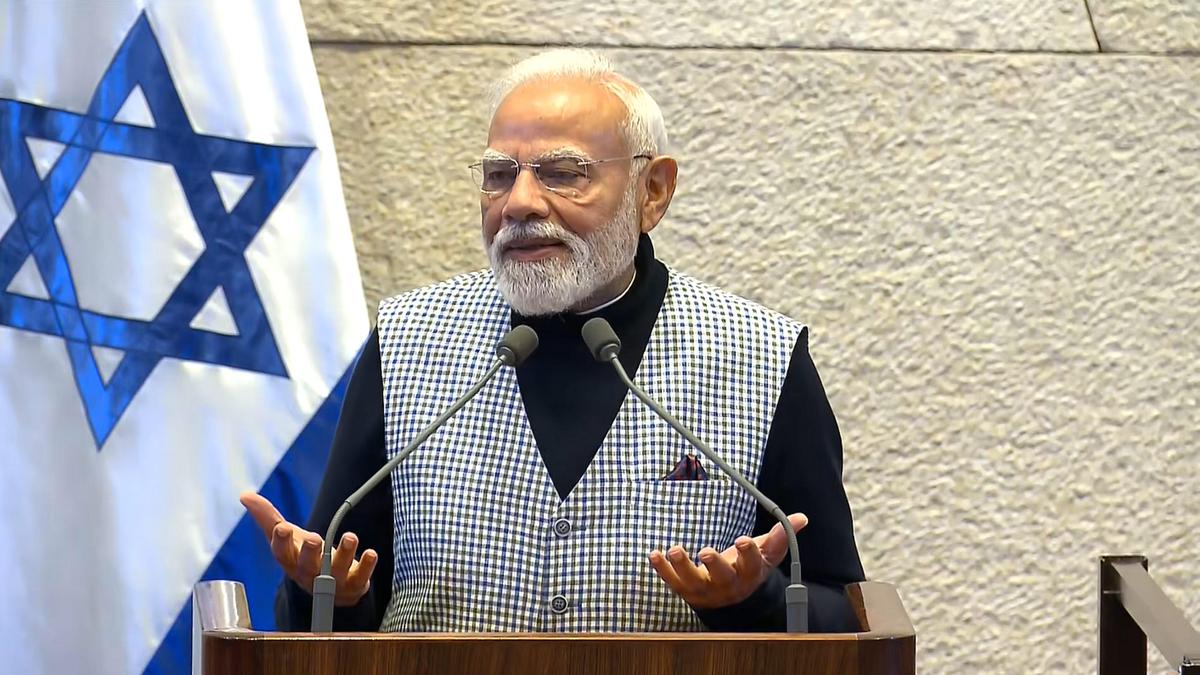
The air inside the Knesset doesn't just hold the scent of history; it holds the weight of it. When Narendra Modi stood before the Israeli parliament, he wasn’t just a prime minister delivering a diplomatic script. He was the physical manifestation of a bridge that had been under construction for decades—one built not with steel, but with a shared, bone-deep understanding of what it means to be a civilization under siege.
For years, the relationship between New Delhi and Jerusalem was a whispered affair. It was a romance conducted in the shadows of the Cold War, muffled by India’s traditional reliance on Arab oil and its historic commitment to the Non-Aligned Movement. But the shadows have retreated. Today, the lights are bright, the cameras are rolling, and the handshake is firm.
The Architect of a New Reality
To understand why this moment matters, look past the tailored suits and the polished marble. Look instead at a hypothetical farmer in the parched fields of Maharashtra. Let’s call him Amit. For years, Amit’s livelihood was a gamble against a sky that refused to cry. His soil was tired. His yield was a fraction of what it should be.
Then came the drip.
Israeli irrigation technology, born from the desperation of a nation that bloomed in a desert, found its way to Amit’s village. This isn't just a trade deal. It is a transfusion of survival. When Modi tells the Knesset that India stands "firmly" with Israel, he isn't just talking about missiles or intelligence sharing. He is talking about Amit. He is talking about the fundamental right of a nation to feed its people and protect its borders using every scrap of ingenuity available.
The transition from "cold shoulder" to "strategic partner" didn't happen overnight. It required a ruthless pragmatism. India has historically walked a tightrope, balancing its support for the Palestinian cause with its growing need for Israeli defense tech. But the tightrope has widened into a highway.
The Invisible Shield
While the public sees the handshakes, the real story lives in the "invisible stakes." India is currently the world’s largest buyer of Israeli military equipment. This isn't about vanity. It’s about a neighborhood that rarely sleeps soundly.
Between the volatile borders of the Himalayas and the maritime tensions of the Indian Ocean, India’s security needs are gargantuan. Israel, a country that has turned "survival against the odds" into a national brand, provides the sensors, the drones, and the surface-to-air missiles that act as India's silent guardians.
Consider the "Barak 8" missile system. It’s a joint venture, a child of two mothers. It represents a shift from a buyer-seller relationship to one of co-creation. This is the "Make in India" initiative breathing through an Israeli respirator. They aren't just selling weapons; they are sharing the blueprints of defiance.
A Shared Grammar of Trauma and Triumph
There is a psychological resonance here that many Western observers miss. Both nations are defined by partition. Both are ancient civilizations that became young states in the late 1940s. Both find themselves surrounded by ideologies that often contest their very right to exist.
When a terrorist attack strikes a cafe in Tel Aviv or a luxury hotel in Mumbai, the grief in both cities speaks the same dialect. This shared grammar of trauma has created an intelligence-sharing bond that is reportedly among the most intimate in the world. They don't just trade data; they trade perspectives on a world that feels increasingly fragmented.
But the bond isn't solely defined by what they fear. It is defined by what they seek to build.
The Silicon Connection
Walk through the tech hubs of Bengaluru and Tel Aviv and you’ll see the same frantic energy. This is the "Silicon Wadi" meeting the "Silicon Valley of the East." This isn't just about apps or software. This is about the future of global resilience.
From cybersecurity to agricultural innovation, the two nations are weaving a web of interdependency that makes the "firmness" of Modi's speech at the Knesset feel like a statement of fact rather than a diplomatic flourish. It is a partnership of the "un-common" nations, those that refuse to be defined by their geography or their past.
The true significance of this moment lies in its permanence. This is no longer a temporary alignment. This is the new architecture of the 21st century.
India’s firm stance with Israel isn’t just a political choice. It is a historical inevitability. It is the sound of two ancient giants waking up to the reality that they don't have to face the darkness alone.
The saffron and the star have found their common ground.