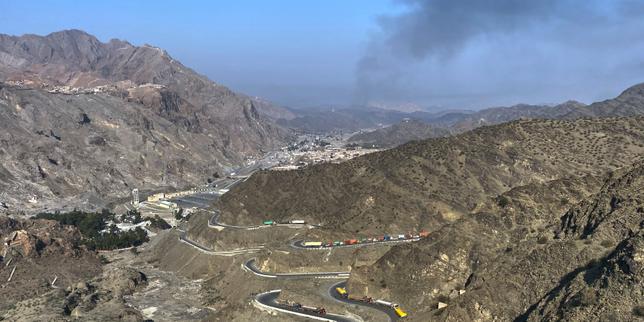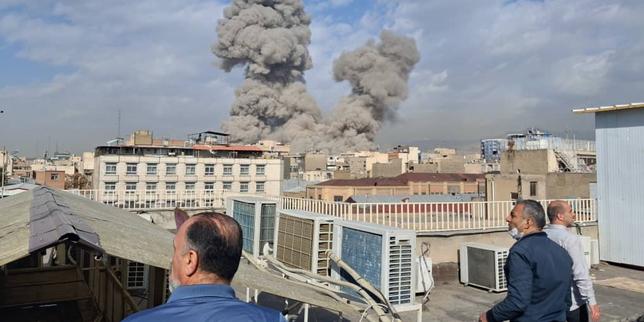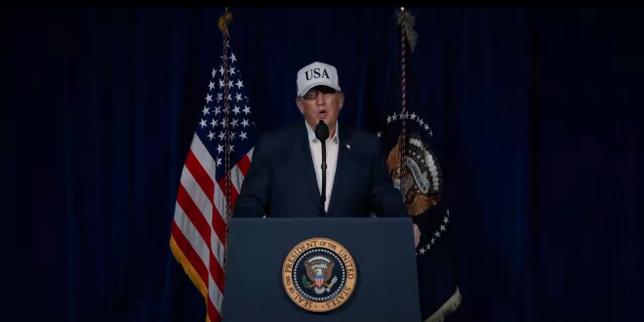
The recent escalation in American military posture toward Tehran marks a definitive break from years of strategic patience. When Donald Trump addressed the nation to announce targeted strikes against Iranian interests, the immediate justification centered on a familiar specter: the nuclear threshold. However, the surface-level rhetoric regarding enrichment percentages and centrifuge counts masks a much more volatile reality. This isn't just about a bomb that hasn't been built yet. It is about a regional power structure that has been systematically dismantled by proxy warfare and the sudden, violent reassertion of American kinetic dominance.
The decision to move from sanctions to missiles suggests that the economic "maximum pressure" campaign reached its logical ceiling. For years, the global community watched as the Rial plummeted and oil exports were throttled, yet Tehran’s regional influence only tightened. The strikes represent a realization in Washington that financial strangulation cannot stop a drone program that relies on off-the-shelf components or a militia network that thrives on chaos. By targeting the infrastructure of the Islamic Revolutionary Guard Corps (IRGC), the United States has signaled that the era of fighting through proxies is over. The fight is now direct, and the stakes are existential for the current Iranian leadership. Meanwhile, you can explore similar developments here: The Cold Truth About Russias Crumbling Power Grid.
The Nuclear Math Behind the Missiles
To understand the timing of these strikes, one must look past the podium and into the bunkers of Natanz and Fordow. For months, intelligence reports indicated that Iran’s "breakout time"—the duration needed to produce enough weapons-grade uranium for a single nuclear device—had shrunk from months to mere weeks. While the political discourse often focuses on the JCPOA (the 2015 nuclear deal), the technical reality has evolved far beyond that framework.
Modern enrichment uses cascades of IR-6 centrifuges. These machines are significantly more efficient than the first-generation models used a decade ago. If a nation possesses 60% enriched uranium, the jump to 90% (weapons-grade) is a matter of technical tweaking rather than a massive industrial hurdle. The physics of enrichment is front-loaded; the hardest part is getting from 0% to 5%. By the time you reach 60%, the vast majority of the work is already done. The American strikes were designed to disrupt the supply chains and command structures that protect this specific technical progression. To explore the full picture, check out the excellent report by USA Today.
The administration’s gamble is that by hitting military targets now, they prevent the need for a much larger, more catastrophic campaign against hardened nuclear sites later. It is a doctrine of "preemptive de-escalation," though the irony of that term is lost on no one in the Middle East.
The Proxy Network Collapse
For two decades, Iran’s primary defense strategy was "forward defense." This meant fighting its battles in Lebanon, Syria, Iraq, and Yemen rather than on its own soil. The IRGC-Quds Force created a mosaic of allied groups that provided Tehran with plausible deniability. When a rocket hit an American base in Erbil, Tehran could shrug its shoulders.
The current American strategy has stripped away that deniability. By holding the center responsible for the actions of the periphery, the U.S. has disrupted the internal logic of the Iranian security state. If the "Axis of Resistance" no longer shields the Iranian mainland from direct retaliation, the value of those proxies diminishes overnight. We are seeing a fundamental shift in how "gray zone" conflicts are managed. The U.S. is no longer willing to play the game of shadow boxing; it is going for the head of the boxer.
The Drone Paradigm
One factor that the competitor’s reportage missed entirely is the democratization of precision strikes. Iran’s development of the Shahed series of loitering munitions—cheap, effective, and hard to detect—changed the cost-benefit analysis of regional war.
These drones allow a relatively isolated power to project force thousands of miles away without a billion-dollar air force. They are the "poor man's cruise missile." The American strikes specifically targeted assembly plants and storage facilities for these systems. This wasn't just a punishment for past behavior; it was a proactive attempt to blind the IRGC’s long-range eyes.
Internal Pressures and the Succession Crisis
We cannot ignore the domestic climate within Iran. The aging Supreme Leader, Ayatollah Ali Khamenei, faces a looming succession crisis. The hardliners in the IRGC are jockeying for position, and a confrontation with the "Great Satan" often serves as a unifying force for the regime's base. However, this is a dangerous gambit. Unlike the 1980s, the Iranian population is young, hyper-connected, and increasingly disillusioned with a government that prioritizes foreign adventures over the price of eggs in Tehran.
The strikes put the IRGC in a vice. If they don't respond, they look weak to their internal rivals and regional allies. If they respond too forcefully, they risk an all-out war that they cannot win and that would likely lead to the collapse of the regime. This is the "strategic dilemma" that Washington is currently exploiting. They are betting that the Iranian leadership values survival over pride.
The Intelligence Failure of Diplomacy
For years, the Western diplomatic core operated under the assumption that Iran could be integrated into a regional security framework through economic incentives. This was a catastrophic misreading of the IRGC’s DNA. The Guard is not just a military branch; it is a conglomerate that controls roughly a third of the Iranian economy. They do not want "normalization" because normalization requires transparency and a move away from the black-market economy that sustains them.
The American strikes effectively end the era of the "diplomatic solution" as it was previously understood. There is no going back to the 2015 status quo. The new reality is a containment policy backed by the credible threat of immediate, devastating force. This isn't a return to the "forever wars" of the early 2000s, but rather a shift toward a "high-tech siege" model of warfare.
Silicon and Steel
The technical sophistication of the American strikes also serves as a message to other global players. Using a combination of cyber-disruption to blind radar and precision-guided munitions to hit specific floors of buildings, the U.S. demonstrated a level of "surgical" capability that few can match. This is the "offset" strategy in action. While Russia and China watch closely, the U.S. is proving that its conventional edge remains sharp, even if its political will has been questioned in recent years.
The hardware involved—the F-35s, the B-21 precursors, and the sea-launched Tomahawks—represents an investment of trillions of dollars over decades. Iran, for all its bluster, is fighting with 1970s airframes and 2010s drones. The mismatch is total. The American objective was to remind the world that in a contest of steel and silicon, the result is predetermined.
The Fallout for Global Markets
The immediate reaction to the strikes was a predictable spike in Brent crude prices. However, the long-term implications for energy security are more complex. If the U.S. can successfully deter Iran from closing the Strait of Hormuz, the "risk premium" on oil may actually decrease over time. The world is less dependent on Middle Eastern oil than it was during the 1973 embargo, thanks to American shale and the rise of renewables.
This energy independence gives Washington a freedom of movement it didn't have twenty years ago. They can afford a flare-up in the Gulf without tanking the global economy. This is a structural change in geopolitics that Tehran has failed to account for. They no longer hold the "oil weapon" over the world's head with the same grip.
A New Map of the Middle East
We are witnessing the birth of a new regional alignment. The Abraham Accords were the first sign, but these strikes are the second. A silent coalition of Arab states, Israel, and the U.S. is forming a hard wall against Iranian expansionism. The strikes were not just an American action; they were a signal to Riyadh and Abu Dhabi that the U.S. is still the ultimate security guarantor in the region.
The map is being redrawn, not by diplomats with pens, but by commanders with coordinates. The "Shiite Crescent" that Iran worked so hard to build is being fractured. Every strike on a warehouse in Damascus or a command center in Baghdad is a brick taken out of that wall.
The Illusion of Finality
It is a mistake to think that a single wave of strikes settles the score. Iran has spent forty years mastering the art of the "long game." They will look for vulnerabilities in the American armor, whether through cyberattacks on infrastructure or "lone wolf" operations in Europe or South America. The war has moved from the visible to the invisible.
The U.S. has won this round through sheer kinetic force, but the underlying ideology of the Iranian revolution remains intact. You cannot bomb an idea, but you can certainly make it too expensive to export. The question is whether the American public has the stomach for a multi-year commitment to this new doctrine of active containment.
The red line has been drawn in fire. Whether Tehran chooses to respect it or try to smudge it with more blood will determine the trajectory of the next decade. The era of the "grand bargain" is dead, replaced by the cold, hard logic of the missile.
Monitor the movement of the U.S. Fifth Fleet over the next 48 hours for the clearest indication of whether this was a one-off warning or the opening salvo of a campaign to dismantle the IRGC's regional architecture piece by piece.