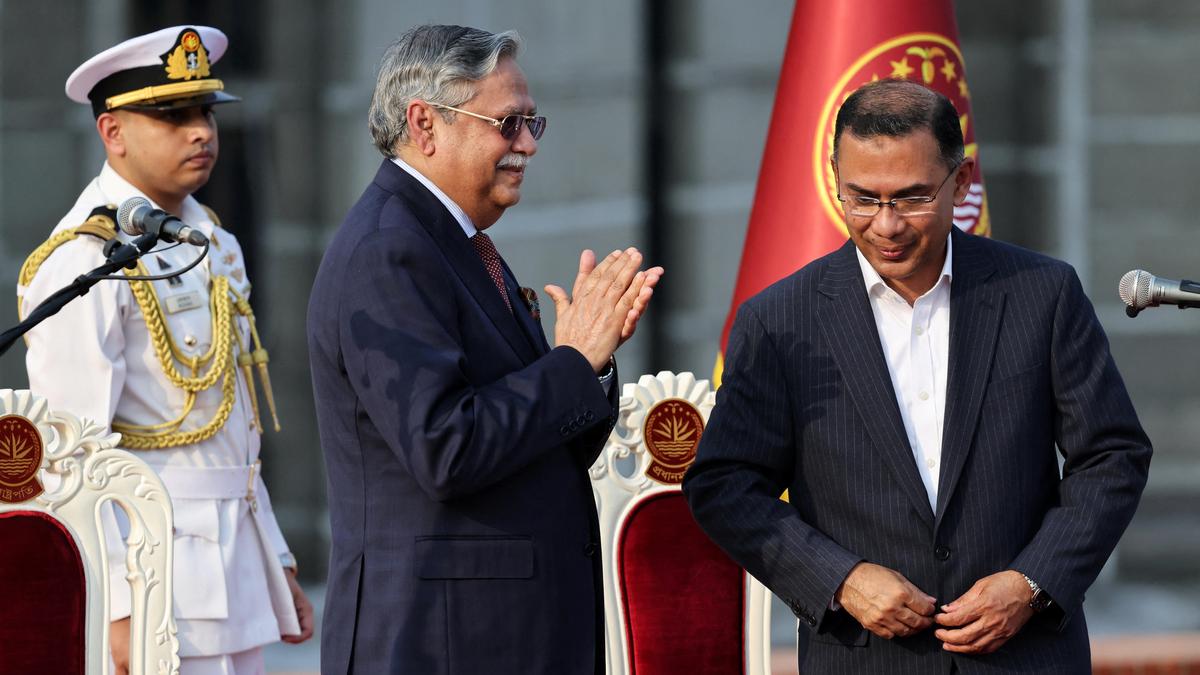
The silence at Bangabhaban has finally been broken, but the noise replacing it tells a story of a deeply fractured state. On February 24, 2026, the administration of Prime Minister Tarique Rahman officially restored the press wing of President Mohammad Shahabuddin. This move effectively ends an eighteen-month period of informational isolation where the head of state was functionally gagged by the preceding interim regime.
While the official narrative frames this as a return to administrative normalcy, the reality is a calculated recalibration of power. For over a year, the President of Bangladesh was a ghost in his own palace, denied the basic staff required to communicate with his citizens or the international community. By reinstating this office, the new government is not just filling vacancies; it is dismantling the remains of an experimental "chief adviser" system that nearly pushed the presidency into total obsolescence.
The Systematic Muzzling of the Head of State
To understand why this restoration matters, one must look at the scorched-earth policy of the interim government led by Muhammad Yunus. Shortly after the 2024 uprising, the interim authorities did not just sideline the President—they systematically dismantled his ability to function. The abolition of the press wing was a surgical strike.
By removing the Press Secretary, deputies, and even the official photographers, the interim regime created a vacuum. When foreign envoys arrived to present their credentials, there were no official images released by the state. Instead, the public had to rely on photos provided by foreign embassies or the armed forces. It was a humiliating arrangement for a sovereign nation. The President himself recently broke his silence, alleging that during those 18 months, he was "nowhere in discussion" and that multiple "plots" were hatched to remove him entirely. This was not a mere budgetary cut; it was a deliberate attempt to turn the presidency into a vestigial organ of the state.
The Architect of the New Narrative
The reappointment of Mohammad Sarwar Alam as Press Secretary is a signal to the old guard and the new power brokers alike. Alam is a veteran of the 1984 BCS Information Cadre who previously served under the last BNP-led government in the early 2000s. His return on a one-year contractual basis signifies a bridge back to traditional governance structures that the student-led "July Uprising" sought to disrupt.
His appointment is governed by Section 49 of the Government Service Act, 2018, requiring a total severance from all other professional or business ties. This strict adherence to formality is a sharp departure from the improvised, ordinance-heavy governance of the past year. The new administration is signaling that the era of "revolutionary" ad-hocism is over, replaced by a rigid, if not defensive, bureaucracy.
Why the Interim Reform Failed to Stick
The Yunus administration’s "Reform Book," published just weeks before the transition, lauded the dismantling of old institutions as a "process of transformation." They argued that the press wing was a relic of an authoritarian era used to manufacture consent. However, by eliminating it rather than reforming it, they created a different kind of darkness.
In the absence of an official presidential voice, rumors flourished. The President’s own admission that he was "kept in the dark" about critical executive decisions underscores a dangerous breakdown in the constitutional machinery. The interim government’s attempt to govern through a "July Charter" without the full participation of the sitting President created a legal grey area that the new Rahman government is now racing to close.
- Institutional Erasure: The removal of photographers who had served for 30 years wasn't about politics; it was about erasing the institutional memory of the state.
- Constitutional Friction: The use of Article 106 to bypass the President on "significant public matters" set a precedent that many analysts feared would lead to a permanent executive imbalance.
- The Media Vacuum: Without a press wing, the presidency had no mechanism to counter narratives or clarify the President's stance on the resignation of the previous Prime Minister—a point of contention that nearly triggered a constitutional crisis in late 2024.
A Fragile Restoration
Restoring the press wing does not automatically restore trust. The media landscape in Bangladesh remains a battlefield. While the interim government claimed to have "reestablished" media freedom, international observers like Reporters Without Borders noted a continued decline in press freedom indices through 2025. Over 300 journalists faced criminal charges during the transition, many of which remain unresolved.
The President’s new press wing enters a space defined by extreme polarization. Their primary challenge will not be scheduling photo ops, but navigating a country where every official statement is scrutinized for "loyalty" to the fallen regime or the current one. The restoration of the press wing is the first step in a broader strategy to stabilize the executive branch before the 2026 general elections, but it remains a hollow victory if the office is simply used to trade one form of state-controlled narrative for another.
The reality of this move is found in its timing. As the country moves toward a general election, the presidency must be seen as a functional, neutral arbiter. By "re-equipping" the President, the current government is ensuring that when the inevitable political storms of the election season arrive, the highest office in the land at least has a microphone. Whether that microphone will be used to speak for the constitution or for the party in power is the question that will define the coming year.
Would you like me to analyze the specific legal changes introduced in the July National Charter regarding presidential powers?