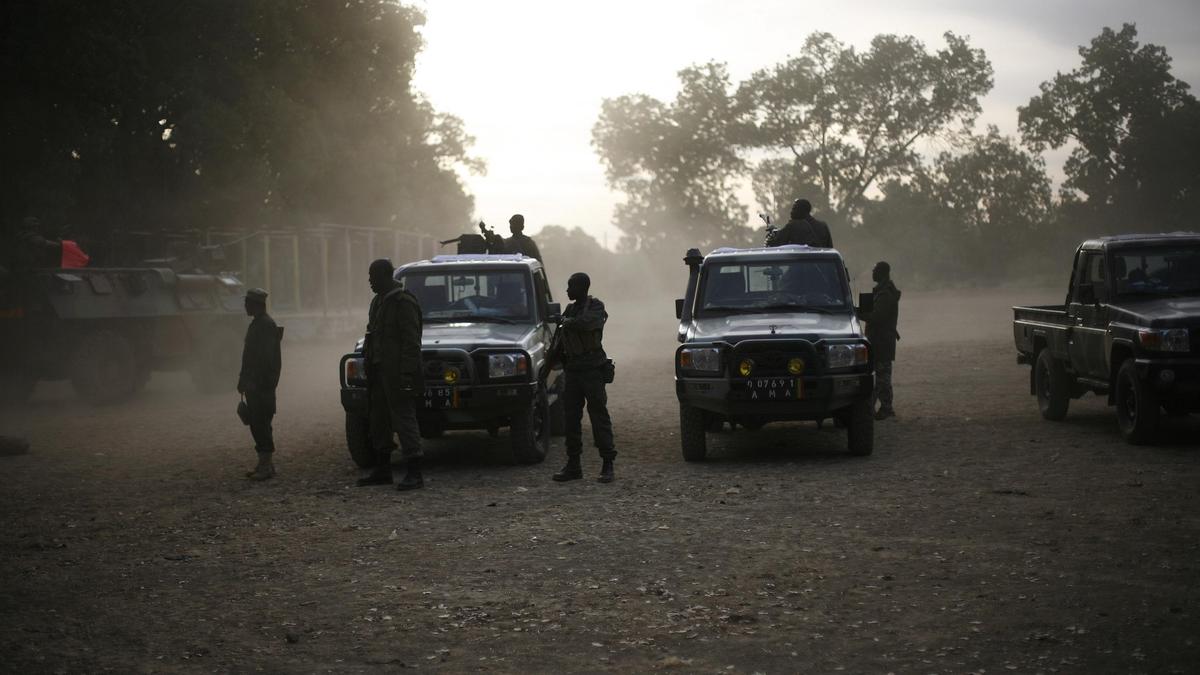
The September 2024 coordinated attacks in Bamako represent a terminal failure of the "Fortress Capital" security doctrine, shifting the conflict from a rural war of attrition to a direct challenge of the state's center of gravity. While initial reports focused on the chaos of the gunfire and blasts, a structural analysis reveals a sophisticated tactical evolution by the Jama’at Nusrat al-Islam wal-Muslimin (JNIM). This was not a random act of terror; it was a calibrated demonstration of the state's inability to secure its most sensitive military infrastructure, specifically the Faladié gendarmerie school and the Modibo Keïta International Airport.
The Triad of Tactical Objectives
JNIM’s operation functioned through three distinct logical layers designed to maximize psychological impact while minimizing the group's own logistical overextension.
- Infrastructure Degradation: By targeting the gendarmerie school, the insurgents struck at the primary pipeline for internal security personnel. This creates an immediate human capital bottleneck in the Malian state’s ability to replace field losses.
- Economic Interdiction: Attacking the airport, particularly the military hangar area used by state partners and the Air Force, serves to increase the "risk premium" for international logistics. If the capital’s runway is contestable, the cost of maintaining aerial supply lines for the northern fronts becomes prohibitively high.
- Governance Delegitimization: The primary value of a military junta lies in its promise of security. By penetrating the capital, the attackers force a reassessment of the junta's core value proposition.
The Geography of Vulnerability: Why Bamako?
Bamako has historically benefited from a geographical buffer provided by the Niger River and a dense concentration of elite security units. However, this concentration created a "high-value target density" that JNIM exploited.
The Faladié district is a strategic nexus. Its proximity to the airport and major transit arteries means that any instability there paralyzes the city's southeastern corridor. The attackers utilized a saturation strategy, where simultaneous strikes at multiple points forced a fragmented response from the Malian Armed Forces (FAMa). When security forces are forced to divide their command and control between a training academy and an international airport, the speed of containment drops exponentially.
The operational success of these incursions stems from a breakdown in the Intelligence-to-Interdiction Cycle. For a coordinated group to move weapons and personnel into the heart of a militarized capital, at least three systemic failures must occur:
- Permeability of the Peripheral Belt: The failure to detect the movement of combatants from rural strongholds into the urban periphery.
- Counter-Intelligence Blind Spots: The ability of insurgents to maintain operational security while conducting pre-attack reconnaissance in high-security zones.
- Response Lag: The interval between the first kinetic engagement and the deployment of air assets or rapid reaction forces.
The Wagner-FAMa Integration Paradox
The current Malian security architecture relies heavily on the integration of Private Military Companies (PMCs), specifically Russian assets, into the national defense framework. This creates a technical friction point known as the Interoperability Gap.
While PMCs provide high-end kinetic capabilities and drone surveillance, their integration with local gendarmerie units is often hindered by disparate communication protocols and differing tactical priorities. During the Bamako attacks, the delay in clearing the airport suggests a lack of unified command. In a high-stakes urban environment, the presence of multiple uncoordinated armed actors—regular army, gendarmerie, and foreign contractors—increases the risk of friendly fire and slows the "clear and hold" process.
Quantifying the Logistical Shift
The transition from IED (Improvised Explosive Device) attacks on rural convoys to coordinated urban raids indicates a significant shift in the Insurgent Resource Allocation.
- Training Requirements: Urban warfare requires a different caliber of combatant than rural skirmishing. The Bamako attackers demonstrated a level of discipline and fire control suggestive of dedicated urban combat training cycles.
- Infiltration Logistics: Maintaining a "sleeper" presence in Bamako requires a sophisticated civilian support network and a steady flow of untraceable funding. This points to the insurgent group's successful integration into the capital's informal economy.
- Weaponry Sophistication: The use of both high-volume small arms and precision explosives indicates a diversified supply chain that remains unaffected by the state's attempts to seal its borders.
The Strategic Value of the Airport Terminal
The attack on the airport terminal and the burning of aircraft represents a direct hit to the state's Power Projection Coefficient. Mali’s geography is vast and inhospitable. The state’s ability to hold northern cities like Gao or Timbuktu is entirely dependent on its aerial logistics.
When an aircraft is destroyed on the tarmac in Bamako, the loss is not merely the replacement cost of the hull. It is the loss of "Sortie Capacity." Fewer planes mean fewer resupply missions to the north, which leads to the isolation of forward operating bases. JNIM is effectively fighting the war for the North in the streets of the South. By targeting the "tail" (logistics and transport), they are paralyzing the "teeth" (frontline infantry).
Information Warfare and the Narrative Vacuum
In the immediate aftermath of the blasts, the state's communication strategy focused on "normalization." However, in the age of decentralized social media, a "normalization" narrative that contradicts visible smoke plumes over the capital creates a Credibility Deficit.
JNIM utilized this vacuum by releasing high-quality footage of their fighters inside the gendarmerie school. This digital footprint serves two purposes:
- Recruitment: It demonstrates "Force Overmatch," proving to potential recruits that the group can strike the state at its strongest point.
- Psychological Attrition: It creates a sense of inevitability among the civilian population, eroding the will to support the state's counter-insurgency efforts.
The Structural Constraint of Urban Counter-Insurgency
Conducting counter-insurgency (COIN) in a city of over 4 million people presents a "Collateral Damage Constraint." High-intensity kinetic responses, such as using heavy artillery or unguided aerial strikes, risk radicalizing the local population and destroying the very infrastructure the state seeks to protect.
The attackers used this to their advantage, choosing targets embedded within residential or high-traffic areas. This forces the military into "Close Quarters Battle" (CQB), where the state's traditional advantages in heavy weaponry are neutralized, and the fight is decided by the tactical proficiency of small units.
The Geopolitical Repercussions of Capital Instability
The Bamako attacks cannot be viewed in isolation from the broader Sahelian context. As Mali, Burkina Faso, and Niger move toward a more autonomous "Alliance of Sahel States" (AES), the security of their respective capitals becomes the ultimate test of their sovereign capability.
The failure to prevent the Bamako incursion puts immense pressure on the AES framework. If the most guarded city in the alliance is vulnerable, the "mutual defense" clauses of the alliance appear more like a shared vulnerability than a collective strength. This encourages further insurgent boldness across the regional borders, leading to a "Contagion of Instability" where groups like JNIM or ISGS (Islamic State in the Greater Sahara) move resources to wherever the state's defensive perimeter is thinnest.
Operational Redesign: The Mandatory Pivot
For the Malian state to regain the initiative, it must move beyond a reactive stance. This requires a transition from "Area Defense" to "Intelligence-Led Preemption."
- Network Mapping: The state must aggressively map the financial and logistical nodes within Bamako that facilitated the infiltration. This involves monitoring the informal hawala banking systems and real estate transactions in the urban periphery.
- Decentralized Command: Security forces must move toward a decentralized command structure that allows local unit commanders to engage threats without waiting for orders from a centralized—and potentially compromised—headquarters.
- Airfield Hardening: The Modibo Keïta International Airport requires a multi-layered "Defense in Depth" strategy, including automated perimeter detection and dedicated rapid-response units that are physically separated from the main military barracks to prevent a single point of failure.
The Bamako event marks the end of the "Buffer Zone" era. The conflict is no longer a distant problem for the hinterlands; it is an existential threat to the seat of power. The survival of the current governance model depends not on its ability to reclaim desert territory in the north, but on its ability to secure the four-kilometer radius around the presidential palace and the international airport. Failure to do so will result in a "hollow state" scenario, where the government controls the buildings of the capital while an insurgent shadow state controls the streets.
Security assets must be repositioned to prioritize "Key Resource Protection" (KRP). This means shifting from broad sweeps of rural areas to the surgical hardening of the capital's central nervous system—communications, transport, and military leadership hubs. The state’s move must be to increase the "Entry Cost" for insurgents to a level that makes urban incursions a net loss for their limited elite cadres.