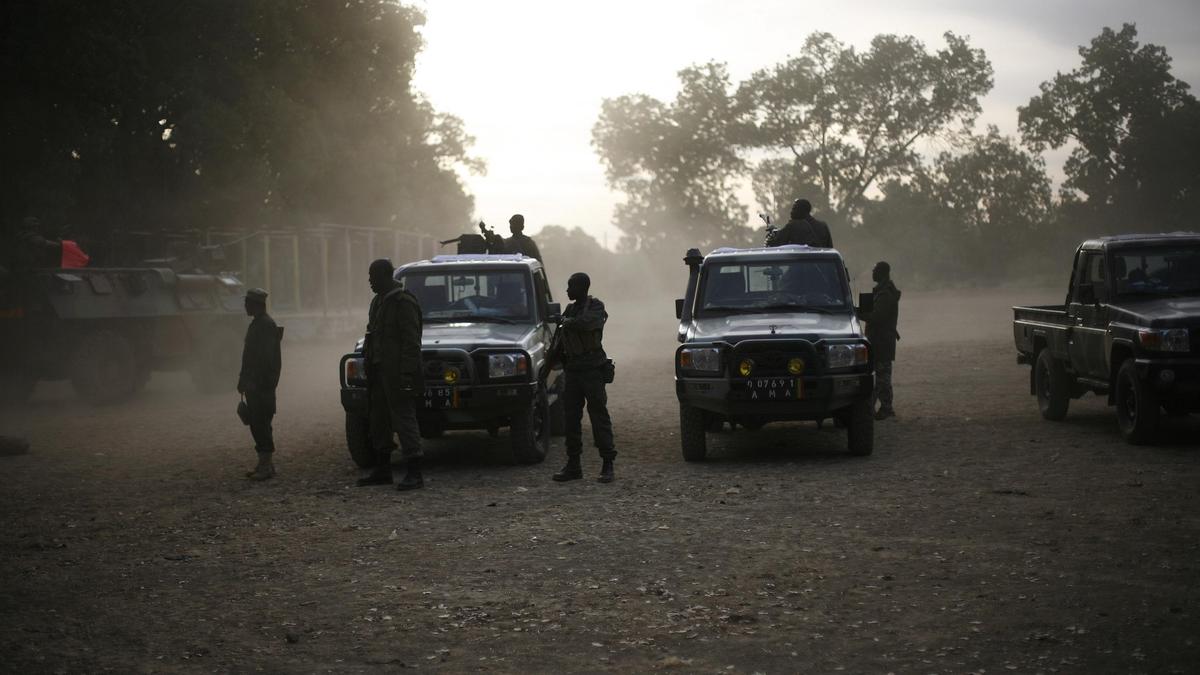
The security architecture of Mali rests upon the stability of the Kati military base, a facility that functions as the de facto epicenter of political and military power within the state. When reports of gunfire and explosions emerge from this specific coordinate, it signifies more than a tactical skirmish; it indicates a failure in the internal security perimeter of the ruling junta. The kinetic events at Kati are not isolated incidents of unrest but are symptoms of a fractured command structure and the erosion of the state's monopoly on violence.
The Strategic Gravity of Kati
To understand why gunfire at Kati triggers immediate national paralysis, one must analyze the base’s role through the lens of Strategic Centralization. Kati is not merely a garrison; it is the historical springboard for every successful coup d’état in Mali’s post-colonial history.
- Proximity Dynamics: Located approximately 15 kilometers from the capital, Bamako, the base allows for rapid troop deployment to the Presidential Palace and key ministries.
- Logistical Command: It serves as the primary storage site for heavy weaponry, armor, and munitions.
- Symbolic Hegemony: Control over Kati is synonymous with control over the transition government.
When "loud blasts" are reported by witnesses, the immediate analytical concern is the source: are these defensive measures, offensive breaches, or internal mutinies? In the context of the current Malian political climate, characterized by the presence of the Wagner Group (now Africa Corps) and heightened activity from the Katiba Macina and ISGS (Islamic State in the Greater Sahara), these blasts represent a breach of the "Green Zone" equivalent in West African geopolitics.
The Triad of Threat Vectors
The instability at the Kati camp can be categorized into three distinct threat vectors, each carrying different implications for state longevity.
1. The Internal Fragmentation Vector
The Malian Armed Forces (FAMa) are not a monolithic entity. The integration of various paramilitary groups and the shifting loyalties of mid-level officers create a high-friction environment. Historical data suggests that internal friction often manifests as "gunfire near the camp" when pay cycles are missed or when specific factions feel marginalized by the ruling council. This is a failure of Internal Resource Distribution. If the state cannot maintain the financial and social contract with its primary enforcers at Kati, the base transforms from a shield into a pressure cooker.
2. The Asymmetric Penetration Vector
Terrorist organizations in the Sahel have transitioned from rural insurgency to urban-peripheral strikes. An attack on Kati suggests a significant leap in the intelligence and logistical capabilities of groups like JNIM (Jama'at Nusrat al-Islam wal-Muslimin). For an insurgent force to reach the perimeter of Mali's most fortified position, they must bypass multiple layers of surveillance and checkpoints. This indicates a Security Intelligence Deficit. The mechanism here is simple: if the perimeter of Kati is porous, no square inch of Malian territory can be classified as secure.
3. The Proxy Influence Vector
The introduction of Russian private military contractors has altered the friction points within the base. The integration of foreign tactical units into a sovereign military headquarters introduces a "Two-Master" problem. Disagreements over tactical execution or command hierarchy between FAMa leadership and foreign advisors can lead to kinetic "misunderstandings" or localized mutinies.
Quantifying the Blast Impact
The use of explosives—the "loud blasts"—indicates a shift from small-arms harassment to high-order destruction. In military logic, the use of IEDs (Improvised Explosive Devices) or VBIEDs (Vehicle-Borne IEDs) against a military camp serves two purposes: Perimeter Breach and Psychological De-escalation.
The mechanics of a VBIED attack on a fortified position like Kati follow a predictable trajectory:
- Shock Phase: The primary blast neutralizes the immediate gate guards and destroys physical barriers.
- Saturation Phase: Small arms fire prevents rapid response units from mobilizing to the breach point.
- Infiltration Phase: Foot soldiers enter the facility to sabotage high-value assets (aircraft, communications, or leadership).
If the reports of gunfire are sustained, it suggests that the "Shock Phase" failed to result in an immediate surrender, leading to a protracted engagement. This duration is a critical metric. A five-minute engagement is a harassment; a two-hour engagement is a siege.
The Economic and Geopolitical Cost Function
Instability at Kati has a direct correlation with the Malian state's creditworthiness and its ability to negotiate international security partnerships.
- Market Volatility: Rumors of unrest at the base lead to immediate spikes in the cost of essential goods in Bamako as merchants anticipate road closures and supply chain disruptions.
- Diplomatic Isolation: Repeated security failures at the "impenetrable" base weaken the junta's leverage with ECOWAS (Economic Community of West African States) and the African Union.
- Resource Allocation: Every hour of combat at Kati diverts resources from the northern fronts (Gao, Timbuktu), where the insurgent threat is most acute. This creates a "Vacuum Effect" where the capital's insecurity fuels rural insurgency.
The cost function of a Kati breach can be expressed as the sum of lost tactical readiness and the exponential increase in the "Coup Risk Premium" that foreign investors and domestic actors place on the regime.
Structural Vulnerabilities in the Current Defense Model
The reliance on a centralized defense model at Kati creates a "Single Point of Failure." In systems engineering, a robust system requires redundancy. Mali’s security architecture lacks this. If Kati falls or is neutralized even temporarily, the central government loses its ability to project power.
The current defense model suffers from:
- Low Signal-to-Noise Ratio: Frequent false alarms or minor internal disputes desensitize the garrison to actual external threats.
- Intelligence Siloing: Information regarding insurgent movements often fails to reach the tactical commanders at Kati in a timeframe that allows for proactive defense.
- Over-concentration: Storing the majority of the nation's kinetic assets in one location within range of a single coordinated strike is a violation of basic strategic dispersion principles.
Tactical Response Requirements
To mitigate the recurrence of kinetic events at Kati, the command must move from a reactive posture to a predictive one. This involves the implementation of a "Layered Defense Topology."
- The Deep Perimeter: Establishing a 5km surveillance buffer around Kati using aerial reconnaissance and human intelligence (HUMINT) to identify anomalies in traffic and personnel movement.
- Electronic Governance: Implementing biometric access for all personnel to eliminate the risk of "Trojan Horse" infiltrations by insurgents wearing FAMa uniforms.
- Decentralized Command: Empowering secondary bases (such as those in Segou or Mopti) to act as autonomous operational hubs should the Kati-Bamako axis be compromised.
The events at Kati are a diagnostic of the state's internal health. High-decibel reports from the camp are the sound of a system under extreme mechanical stress. Without a fundamental recalibration of how the base is protected—and how the soldiers within it are managed—the site will continue to be the primary catalyst for Malian volatility.
The immediate strategic priority must be the "Purge and Harden" protocol: identifying the specific breach point (whether it was a physical gate or a human betrayal) and reinforcing the perimeter with automated, non-human-dependent surveillance systems. Failure to secure the Kati perimeter within the next 48 hours will signal to both domestic rivals and regional insurgents that the heart of the Malian state is susceptible to a terminal strike.
The junta must now choose between transparently addressing the breach to maintain public confidence or suppressing information to maintain the "aura of strength." History suggests that in the Sahel, suppressed information only fuels the next explosion.