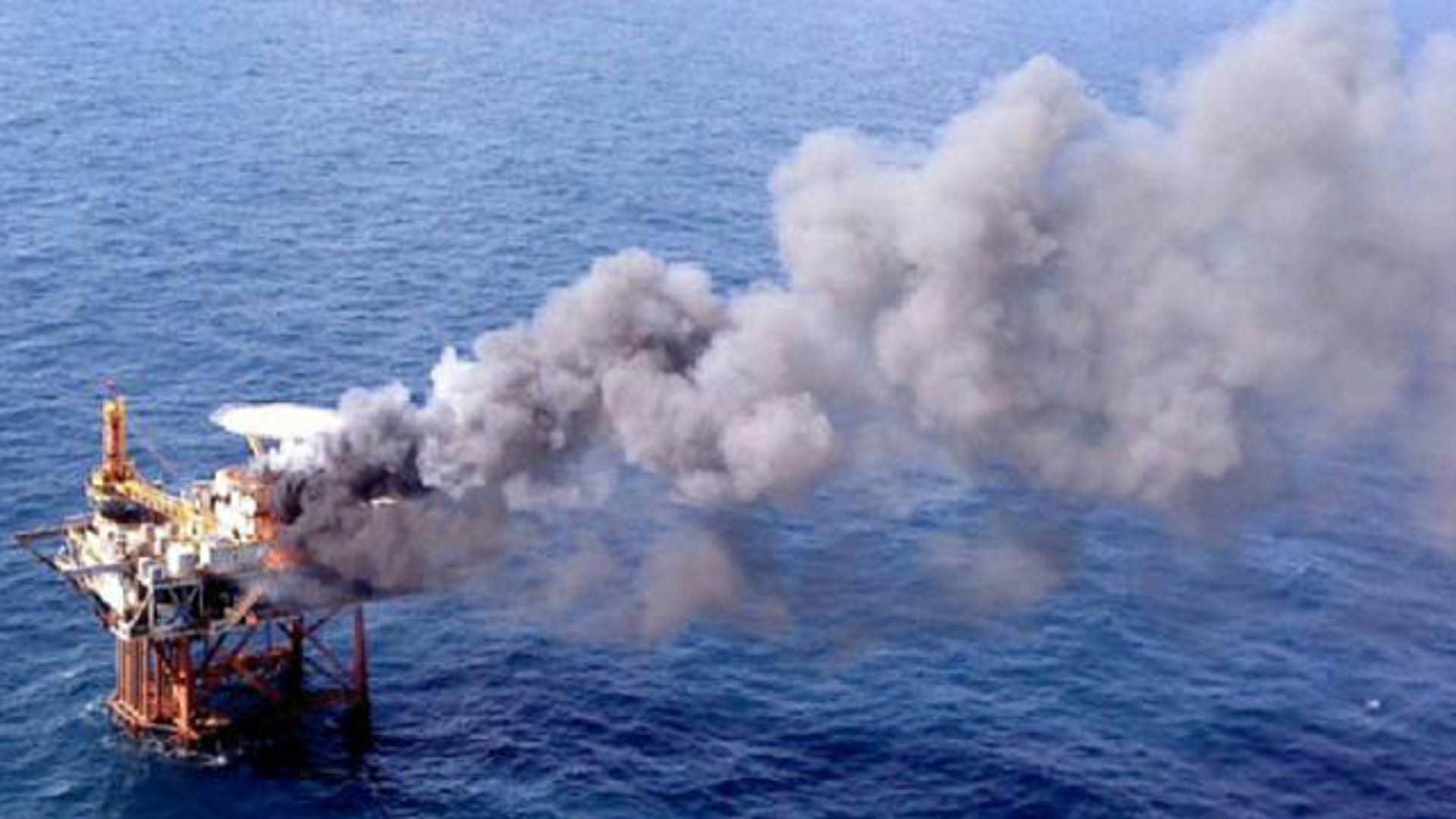
The coffee in the breakroom at the Jizan refinery is usually bitter, a dark necessity for men who live their lives by the rhythmic pulse of high-pressure valves and the low hum of heavy industry. For the night shift, the world is a grid of steel and shadow. It is a predictable universe. You check the gauges. You listen for the hiss of a leak. You watch the flickering orange glow of the flare stacks against the Red Sea.
Then the sirens scream.
It is a sound that cuts through the mechanical drone, a jagged edge of noise that tells every worker that the border is no longer just a line on a map. It is a physical presence. On this particular night in southwestern Saudi Arabia, the "missile debris" reported in the morning wires wasn't just a technical footnote. It was a rain of jagged, white-hot metal that turned a billion-dollar feat of engineering into a frantic battlefield of fire and foam.
The Calculus of a Falling Star
War in the modern age has a strange, detached geometry. From a distance, an intercept looks like a celebration—a bloom of light, a silent flash, a streak of a Patriot missile chasing a ghost. But gravity is a stubborn auditor. What goes up, even if shattered into a thousand pieces by a successful interception, must eventually find a home on the ground.
In Jizan, that home was the Aramco refinery.
When the remnants of the projectile struck, they didn't just hit a building. They hit a node in the global central nervous system. We talk about oil in terms of barrels, benchmarks, and Brent Crude prices, but in that moment, the stakes were measured in the heat radiating off a storage tank.
Fire is a living thing. In a refinery, it is a monster kept in a very small cage. When debris pierces that cage, the monster grows. The initial reports were sanitized, stripped of the adrenaline and the smell of burning synthetics. They spoke of a "limited fire." But there is nothing limited about the terror of standing next to thousands of gallons of combustible fuel while the sky is still falling.
The Invisible Pipeline to Your Pocket
Most people reading the news in London, New York, or Tokyo saw a headline about a fire and kept scrolling. They didn't feel the heat. They didn't hear the frantic radio chatter of the emergency crews. Yet, the invisible threads of the global economy mean that a spark in Jizan vibrates through every gas pump on the planet.
Security isn't just about walls and soldiers anymore. It’s about the terrifying fragility of the things we take for granted. We live in a world where a drone or a missile—often costing less than a mid-sized sedan—can threaten an infrastructure project that powers entire cities.
Consider the hypothetical technician, let's call him Ahmed. Ahmed has a wife and three daughters in a quiet neighborhood ten miles from the plant. When the impact happened, Ahmed didn't think about the price of oil. He didn't think about regional geopolitics or the complex dance between the Saudi-led coalition and the Houthi rebels in Yemen.
He thought about the pressure gauge on Tank 42.
If the pressure rises too fast, the safety valves blow. If the valves blow near an open flame, the refinery becomes a sun. Ahmed stayed. Not because he is a soldier, but because he is a steward of the machine. The narrative of "missile debris" masks the reality that these facilities are manned by people who have become the front line of a conflict they didn't choose.
The War of Attrition in the Clouds
The strikes on Saudi energy infrastructure have become a grim routine, a steady drumbeat of escalation designed to prove a point: nowhere is safe. This isn't a traditional war of territory; it is a war of nerves.
The strategy is simple. You don't need to destroy the refinery to win. You just need to make it too expensive to insure. You just need to make the workers look at the sky every time they hear a loud noise. You just need to create enough "debris" to keep the markets twitchy and the headlines constant.
It is a psychological siege.
We see the statistics—hundreds of drones intercepted, dozens of missiles neutralized. We treat it like a video game. But the reality is found in the charred remains of a cooling tower. It’s found in the soot that covers the uniforms of the fire crews who spent their dawn hours wrestling a chemical beast into submission.
There is a profound irony in the fact that the very resource that built the modern world is now its most vulnerable target. We are tethered to these sites. Our mobility, our warmth, and our food supply are all hostages to the trajectory of a falling piece of scrap metal.
Beyond the Smoke
By the time the sun rose over the Red Sea, the fire was out. The official statements were released, polished and professional. "No casualties," they said. "No impact on supply," they assured.
The markets breathed a sigh of relief. The price of oil ticked down a fraction of a percent. The world moved on to the next crisis, the next viral video, the next political spat.
But at the refinery, the silence was different. It was the silence of a close call.
Maintenance crews moved in to inspect the damage, their boots crunching on the fragments of the missile that had caused the chaos. These pieces of metal, twisted and blackened, are the modern artifacts of our era. They are the physical proof that the distances we think protect us are an illusion.
We often believe we are spectators to history, watching events unfold on a screen from the safety of our living rooms. We aren't. We are all downstream of that fire. We are all connected to the technician who stayed at his post, the pilot who fired the interceptor, and the faceless person who pushed the launch button hundreds of miles away.
The fire in Jizan was eventually extinguished, but the heat remains. It lingers in the geopolitical tension that never quite cools. It stays in the eyes of the men who go back to work the next night, checking the gauges, drinking the bitter coffee, and occasionally, despite themselves, glancing up at the stars to see if any of them are moving.
The sky is vast, but it has never felt smaller.