.jpg?width=1200&auto=webp&crop=3%3A2)
The failure of the United States Senate to pass a resolution limiting executive war powers regarding Iran is not a mere binary political outcome; it is a manifestation of the structural tension between Article I and Article II of the Constitution, filtered through the lens of modern geopolitical risk management. By voting down the measure intended to block unauthorized military escalation, the Senate signaled a preference for executive flexibility over legislative constraint, effectively validating a "deterrence-by-uncertainty" model in the Persian Gulf. This decision rests on three distinct pillars: the erosion of the War Powers Resolution of 1973, the expansion of the "imminent threat" doctrine, and the internal political calculus of risk-shifting.
The Erosion of the War Powers Framework
The legislative attempt to curb the executive branch relied on the War Powers Resolution of 1973 (WPR). Theoretically, the WPR serves as a circuit breaker, requiring the President to consult Congress before introducing U.S. Armed Forces into hostilities. In practice, the resolution has been hollowed out by decades of executive overreach and judicial silence.
The primary failure point in the recent Senate debate was the definition of "hostilities." The Executive Branch consistently interprets this term to exclude targeted strikes, drone operations, or brief skirmishes that do not involve sustained ground troop presence. This creates a legal gray zone where the President can execute high-impact military actions—such as the strike on Qasem Soleimani—without triggering the 60-day clock mandated by the WPR.
By voting down the resolution, the Senate implicitly accepted the Executive’s narrow definition. This preserves a status quo where the "introduction of forces" is viewed through a 20th-century lens of troop deployments, ignoring the reality of 21st-century kinetic actions. The result is a legislative body that has functionally outsourced its Article I, Section 8 power—the power to declare war—to the Office of the Legal Counsel (OLC) within the Department of Justice.
The Imminent Threat Doctrine and the Cost of Miscalculation
Central to the debate was the invocation of "self-defense" as a justification for bypassing congressional approval. Under international law and Article II of the Constitution, the President possesses the inherent authority to defend the nation against an imminent attack. However, the definition of "imminence" has undergone a radical expansion, shifting from a "seconds-to-impact" requirement to a "pattern of behavior" analysis.
- The Strategic Paradox: If the Senate restricts the President’s ability to respond to Iran, it risks signaling weakness to Tehran, potentially inviting the very aggression the resolution seeks to avoid.
- The Intelligence Asymmetry: Senators often lack the granular, real-time intelligence data held by the Executive. This creates a psychological barrier to voting for a restriction; the fear of being proven wrong by a subsequent attack outweighs the desire for constitutional consistency.
- The Deterrence Function: Maintaining an "all options on the table" posture requires the credible threat of force. A Senate-imposed restriction acts as a visible ceiling on that threat, theoretically diminishing the United States' bargaining power in non-kinetic negotiations.
The rejection of the resolution suggests that a majority of the Senate views the risk of executive overreach as less catastrophic than the risk of a perceived security vacuum. They have prioritized the utility of force over the legitimacy of its authorization.
The Political Calculus of Risk-Shifting
Legislative bodies are fundamentally risk-averse institutions. Voting for a war-limiting resolution requires taking "ownership" of the resulting foreign policy outcomes. If a Senator votes to restrict the President and Iran subsequently attacks U.S. assets, that Senator bears direct political responsibility. Conversely, by voting down the resolution, the Senate leaves the responsibility entirely with the White House.
This dynamic creates a "Responsibility Sink." The Executive is willing to take the risk for the sake of operational speed, and the Legislature is willing to let them, provided they can criticize the outcome if it fails. This is not a failure of the system; it is the system operating as an equilibrium of blame-avoidance.
Structural Dependencies and the Iranian Feedback Loop
The Senate's decision cannot be viewed in isolation from the broader regional architecture. The United States' posture toward Iran is tied to a complex web of variables, including maritime security in the Strait of Hormuz, the stability of the Iraqi government, and the security of regional allies.
The Strait of Hormuz Variable
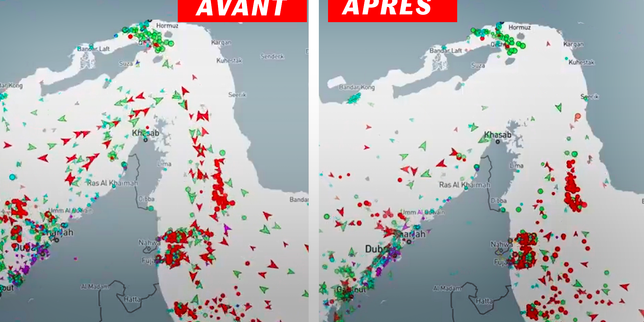
Approximately 20% of the world’s petroleum liquids pass through the Strait of Hormuz. Any legislative signal that suggests a hamstrung U.S. military response can lead to immediate volatility in global energy markets. The Senate’s refusal to pass the resolution serves as a "market-stabilization" vote, assuring commercial shipping interests that the U.S. naval presence remains backed by an unencumbered executive mandate.
The Iraqi Sovereignty Constraint
The legal basis for U.S. presence in the region is often predicated on invitations from host nations or specific counter-terrorism authorizations (such as the 2001 and 2002 AUMFs). Iran-backed militias frequently target U.S. personnel in Iraq to force a withdrawal. The Senate’s vote reinforces the "force protection" argument: the idea that as long as U.S. troops are in the line of fire, the President must have the unilateral authority to strike back at the source of the threat, regardless of national borders or formal declarations of war.
The Functional End of the 2002 AUMF as a Limiting Factor
While the resolution specifically addressed Iran, the underlying tension involves the 2002 Authorization for Use of Military Force (AUMF) Against Iraq. The Executive Branch has frequently "stretched" this authorization to cover actions against Iranian-aligned actors within Iraqi territory. The failure to pass a new, restrictive resolution effectively grants a "legacy license" for continued operations under outdated authorizations.
This creates a cumulative legal precedent. Each time the Senate declines to assert its authority, the "Zone of Twilight"—a term coined by Justice Robert Jackson in Youngstown Sheet & Tube Co. v. Sawyer—expands in favor of the President. When Congress remains silent or fails to act, executive power is at its maximum because it includes all the discretionary power of the President plus the implied acquiescence of the Legislature.
Quantitative Implications of Legislative Inaction
The absence of a formal war-limiting resolution has measurable impacts on defense budgeting and long-term strategic planning.
- Overseas Contingency Operations (OCO) Funding: Without a clear definition of the conflict’s boundaries, the "War on Terror" funding mechanisms remain elastic, allowing for the shifting of billions of dollars toward Iran-focused containment without specific line-item debates.
- Resource Allocation: The military must maintain a "Dual-Track" readiness posture—prepared for both low-intensity proxy warfare and high-intensity conventional conflict. The Senate's vote ensures that the Department of Defense continues to prioritize flexible, rapid-response capabilities over a more focused, containment-oriented force structure.
- The Opportunity Cost of Oversight: Every hour spent debating a non-binding or failed resolution is an hour not spent on the rigorous reform of the underlying authorizations (AUMFs). The Senate has chosen symbolic confrontation over systemic overhaul.
The logical conclusion of this trajectory is the normalization of "Permanent Pre-War." The United States is neither at war with Iran in a constitutional sense nor at peace in a functional sense. The Senate has codified this middle state by refusing to draw a definitive line.
Future legislative efforts must move beyond the "Stop the War" rhetoric and instead focus on the "Definition of Hostilities." Until the legal language of the 1973 War Powers Resolution is updated to include cyber-warfare, drone strikes, and "gray zone" kinetic actions, the Executive will continue to operate with a de facto blank check. The strategic play for those seeking to rebalance power is not the repeal of specific actions, but the precise, technical narrowing of the "imminent threat" and "hostilities" definitions in federal law. Without this, the Senate remains a spectator in the theater of modern war.