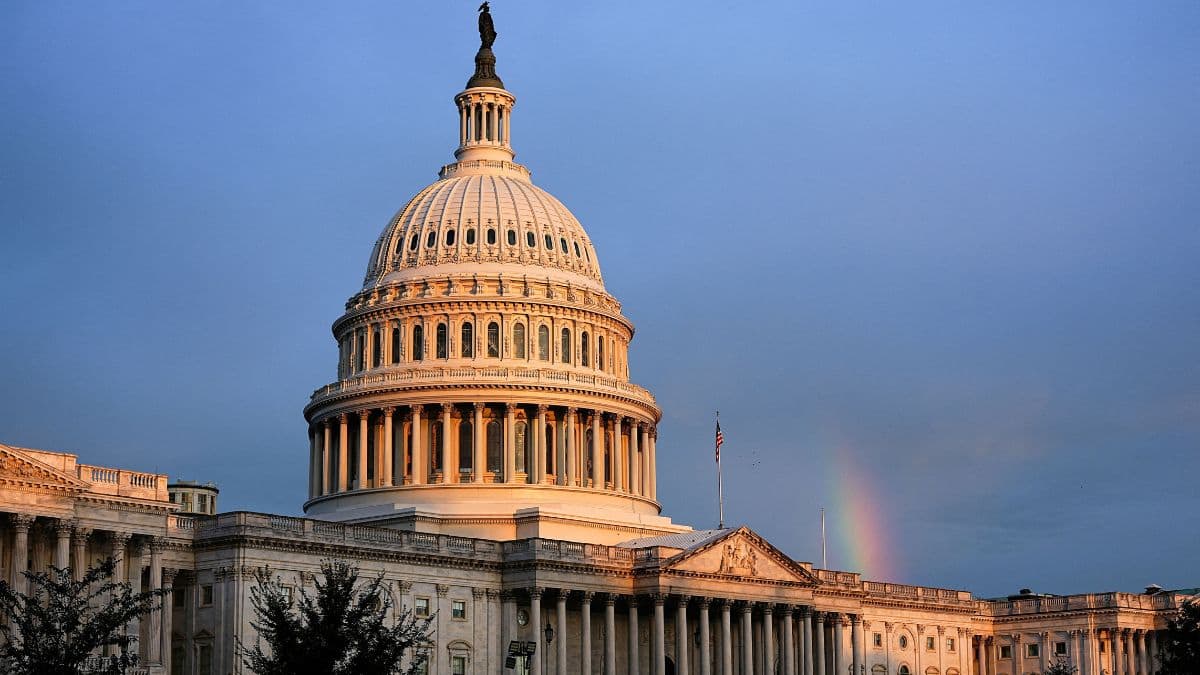
The current legislative push within the US Congress to restrict executive war powers marks a fundamental shift in the domestic management of geopolitical risk. While public discourse focuses on the immediate threat of escalation in West Asia, the underlying conflict is a structural struggle over the War Powers Resolution of 1973 and its application to modern, non-linear warfare. The strategic intent of these legislative maneuvers is to re-establish a "friction cost" for military engagement, forcing the executive branch to internalize the political and legal risks of kinetic intervention before the first strike occurs.
The Triad of Executive War-Making Authority
To analyze the current tensions, one must first deconstruct the legal architecture that allows the President to bypass a formal declaration of war. The executive branch operates under three primary pillars of authority, each providing a different level of maneuverability:
- Article II Constitutional Authority: This provides the Commander-in-Chief the power to repel sudden attacks. The ambiguity lies in the definition of "imminent threat," which has expanded over the last two decades to include preemptive strikes against non-state actors.
- The 2001 Authorization for Use of Military Force (AUMF): Originally intended to target those responsible for the September 11 attacks, this statute has become a "blank check" for global counter-terrorism. Its lack of geographic or temporal boundaries creates a legal loophole for operations across West Asia.
- The 2002 AUMF (Iraq): While ostensibly focused on the Saddam Hussein regime, this authorization remains on the books, providing a secondary legal layer for operations within Iraqi borders, including strikes against Iranian-backed militias.
The Congressional vote is not merely a protest; it is a targeted strike against the "zombie" authorizations (2001 and 2002 AUMFs) that permit perpetual executive action without renewed debate.
Escalation Cycles and the Feedback Loop of Deterrence
The tension in West Asia is driven by a failure of the traditional deterrence model. In classical game theory, deterrence requires Capability, Credibility, and Communication. The current friction arises because the "Communication" component is fragmented between a White House attempting to signal restraint and a Congress signaling internal division.
The kinetic exchanges—ranging from drone strikes on logistics hubs to naval interdictions in the Red Sea—follow a predictable Escalation Ladder. Each rung represents an increase in the intensity of force:
- Rung 1: Gray Zone Operations: Cyberattacks, proxy funding, and maritime harassment.
- Rung 2: Proportional Response: Targeted strikes on unmanned assets or empty facilities to "send a message" without causing casualties.
- Rung 3: Structural Degradation: Strikes on Command and Control (C2) nodes and ammunition storage, intended to limit the adversary’s physical ability to strike.
- Rung 4: Direct Confrontation: Open engagement between sovereign militaries.
Congress intervenes at Rung 2 and 3 because the War Powers Resolution triggers a 60-day "clock" once hostilities are introduced. By forcing a vote, legislators are attempting to stop the momentum before it reaches Rung 4, where the political cost of withdrawal becomes prohibitively high.
The Economic and Logistical Cost Function of Prolonged Conflict
Military strategy in West Asia cannot be divorced from the logistical realities of global trade. The "West Asia Tensions" are, at their core, an assault on the Sea Lines of Communication (SLOC).
When Congress debates war powers, they are implicitly debating the protection of the Suez Canal and the Bab al-Mandab Strait. The cost function of this conflict is measured in three variables:
- Insurance Premiums (I): The surge in War Risk Insurance for commercial vessels.
- Rerouting Costs (R): The fuel and time expenses of bypassing the region via the Cape of Good Hope.
- Depletion Rates (D): The cost of using million-dollar interceptor missiles (like the SM-2 or Sea Viper) to down thousand-dollar "suicide" drones.
$$Total Cost = I + R + D$$
The mismatch in variable D creates a fiscal trap. The US military is currently trading expensive, finite interceptor inventory for cheap, mass-produced adversary assets. Legislative intervention seeks to prevent this tactical success from becoming a strategic failure through resource exhaustion.
Structural Bottlenecks in the War Powers Resolution
The War Powers Resolution (WPR) is often criticized as "toothless," but its primary function is to create a political bottleneck. Under Section 5(b), the President must terminate any use of US Armed Forces within 60 days unless Congress has declared war or provided a specific authorization.
The bottleneck occurs because the definition of "hostilities" is not legally settled. The Executive branch frequently argues that intermittent strikes or support roles (such as aerial refueling or intelligence sharing) do not constitute "hostilities."
The current legislative push aims to close these definitions:
- Defining "Hostilities": Including any kinetic exchange, regardless of the presence of "boots on the ground."
- Automatic Funding Cutoffs: Linking the 60-day clock to the Treasury, effectively de-funding unauthorized missions.
- Reporting Requirements: Moving from qualitative descriptions to quantitative data on strike frequency and casualty counts.
The Regional Power Vacuum and the Proxy Paradox
A significant risk ignored by the competitor's narrative is the Proxy Paradox. By limiting the President's ability to use direct force, Congress may inadvertently incentivize "proxy-only" warfare.
In West Asia, this manifests as increased reliance on regional partners to conduct kinetic operations. While this reduces the risk to US personnel, it increases Principal-Agent Risk. The "Agent" (the regional partner) often has different end-state goals than the "Principal" (the US).
For example, a regional partner might seek total regime change in a neighboring state, whereas US strategic interest might only require the cessation of maritime attacks. When the US provides the hardware but lacks the legal authority to manage the "software" (the tactical execution), the risk of uncontrolled escalation increases.
The Strategic Path Forward: Integrating Diplomacy with Credible Constraint
The resolution of the West Asia crisis requires a shift from Reactive Tactics to Structured Strategy. The objective of the US Congress should not be the total removal of executive power—which would paralyze the state during a genuine crisis—but the implementation of Conditional Authorization.
This framework involves:
- Sunset Clauses: Any authorization for force in West Asia must expire every 12 to 24 months, forcing a public debate and a fresh mandate.
- Geographic Geo-fencing: Explicitly limiting operations to specific maritime corridors or border zones to prevent "mission creep."
- Tiered Transparency: Monthly briefings to the "Gang of Eight" that quantify the effectiveness of strikes against the stated goal of deterrence.
The legislative body must recognize that "No Vote" is a choice in itself. By avoiding a definitive stand on war powers, Congress allows the Executive to set a precedent that will be utilized by future administrations, regardless of party. The immediate priority is the repeal of the 2002 AUMF to remove the legal "safety net" that allows for intervention in Iraq and Syria without contemporary justification.
Short-term stability in West Asia depends on the perception of US resolve. However, long-term national security depends on the integrity of the constitutional process. The most effective deterrent is not a President with an unlimited mandate, but a government that demonstrates the unified legal and political will to act when necessary. This requires the Executive to present a clear, data-backed case for intervention and for Congress to either validate that case with an authorization or reject it with a formal withdrawal of funds.
The move toward a vote is the first step in rebalancing the scales of the "Imperial Presidency." Success is defined by a return to a system where military action is the result of a deliberate, public, and legally sound national consensus rather than an administrative default.