The keys always feel heavier when you know you might never turn them in a lock again. For a family in the southern suburbs of Beirut, that weight isn't metaphorical. It is a physical pull on the pocket, a cold piece of metal that represents a lifetime of saved wages, wedding photos left in a drawer, and the specific scent of a kitchen that no longer exists.
War is often described in the sterile language of geometry. We hear about "buffer zones," "axes of advancement," and "vectors of displacement." But a buffer zone isn't a line on a map. It is a hollowed-out space where grandmothers used to hang laundry. It is a perimeter of silence enforced by the whistle of descending iron. When the Israeli military announced the formal creation of a "zone tampon" in Southern Lebanon, they weren't just drawing a boundary. They were erasing a geography of home.
The Architecture of Absence
Consider the mechanics of a "secure perimeter." To the strategist in a reinforced concrete basement in Tel Aviv, the logic is sound. If you push the threat back by twenty kilometers, the rockets have a harder time finding their mark. It is a mathematical equation of safety. But equations don't account for the dust.
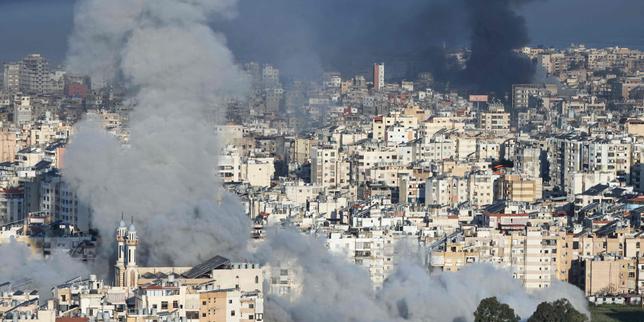
The latest strikes on the southern suburbs of Beirut—the Dahiyeh—are not merely tactical strikes on infrastructure. They are the punctuation marks at the end of a long, grueling sentence. Each explosion sends a plume of pulverized concrete into the Mediterranean air, a gray shroud that settles on everything. This is the "zone" in its infancy. It begins as fire and ends as a void.
The Israeli military justifies these maneuvers as a necessity for the return of their own displaced citizens in the north. It is a tragic symmetry. To make one side feel safe enough to sleep, the other side must be kept awake by the drone of constant surveillance. One person's security becomes another person's exile. This is the invisible cost of the "zone." It is a trade-off where the currency is human belonging.
The Geography of the Displaced
If you walk through the makeshift shelters now lining the streets of central Beirut, you see the reality of the map. People aren't just moving; they are vibrating with a specific kind of trauma. There is the man who carries a birdcage because it was the only thing he could grab before the ceiling bowed. There is the woman who keeps checking her phone for a signal that will never come from a neighborhood that is currently being reshaped by 2,000-pound bombs.
The "buffer zone" effectively turns a sovereign landscape into a laboratory of deterrence. In this space, the ordinary rules of life are suspended. Schools become barracks. Olive groves become minefields. The ground itself is treated as a liability.
The world watches this through a lens of "escalation management." We track the price of oil and the diplomatic cables flying between Washington and Tehran. We wonder if Iran will retaliate, or if the "red lines" have been blurred into a muddy brown. But for the people under the flight path, there are no red lines. There is only the sky, and what might fall from it.
The Ghost in the Machine
We often talk about these conflicts as if they are a game of chess played by grandmasters. We focus on the "Hezbollah infrastructure" or the "IDF capabilities." But this perspective ignores the ghost in the machine: the sheer, grinding exhaustion of a population that has been told to "evacuate" for three generations.
When an army tells a city to leave, where does the city go? Beirut is already a vessel overflowing. The infrastructure is a patchwork of scars. The electricity is a rumor. The economy is a ghost story. Into this fragility, the new military reality drops like a stone into a cracked mirror.
The creation of a buffer zone is a confession. It is an admission that diplomacy has failed so utterly that the only remaining solution is physical distance. It is the ultimate "un-neighboring." By clearing the land, you aren't just removing a military threat; you are removing the possibility of a shared future. You are saying that the only way to coexist is to ensure that you cannot see one another.
The Weight of the Silence
There is a specific sound that follows a heavy bombardment. It isn't the explosion itself—that is a sharp, deafening crack that fills the lungs. The real sound of the "zone" is the silence that follows. It is the sound of a street where no cars are moving, where no shop shutters are being raised, where the only thing moving is the wind through broken glass.
Israel’s military leaders speak of this as a "new phase." In the language of war, a new phase usually means more of the same, just deeper. More precision, which is a polite word for more destruction. More "clearing," which is a polite word for more displacement.
The stakes aren't just about who controls a ridge or a valley. The stakes are the internal maps we all carry. When your home becomes a "buffer," your identity becomes an "interruption." You are no longer a citizen, a teacher, or a father. You are a demographic variable to be moved across a board.
As the strikes continue to hammer the southern suburbs, the dust settles on the statues in Martyrs' Square. The city waits. It has waited before. But this time, the silence feels different. It feels like the map is being redrawn in ink that won't dry, carving out a space where nothing is allowed to grow, where no one is allowed to stay, and where the only thing left is the heavy, cold weight of a key that no longer has a door.
The red line isn't on the map. It's in the heart of a child wondering why the horizon is glowing at midnight.