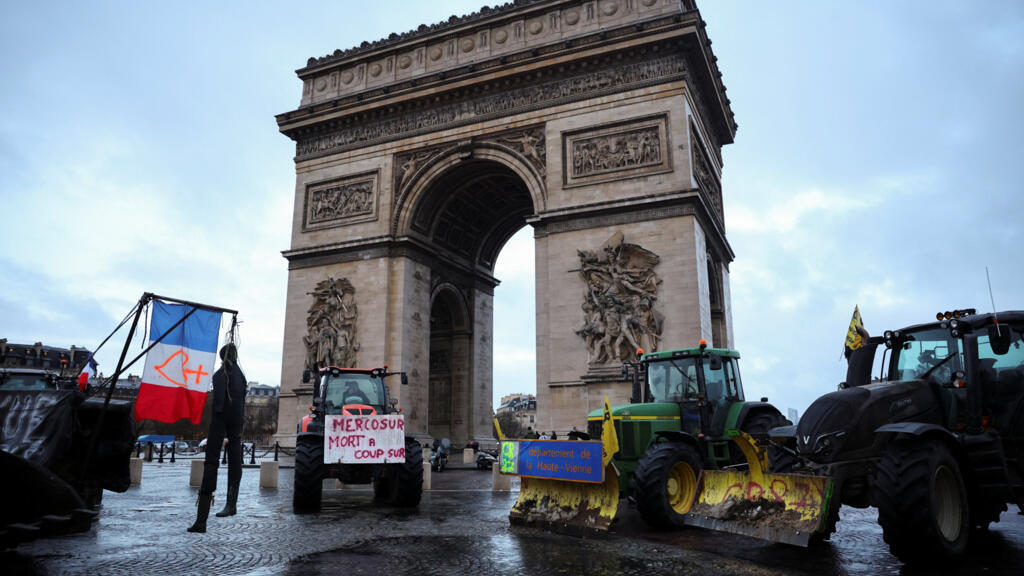
The declaration of illegality by the French government regarding the agrarian blockade of Paris represents a collision between two incompatible systems: the rigid, centralized logistics of a globalized capital and the decentralized, high-mass physical power of agricultural machinery. While the state frames the conflict through the lens of legal transgression, the true battle is being fought over Supply Chain Velocity and Urban Access Friction. When a tractor occupies a lane on the A1 or A6 motorway, it is not merely a symbolic protest; it is a calculated injection of inertia into a system that requires near-zero latency to function.
The Mechanism of Modern Siege
Traditional blockades relied on walls to keep resources out. The modern agrarian blockade utilizes the "Just-in-Time" (JIT) vulnerability of the Paris metropolitan area. Paris, like most Tier-1 global cities, maintains an incredibly low Inventory-to-Sales Ratio for perishable goods. Most supermarkets in the urban core operate on a 24-to-48-hour replenishment cycle.
By positioning heavy machinery at "choke points"—specifically the convergence of the A1 (North), A4 (East), A6 (South), and A13 (West)—protesters are manipulating the Marginal Cost of Transit.
The effectiveness of this strategy is governed by three primary variables:
- Mass-to-Space Displacement: A standard Class 8 tractor occupies approximately 2.5 times the footprint of a passenger vehicle but possesses significantly higher "removal friction" due to weight and specialized towing requirements.
- Network Redundancy Exhaustion: As primary arteries are severed, traffic bleeds into secondary and tertiary roads. These routes lack the throughput capacity to handle diverted heavy goods vehicles (HGVs), leading to systemic "Gridlock Contagion."
- The Rungis Variable: The Rungis International Market serves as the central nervous system for European food distribution. It is the largest wholesale market in the world. Forcing a slowdown at Rungis does not just starve Paris; it creates a bullwhip effect that disrupts pricing across the Eurozone.
The Legal Framework vs. Kinetic Reality
The government's labeling of the protest as "illegal" is a tactical attempt to lower the threshold for the use of the Gendarmerie Nationale. Under French law, the right to protest is protected, but it is not absolute. It is balanced against the "Freedom of Movement" and "Public Order."
The state’s move to deploy armored vehicles (VBRGs) near Rungis and Paris airports signals a shift from negotiation to Asset Protection. In a strategic context, the government is identifying "Critical Nodes" that, if compromised, would lead to a total loss of administrative control.
- Node A: Rungis Market. If the flow of calories stops, the political cost of the protest climbs exponentially.
- Node B: Roissy-Charles de Gaulle and Orly. These are the primary conduits for high-value, low-weight trade and international mobility.
- Node C: The Périphérique. The ring road is the final defensive perimeter. Once tractors breach this line, the police lose the ability to use "containment" tactics and must switch to "eviction" tactics, which carry much higher risks of escalation and injury.
The Economic Cost Function of Agrarian Unrest
To understand why farmers are willing to risk the "illegal" label, one must analyze the Input-Output Distortion currently plaguing French agriculture. The protesters are not fighting against a single law; they are fighting against a compressed margin caused by three converging factors:
- Regulatory Divergence: French farmers are subject to the "Ecophyto" plan and various EU-wide "Green Deal" mandates. These regulations increase the Operational Expenditure (OPEX) per hectare. Simultaneously, trade agreements (such as the proposed Mercosur deal) allow for the import of products from regions with significantly lower regulatory overhead.
- Energy Arbitrage: The removal of tax breaks on GNR (Non-Road Diesel) directly attacks the primary energy source of agricultural production. In a sector where fuel accounts for a double-digit percentage of total costs, a sudden tax hike acts as a regressive tax on production.
- Price Inelasticity: Retailers and processors often hold more bargaining power than individual producers. When costs rise, farmers cannot easily pass those costs down the chain due to "Loi Egalim" complexities and international competition.
The protest is an attempt to force a Value Redistribution. By creating an artificial scarcity of road space, farmers are leveraging their only remaining asset: their ability to halt the economy.
Strategic Asymmetry: Tractors as Tactical Assets
The choice of the tractor as a tool of protest is a masterclass in Tactical Asymmetry.
A police line can easily disperse a crowd of people using tear gas or water cannons. However, a 5-ton piece of machinery is functionally immune to most non-lethal crowd control measures.
- Durability: Tractors are designed for harsh environments and high-torque operations. They are difficult to move without the driver's cooperation.
- Protection: The cab provides a physical barrier for the operator, shielding them from environmental and external pressures.
- Force Multiplication: A dozen tractors can effectively close a four-lane highway that would otherwise require hundreds of protesters to block.
The government’s "illegal" designation is a prerequisite for the use of heavy-duty towing equipment and the potential seizure of private property. However, the logistics of seizing hundreds of tractors simultaneously are non-existent. There is no "Tractor Pound" large enough to house the fleet, nor are there enough heavy-haulage operators willing to risk the ire of the agricultural community to move them.
The Failure of the "Centralized Solution"
The French government's response has historically been to offer Direct Subsidies or temporary tax breaks. This is a "Patch-Based" approach to a "Systemic Architecture" problem.
The fundamental issue is the Regulatory Friction between the European Union’s environmental goals and the French state’s need for food sovereignty. The EU's "Farm to Fork" strategy aims to reduce pesticide use by 50% and dedicate 25% of land to organic farming by 2030. While environmentally sound in a vacuum, these goals do not account for the Global Competitive Parity required to keep French farms solvent.
Modeling the Escalation Path
If the blockade persists, the conflict will evolve through three distinct phases:
Phase 1: Friction (Days 1-3)
Commuter delays, minor delivery laggards, and high media visibility. The state uses rhetoric to delegitimize the movement.
Phase 2: Scarcity (Days 4-7)
Stockouts of fresh produce begin in central Paris. The "Just-in-Time" delivery model breaks down. Public sentiment begins to shift from "Sympathy with the Farmer" to "Frustration with the State."
Phase 3: Critical System Failure (Day 8+)
Rungis market operations cease. The government is forced to choose between a massive kinetic clearance operation—which risks turning farmers into martyrs—or a total capitulation to agricultural demands, which would signal weakness to other labor sectors (e.g., transport, energy).
The Bottleneck of Legitimacy
The government's insistence on the "illegal" nature of the protests is an attempt to control the Narrative Capital. By framing the farmers as lawbreakers, the state justifies the deployment of the CRS (Compagnies Républicaines de Sécurité). Yet, this ignores the Moral Legitimacy the farmers hold in the French psyche. Agriculture is not just a sector; it is a pillar of national identity.
The state is currently trapped in a Strategic Dilemma:
- Action: Forcefully clearing the landmarks and motorways ends the blockade but risks a nationwide strike and violent escalation.
- Inaction: Allowing the blockade to continue proves the state is unable to secure its own capital, leading to a collapse in administrative authority.
Strategic Play: The Path to De-escalation
To resolve the impasse without systemic collapse, the government must move beyond the "illegal" label and address the Structural Deficit of the agricultural sector.
The play is not a one-time payment. It requires a Regulatory Moratorium.
- Immediate Freeze on GNR Tax Hikes: This restores the immediate cash flow of the farms.
- Emergency "Egalim" Enforcement: Triggering immediate audits of retail and processing margins to ensure price increases at the shelf are being reflected at the farm gate.
- The "Clause de Sauvegarde" (Safeguard Clause): Invoking EU provisions to temporarily restrict imports from countries that do not meet French production standards.
The current blockade is a physical manifestation of a digital and economic misalignment. Until the Cost of Compliance is lower than the Cost of Rebellion, the tractors will remain. The government's best move is to stop fighting the blockade and start fixing the broken incentive structures that made the blockade the only logical choice for the producer.