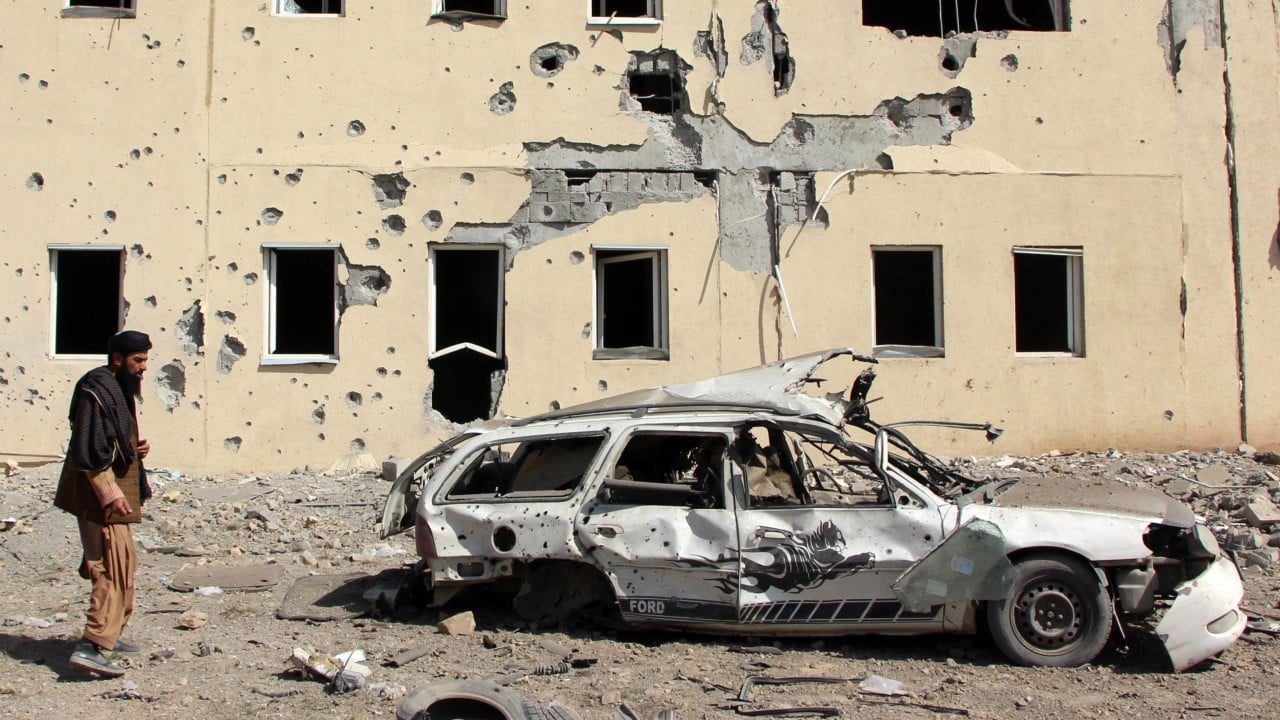
The strategic equilibrium in the Middle East has shifted from a "gray zone" shadow war to a high-velocity kinetic confrontation defined by a three-axis escalation ladder. Understanding the current conflict between the United States, Israel, and Iran requires moving beyond surface-level political rhetoric to analyze the structural mechanics of regional deterrence, the technical constraints of missile defense, and the economic friction points that dictate Beijing's intervention threshold. The current theater is not a series of isolated skirmishes but a synchronized stress test of the "Axis of Resistance" against the integrated air defense systems (IADS) of the West.
The Tri-Axis Escalation Framework
To quantify the current trajectory, the conflict must be viewed through three distinct operational layers. Each layer possesses its own set of triggers and de-escalation off-ramps.
1. The Proxy-Sovereign Interface
For decades, Iran utilized a "forward defense" strategy, employing non-state actors like Hezbollah in Lebanon, the Houthis in Yemen, and various militias in Iraq to create a buffer. This system allowed Tehran to project power while maintaining plausible deniability. The October 7 attacks and the subsequent Israeli response in Gaza and Lebanon have collapsed this deniability. We are now seeing the "Sovereign-Direct" phase, where the principal actors—Israel and Iran—engage in direct territorial exchanges. This transition increases the risk of miscalculation because the traditional signaling mechanisms used in proxy warfare do not apply to direct ballistic missile exchanges.
2. The Integrated Air Defense Attrition Rate
The military viability of the US-Israel alliance rests on the cost-exchange ratio of interceptors versus incoming projectiles. Israel’s multi-layered defense—comprised of Iron Dome, David’s Sling, and Arrow 2/3—is technically superior but economically and logistically vulnerable.
- Iron Dome: Targets short-range rockets ($50,000 per interceptor).
- David’s Sling: Targets medium-range missiles ($1 million per interceptor).
- Arrow 3: Targets exo-atmospheric ballistic missiles ($3 million+ per interceptor).
Iran’s strategy focuses on "saturation strikes" designed to overwhelm these systems through sheer volume. When Iran launches a wave of 200+ drones and missiles, the goal is not necessarily to hit a specific target but to force the depletion of high-end interceptor stockpiles. The United States provides the critical logistics "bridge" here, but the production capacity for SM-3 and SM-6 missiles (standard on US Navy Aegis destroyers) is a finite resource. If the attrition rate of interceptors exceeds the monthly production rate of the Western defense industrial base, the defensive shield becomes porous.
3. The Maritime Choke-Point Constraint
The Red Sea and the Strait of Hormuz represent the primary economic levers in this conflict. The Houthi movement's use of low-cost anti-ship cruise missiles (ASCMs) and one-way attack (OWA) UAVs has effectively increased the "war risk insurance" premiums for global shipping. This is a form of asymmetric economic warfare where a non-state actor with $20,000 drones can disrupt a multi-billion dollar trade route.
China’s Strategic Calculus: The Energy-Security Paradox
Beijing’s reaction to a US-Israel-Iran war is governed by a fundamental tension between its energy dependency and its desire to displace US regional hegemony. China is the largest buyer of Iranian crude oil, much of it processed through "dark fleet" tankers and small independent refineries (teapots) in Shandong province.
The Energy Vulnerability Function
China imports roughly 70% of its crude oil. A full-scale war that shuts down the Strait of Hormuz would trigger a global supply shock that hits Beijing harder than Washington, given the United States' status as a net energy exporter. Consequently, China's "neutrality" is actually a managed effort to prevent total regional collapse while simultaneously using the conflict to overextend US military resources.
The Diplomatic Arbitrage
China utilizes the conflict to position itself as a "rational mediator" compared to what it characterizes as "Western destabilization." By brokering the Saudi-Iran rapprochement in 2023, Beijing signaled it is willing to provide a diplomatic alternative to the US security umbrella. However, China lacks the power projection capabilities (expeditionary carrier groups) to actually enforce security in the Persian Gulf. Their primary move is financial and diplomatic insulation, not military intervention.
Technical Limitations of the Iranian Counter-Strike
A data-driven assessment of Iran’s conventional capabilities reveals significant bottlenecks. While Iran possesses the largest ballistic missile arsenal in the region, its air force (IRIAF) is largely comprised of modernized 1970s-era airframes (F-4s, F-14s).
The Precision-Guidance Gap
Most of Iran's long-range strike capability relies on the Fattah and Kheibar Shekan missile families. While these feature Maneuverable Re-entry Vehicles (MaRVs), their Circular Error Probable (CEP)—a measure of accuracy—remains higher than Western equivalents. To destroy a hardened Israeli target (like an F-35 hangar), Iran must fire a larger volume of missiles to guarantee a "kill" probability.
The ISR Deficit
Iran lacks a robust satellite constellation for real-time Intelligence, Surveillance, and Reconnaissance (ISR). This means they rely on "pre-programmed" coordinates for fixed targets. They struggle to hit mobile targets or perform Battle Damage Assessment (BDA) in real-time. This forces them into a rigid, scripted style of warfare that Western electronic warfare (EW) suites are specifically designed to jam.
The Strategic Logic of Israeli Prematurity
Israel’s tactical decisions are driven by the "Begin Doctrine," which dictates that Israel will not allow any regional enemy to acquire weapons of mass destruction. The window for a conventional strike on Iran’s nuclear facilities at Natanz and Fordow is closing as Iran moves its enrichment centrifuges deeper underground.
The structural limitation here is distance. An Israeli strike on Iran requires:
- Refueling Capacity: Israel’s fleet of KC-707 tankers is aging, and the newer KC-46As are still being integrated.
- Airspace Sovereignty: A strike package must fly over Jordan, Saudi Arabia, or Iraq. This creates a diplomatic "friction cost" for the US, which must manage these bilateral relationships.
- Munition Penetration: Neutralizing Fordow requires "Bunker Buster" munitions like the GBU-57 Massive Ordnance Penetrator (MOP), which is currently only deployable by US B-2 bombers.
This creates a "Capability Dependency" where Israel can start a war with Iran, but only the United States can finish it at the structural level of neutralizing the nuclear program.
Economic Contagion and the Global Friction Point
A war involving the US and Iran would likely result in a "Risk-Off" event in global markets, but the mechanics differ from previous oil shocks.
- Cyber Warfare as a Multiplier: Iran’s cyber units (notably APT33) have demonstrated the ability to target ICS/SCADA systems in the energy sector. A kinetic war would be accompanied by a digital offensive targeting Western financial clearinghouses and regional desalination plants.
- The Insurance Bottleneck: If the Persian Gulf is declared a "total exclusion zone," global shipping capacity drops by 15-20% as vessels are rerouted around the Cape of Good Hope. This adds 10-14 days to transit times, creating a "bullwhip effect" in global supply chains that triggers a localized inflationary spike in the EU and Asia.
The Operational End-State
The conflict is currently in a state of Competitive Endurance. The US strategy is to provide a "Defensive Ceiling" (intercepting missiles) while allowing Israel to degrade Iran’s proxy infrastructure. Iran’s strategy is to increase the "Cost of Presence" for the US until domestic political pressure forces a withdrawal from Iraq and Syria.
The pivot point occurs when one side perceives that its "Strategic Depth" is being permanently eroded. For Israel, this is the nuclear threshold. For Iran, this is the total decapitation of Hezbollah’s leadership.
The tactical recommendation for regional observers is to monitor the deployment of US THAAD (Terminal High Altitude Area Defense) batteries. The presence of THAAD on Israeli soil signals a shift from "supportive defense" to "integrated combat operations," effectively tethering US personnel to the Israeli kinetic response. This is the ultimate "tripwire" that prevents a return to the gray zone and cements the transition into a high-intensity theater war.
Future stability depends not on a peace treaty, which is functionally impossible under the current Iranian clerical structure, but on the restoration of a "Balance of Terror" where the cost of a saturation strike is mathematically proven to exceed the potential gain. Until the US-Israel interceptor production outpaces Iranian missile replenishment, the region remains in a state of unstable equilibrium.