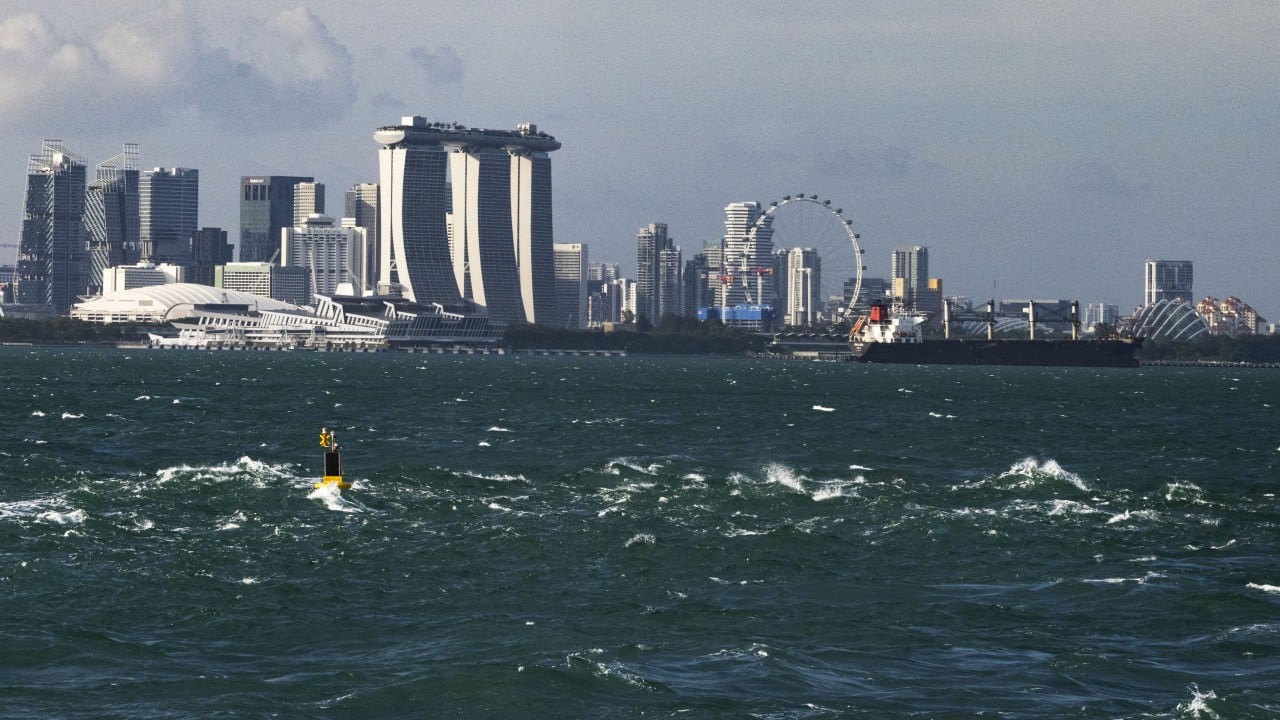
Singapore is currently performing the world’s most dangerous high-wire act. While Washington and Beijing trade insults and export controls, this tiny island nation is trying to be everyone’s best friend. It’s not about being indecisive. It’s about survival. If you think Singapore is just "splitting the difference," you’re missing the point of their entire foreign policy.
The old "same-same but different" mantra doesn't quite cut it anymore. The stakes have shifted from simple trade disagreements to a fundamental struggle over who writes the rules for the next century. For a country that depends entirely on global stability to keep its ports running and its banks full, this isn't a spectator sport. It’s a fight for the right to exist without picking a side that might eventually lose.
The Myth of Moving to the Middle
Most people think neutrality means standing exactly halfway between two points. That’s a mistake. Singapore’s version of neutrality is active, not passive. They aren't sitting still. They’re constantly recalibrating their weight based on which way the wind blows.
Take the military side of things. Singapore hosts a US Navy logistics command and lets American littoral combat ships and P-8 Poseidon aircraft rotate through its bases. That makes them a vital security partner for the West. But look at the ledger on the other side. China is Singapore’s largest trading partner. You can’t just turn off that tap without your economy crashing.
So, they do both. They sign defense pacts with the US while upgrading Free Trade Agreements with China. They buy F-35s from Lockheed Martin but welcome massive investments from Alibaba and Tencent. It’s a balancing act that requires a level of diplomatic finesse most larger nations couldn't pull off.
Why the US China Rivalry Hits Different in Southeast Asia
Washington often views the world through a "democracy versus autocracy" lens. Beijing views it through a "sovereignty and development" lens. Singapore effectively ignores both scripts. They look at the world through the lens of international law.
When Russia invaded Ukraine, Singapore was the only Southeast Asian nation to impose unilateral sanctions. They didn't do it because the US asked. They did it because they’re a small state. If big countries can just gobble up smaller neighbors because of "historical grievances," Singapore is in trouble. This principled stance gives them the moral high ground when they tell the US to stop being so provocative in the South China Sea, or when they tell China to respect the UN Convention on the Law of the Sea (UNCLOS).
The Tech War is the Real Battleground
The real friction isn't happening in the Taiwan Strait; it's happening in the silicon chips inside your phone. This is where Singapore’s "equidistance" gets messy. The US wants to cut China off from high-end semiconductors. China wants to build its own ecosystem.
Singapore sits right in the middle of this supply chain. They have a massive semiconductor manufacturing footprint. Globalfoundries and Micron have huge operations there. At the same time, Chinese tech giants are moving their regional headquarters to Singapore to escape the "Made in China" stigma and avoid US sanctions.
This puts the Singaporean government in a tough spot. They have to comply with US export controls to keep getting American tech, but they can't alienate the Chinese companies that provide thousands of local jobs. They’re basically trying to run two different operating systems on the same hardware. It’s stressful, it’s expensive, and it might not be sustainable forever.
What Singapore Gets Right That Others Get Wrong
You’ll hear analysts say that Singapore is "pro-China" one day and "pro-US" the next. Both are wrong. Singapore is unapologetically pro-Singapore.
They’ve mastered the art of "principled consistency." They don't change their tune depending on who is in the room. When Prime Minister Lawrence Wong or his predecessor Lee Hsien Loong go to Washington, they tell the Americans that China isn't going away and that the US needs to find a way to live with them. When they go to Beijing, they tell the Chinese that the US presence in Asia is a force for stability and that China needs to be a more responsible global actor.
This honesty builds trust. Both superpowers know exactly where Singapore stands. There are no surprises. In a world of "with us or against us" rhetoric, being the guy who tells the truth to both sides is a rare and valuable commodity.
The Economic Reality of Not Choosing
Let’s look at the numbers because they don't lie. The US is the largest source of Foreign Direct Investment (FDI) in Singapore. The value of US investment in Singapore is higher than US investment in China, India, and South Korea combined. That’s a staggering amount of skin in the game.
On the flip side, Singapore has been the largest foreign investor in China for years. They aren't just selling stuff to China; they’re building cities there, like the Suzhou Industrial Park and the Tianjin Eco-City.
If Singapore picks the US, they lose their biggest market and decades of invested capital. If they pick China, they lose their security umbrella and the primary engine of their financial sector. Choosing isn't an option. It’s a death sentence.
The Pressure is Revving Up
The problem is that the "middle ground" is shrinking. The US is increasingly using "friend-shoring," which basically means "move your factories to countries we like." China is pushing "dual circulation," which means "rely more on our own consumers and less on the outside world."
Singapore is feeling the squeeze in sectors like AI and biotechnology. If the US says, "you can't use our AI chips if you share the data with China," Singapore has to make a hard call. Usually, they try to create "clean rooms"—segregated spaces where Western tech and Chinese tech don't touch. But as the tech becomes more integrated, those walls are harder to build.
How to Navigate a Divided World
If you're a business leader or a policy wonk, there's a lot to learn from the Singaporean playbook. It isn't about being "neutral" in the sense of being invisible. It’s about being so useful to both sides that neither can afford to lose you.
First, diversify everything. Singapore doesn't rely on one food source, one energy source, or one trading partner. They get their water from Malaysia, their energy from Australia and Indonesia, and their tech from everywhere.
Second, stick to the rules. When you’re small, the law is your only shield. Singapore obsesses over international treaties. If you follow the rules, it’s much harder for a bully to pick a fight with you without looking like the bad guy.
Third, keep talking. Singapore’s greatest asset is its role as a "neutral convenor." This is where the historic Trump-Kim summit happened. This is where the Wang Yi and Jake Sullivan meetings often take place behind closed doors. By providing a safe space for rivals to talk, Singapore ensures that it remains relevant to the global power structure.
Stop waiting for the US and China to fix their relationship. It isn't happening anytime soon. Instead, watch how Singapore handles the next crisis. They’ve turned "not choosing" into a high-art form, and in a world that’s increasingly black and white, their shades of grey are the only thing keeping the global economy from fracturing completely.
Start looking at your own supply chains and partnerships. Are you overly exposed to one side? Do you have a "Singapore strategy" for your own business? If you don't, you're vulnerable. Build redundancy now while you still have the breathing room to do it. Keep your channels open to everyone, but your loyalty strictly to your own bottom line. That’s the Singapore way. It’s worked for them for sixty years, and it’s the only way to survive what’s coming next.


