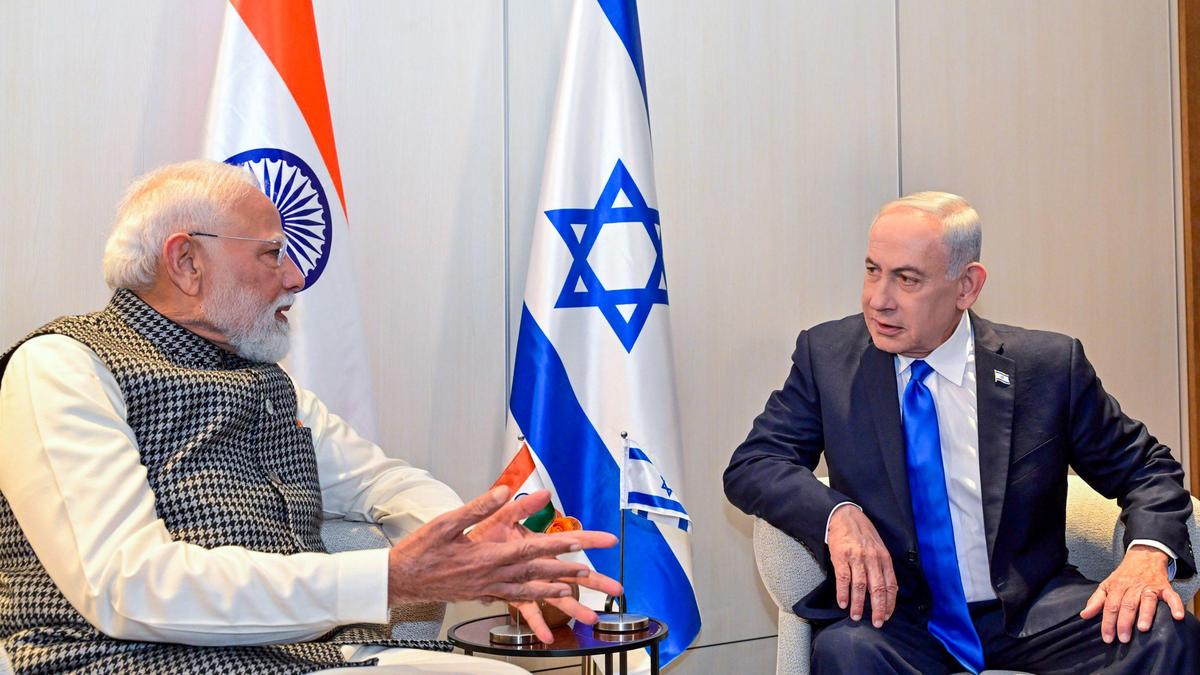
The diplomatic press corps has a favorite script. It involves Prime Minister Narendra Modi and Prime Minister Benjamin Netanyahu shaking hands, talking about "civilizational bonds," and signing vague Memorandums of Understanding (MoUs) that promise a high-tech utopia. The mainstream narrative suggests this is a unique, unbreakable strategic partnership.
It isn't. It is a transactional, fragile convenience that both sides are over-marketing to their domestic audiences.
The "lazy consensus" says that India and Israel are natural allies because they share similar security threats and a passion for deep-tech. This ignores the reality that India’s energy security still lives in the pockets of Gulf monarchs, and Israel’s long-term survival depends on a Western patronage that is increasingly skeptical of New Delhi’s brand of strategic autonomy.
The Defense Myth
For decades, the bedrock of this relationship has been defense. India is Israel’s largest arms client. Between 2019 and 2023, India accounted for roughly 37% of Israel’s total arms exports. The media calls this "strategic depth." I call it a single-point-of-failure risk that should keep Indian generals awake at night.
Dependency is not a partnership. When India buys Barak-8 missile systems or Phalcon AWACS, it isn't just buying hardware; it is buying into a proprietary ecosystem that it cannot replicate at home. The "Make in India" initiative has barely scratched the surface of Israeli IP. Israel sells the product, not the soul. They provide the "black box" technology but keep the keys.
If you think this is a marriage of equals, look at the technology transfer rates. Israel is a small nation that survives on its qualitative military edge. They are not about to hand over the crown jewels of signal processing or sensor fusion to a country that still maintains a cozy defense relationship with Russia. India’s attempt to play both sides—S-400s from Moscow and Heron drones from Tel Aviv—creates a ceiling for how much high-end tech Israel will actually share.
Agriculture and Water: The PR Playbook
Every time a high-level delegation meets, we hear about the "Centers of Excellence" in agriculture. We see photos of Israeli drip irrigation in Haryana. It’s great optics. It’s also a drop in the bucket.
India has roughly 160 million hectares of arable land. Israel has about 300,000. Applying Israeli water management techniques to the scale of the Indian subcontinent isn't a matter of "copy-pasting" tech; it’s an infrastructure nightmare that requires trillions in capital that neither side has committed.
The "cooperation" in agriculture is often used to mask the lack of progress in a Free Trade Agreement (FTA). We have been talking about an FTA for over a decade. Why hasn't it happened? Because when you move past the "start-up nation" slogans, the two economies are actually highly protected and competitive in ways that hurt. India wants labor mobility; Israel wants market access for its high-margin chemicals and tech. Neither side is willing to blink on the tariffs that actually matter.
The I2U2 and the "Middle East Corridor" Fantasy
The IMEC (India-Middle East-Europe Economic Corridor) was heralded as the definitive answer to China’s Belt and Road. It was supposed to be the crowning achievement of the India-Israel-UAE-USA (I2U2) grouping.
Then reality hit.
Geopolitics is not a boardroom presentation. You cannot build a rail and shipping corridor through a region on fire. The current instability in the Levant has proven that India’s "West Asia" policy is built on a house of cards. New Delhi tried to de-hyphenate its relationship with Israel and the Arab world. It worked for a while, but you can only ignore the Palestinian issue until the regional volatility threatens your maritime trade routes.
India’s reliance on the Suez Canal and its massive diaspora in the GCC (Gulf Cooperation Council) means that in any real crunch, New Delhi will always prioritize Riyadh and Abu Dhabi over Tel Aviv. The math is simple:
- Energy: India gets the vast majority of its crude and LNG from the Gulf.
- Remittances: Millions of Indians send back billions of dollars from the GCC.
- Trade: The UAE is India’s third-largest trading partner.
Israel, by comparison, is a niche tech provider. It is a "nice to have," not a "must survive."
The Myth of Shared Values
Pundits love to talk about the "shared democratic values" between the two nations. This is a PR line designed for Washington audiences.
In reality, both leaderships are driven by raw, hyper-nationalist realism. That’s fine—realism is how the world works. But don't mistake a shared enemy for a shared destiny. India’s foreign policy is rooted in "Non-Alignment 2.0" or "Multi-alignment." India will never join a formal military alliance with Israel because that would mean picking a side in a conflict it has no interest in fighting.
Similarly, Israel’s relationship with China is a massive elephant in the room. Despite U.S. pressure, Israel has allowed Chinese firms to manage parts of the Haifa port and invest heavily in its tech sector. India, which views China as its primary existential threat, should be far more critical of this. If Israel is willing to let India’s biggest rival manage its critical infrastructure, where is the "strategic alignment"?
The "Startup Bridge" is a One-Way Street
We hear a lot about the "India-Israel Startup Bridge." The idea is that Israeli innovation combined with Indian scale will conquer the world.
I have seen dozens of these "bridges" fail because they ignore the cultural and economic chasm. Israeli startups are built to exit. They want to be acquired by Google, Apple, or Intel. They are looking for high-valuation exits, not the low-margin, high-volume grind of the Indian consumer market.
Indian VCs and tech giants are looking for IP they can own, but Israeli founders are hesitant to move their engineering cores to Bengaluru. The result? A series of pilot programs that never reach commercial viability. If you want to disrupt this, stop looking for "synergy" and start looking for equity. Until Indian conglomerates start buying Israeli deep-tech firms outright—the way the Americans do—this is just a series of expensive networking events.
Cyber Security: A Dangerous Game
Both nations are leaders in cyber-warfare. This is the one area where the cooperation is actually deep, but it’s also the most toxic.
The fallout from the Pegasus controversy showed what happens when "private" Israeli tech intersects with Indian domestic politics. This isn't just about privacy; it’s about sovereign risk. Using foreign-made tools for national security or domestic intelligence creates a backdoor that you don't control. True "Atmanirbhar" (self-reliance) in the cyber age means building your own stacks. Relying on NSO Group or its successors is a shortcut that will eventually lead to a dead end.
The Wrong Question
People often ask: "How can India and Israel take their relationship to the next level?"
That is the wrong question. The real question is: "How much can India afford to rely on a partner that is perpetually on a war footing and strategically isolated?"
The "Next Level" requires India to stop being a customer and start being a peer. That means:
- Demanding full IP transfer on defense contracts or walking away.
- Forcing the FTA to include massive concessions for Indian service exports.
- Stopping the romanticization of the relationship and treating it like the cold, hard trade deal it is.
The bromance makes for great television. It doesn’t make for a superpower strategy. India needs to stop acting like it’s lucky to have Israel’s attention and start leveraging its market size to dictate the terms of the engagement.
Stop buying the "civilizational bond" marketing. Start counting the cost of the dependency.
Get the tech. Build it yourself. Move on.
_