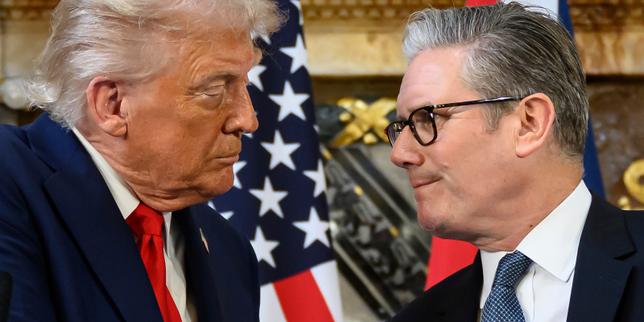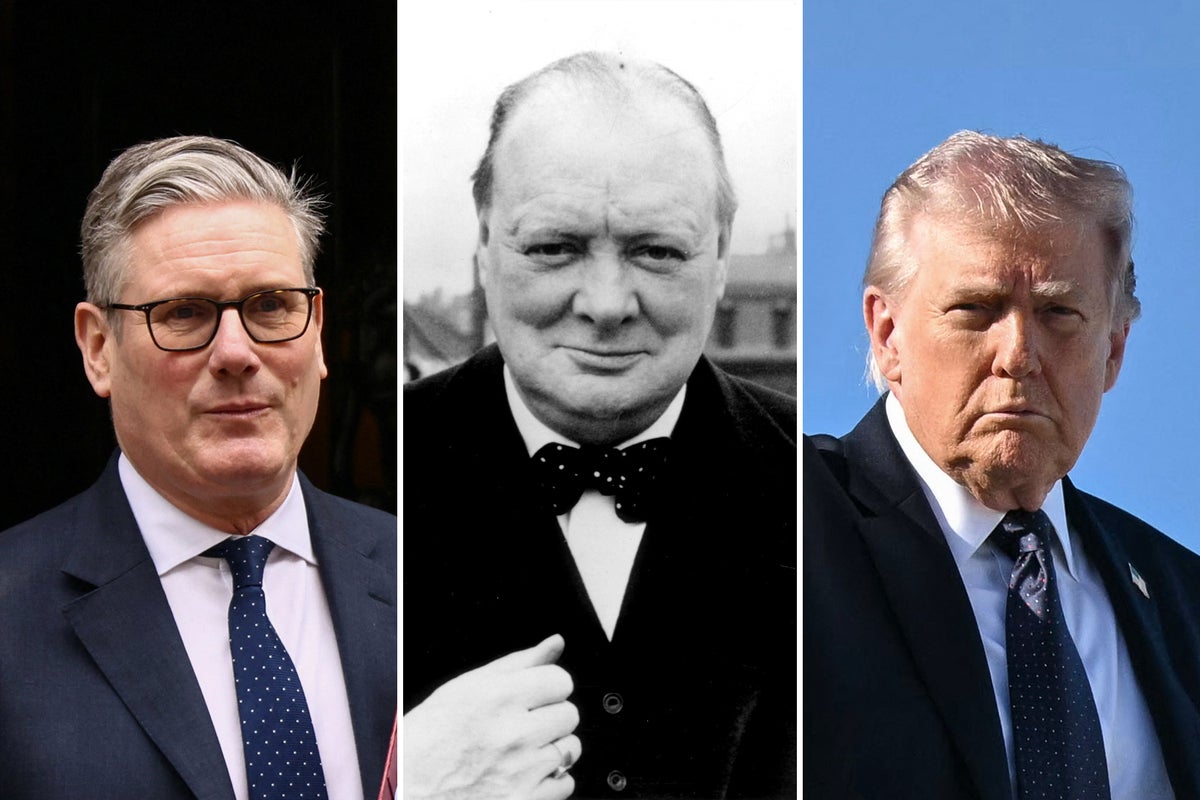
Donald Trump has a particular way of leaning into a microphone, a physical manifestation of a man who understands that in the theater of power, the script matters far less than the performance. When he recently compared Keir Starmer to Winston Churchill, the words didn't land with the weight of a historical tribute. They landed with the sharp, metallic ping of irony.
To understand why that comparison feels like a velvet glove draped over a brass knuckle, you have to look past the mahogany desks of Downing Street. You have to look at the ghosts of 1940 and the very modern, very terrifying specter of a world on the brink of fire.
History isn't a static photograph; it is a living, breathing tension. Churchill wasn't just a man in a waistcoat with a cigar. He was a gambler who knew when to burn the house down to save the foundation. Starmer, by contrast, operates with the careful, measured gait of a human resources director at a mid-sized insurance firm. When Trump invokes the "Bulldog," he isn't complimenting Starmer’s grit. He is pointing out the glaring absence of it.
The Mirage of the Special Relationship
The "Special Relationship" has always been a bit of a polite fiction, a story we tell ourselves so the UK doesn’t feel like a sidecar on a Harley Davidson. But under a second Trump term, that fiction would be stripped to its bones. Imagine a cold Tuesday in the Situation Room. The monitors are glowing with the jagged heat signatures of ballistic missiles rising from the Iranian plateau.
In this room, Trump doesn’t want a lecture on international law or a nuanced brief on the nuances of the JCPOA. He wants a partner who will leap into the dark with him.
Churchill would have understood the stakes of such a moment. He was a man of the "Big Call." Whether it was the disastrous Gallipoli or the defiant "We shall fight on the beaches," Churchill lived in the extremes. Starmer, however, lives in the margin of error. If Tehran begins to glow with the ambition of a nuclear breakout, the gap between Washington’s instinct for a hammer and London’s instinct for a subcommittee will become an abyss.
The Iranian Chessboard and the New Rules
Iran is not just a country on a map; it is a psychological trigger for the American right. To Trump, Iran represents the ultimate "bad deal." It is the one that got away, the one he tried to strangle with "Maximum Pressure," only to see it survive through the lifeline of a fractured West.
Consider the hypothetical, yet painfully plausible, scenario of a direct strike on Isfahan.
A Trump administration would likely view a conflict with Iran not as a tragedy to be avoided at all costs, but as a messy necessity to be finished quickly. He views war through the lens of a real estate developer dealing with a stubborn tenant: you apply enough pressure until they break or they leave.
If Starmer stands at the podium and calls for "restraint" or "proportionality," he isn't being a Churchillian leader in Trump’s eyes. He is being a clerk. The irony of the jibe is that Churchill’s greatest strength was his ability to convince the Americans that Britain was an equal, a fierce and indispensable warrior-nation. Today, the perception is that Britain is a museum with a military budget.
The Cost of Being "The Adult in the Room"
There is a specific kind of exhaustion that comes from trying to be the sensible one in a room full of pyromaniacs. Starmer’s brand is "Sensible Britain." He is the man who tidied up the Labour Party, the man who follows the rules, the man who wears the suit that fits perfectly but says nothing.
In the chaotic, unpredictable world of a "Trump 2.0" foreign policy, being sensible is a liability.
Trump’s Churchill comment was a reminder that the world doesn’t always reward the sensible. It rewards the bold, the loud, and the occasionally reckless. While the UK prides itself on its "soft power" and its diplomatic finesse, the reality of an Iranian war would require something much more visceral. It would require the kind of blood, toil, tears, and sweat that Starmer seems allergic to mentioning, let alone shedding.
The Invisible Stakes of a Fractured Alliance
We often talk about geopolitics as if it’s a game of Risk played by giants. It isn't. It’s a series of phone calls made by tired people in the middle of the night. It’s the sound of a voice cracking when the casualty reports come in. It’s the quiet, sickening realization that your closest ally isn't picking up the phone because they no longer think you have anything useful to say.
If a war with Iran breaks out, the "Special Relationship" will face its ultimate stress test. Trump’s version of Churchill would have been in the cockpit, or at least demanding a seat at the planning table. Starmer’s version of the UK risks being the observer in the gallery, issuing press releases that nobody reads.
The jibe wasn't just a joke about personality. It was a warning about relevance.
In the high-stakes poker game of global security, you can't play if you aren't willing to lose your shirt. Trump knows this. He senses that the modern British establishment is more concerned with the optics of the game than the outcome of the hand. By calling Starmer "Churchill," he is mocking the idea that Britain still has the stomach for the kind of existential brawls that defined the 20th century.
The world is getting louder, hotter, and more dangerous. The ghosts of the past are watching to see if we’ve learned anything, or if we’re just repeating the lines of a play we no longer understand.
Starmer might have the title, but the cigar is missing, and the bulldog has been replaced by a very polite, very quiet Golden Retriever.
When the missiles start to fly, "sensible" isn't a strategy. It’s just a way to watch the world burn with a clear conscience.