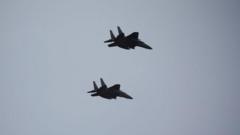
The mid-air collision of two South Korean KT-1 trainer aircraft in April 2022 was not a mechanical failure or a freak weather event. It was a failure of discipline. Four pilots died because the lead aircraft in a formation flight broke fundamental safety protocols to snap photos of the scenery. This wasn't just a lapse in judgment; it was a systemic breakdown in the cockpit environment of the Republic of Korea Air Force (ROCAF).
Investigation records into the crash near Sacheon Air Base reveal a chilling sequence of events. While performing a routine training mission, the flight lead became distracted by the aesthetic of the clouds and the landscape. In an environment where split-second adjustments determine survival, the lead pilot focused on a smartphone camera rather than the instruments or the wingman’s position. The resulting collision sent two multi-million dollar turboprop trainers spiraling into the ground, claiming the lives of two student pilots and two instructors.
Culture of Distraction in High-Stakes Aviation
Modern cockpits are designed to minimize cognitive load, yet human nature often finds ways to reintroduce clutter. The ROKAF investigation highlighted that the pilots involved were not just "unlucky." They were operating under a false sense of security that often plagues experienced instructors and eager students alike. When a pilot deviates from the flight plan to capture social media content or personal mementos, the "bubble" of situational awareness doesn't just shrink—it pops.
A KT-1 Woongbi travels at speeds exceeding 350 km/h during standard maneuvers. At these velocities, a three-second distraction to focus a camera lens is the equivalent of driving a car blindfolded for nearly 300 meters. In a formation flight, where the distance between wingtips is often measured in single digits, there is no margin for error. The lead pilot’s primary job is to be a stable platform for the formation. By shifting focus from the horizon to a hand-held device, the lead pilot effectively abandoned their post while still sitting in the ejection seat.
The Mechanics of the Sacheon Collision
To understand how this happened, one must look at the flight path. The two aircraft were part of a coordinated training exercise. In a standard formation, the wingman maintains a visual "fix" on the lead aircraft. If the lead aircraft makes an unannounced or erratic move, the wingman must react instantly.
In this specific tragedy, the lead aircraft’s flight path became unstable as the pilot manipulated a camera. The investigation found that the lead pilot slowed down and dipped a wing unexpectedly—maneuvers typical of someone trying to frame a shot through a canopy. The trailing aircraft, expecting a steady climb, had nowhere to go. The closure rate was too high for manual override.
Critical Failure Points in the Cockpit
- Situational Awareness (SA): The lead pilot’s SA dropped to near-zero regarding the proximity of the wingman.
- Task Saturation: Attempting to fly a high-performance aircraft while operating a mobile device exceeds the human brain's ability to process emergency inputs.
- CRM (Crew Resource Management): The instructors in the back seats failed to intervene. This suggests a hierarchy where the lead pilot's actions went unchallenged, even when those actions were blatantly dangerous.
Why Technical Safeguards Aren't Enough
The KT-1 is a reliable, Korean-made platform. It features modern avionics and ejection seats that should, in theory, provide a safety net. However, no amount of engineering can compensate for a pilot who chooses to ignore the primary rule of aviation: Aviate, Navigate, Communicate.
The Ministry of National Defense faced immediate backlash following the report. Critics pointed out that the military had been lax in enforcing "sterile cockpit" rules—periods during flight where non-essential activities and conversations are strictly prohibited. The presence of personal smartphones in the cockpits of student pilots is a growing concern globally, but this incident served as a bloody proof of concept for the worst-case scenario.
The Invisible Pressure of Personal Branding
Military aviation is inherently prestigious. For many young pilots, the desire to document their journey and share it with peers or family creates an invisible pressure to capture "the perfect shot." This psychological drive competes with the rigid, often repetitive nature of flight training.
When an instructor—the very person meant to instill discipline—is the one initiating the distraction, the student pilot is placed in an impossible position. They are taught to follow the lead. If the lead is taking photos, the student perceives the risk as acceptable. This is how "normalization of deviance" takes root in a military organization. It starts with a single photo and ends with a debris field.
Tactical Consequences and Readiness
Beyond the tragic loss of life, there is the matter of national security. Every lost airframe and every lost pilot represents a dent in South Korea's defensive posture. The training program for a fighter pilot costs millions of dollars and takes years of intensive work. Losing four personnel in a single afternoon due to a camera phone is a strategic embarrassment.
The ROKAF has since implemented stricter regulations regarding personal electronic devices (PEDs). There are now mandatory checks and harsher penalties for pilots caught with unauthorized devices in the air. Yet, technology is only part of the solution. The real fix requires a shift in the internal culture of the squadrons.
The Training Vacuum
The aftermath of the crash left a temporary void in the training pipeline. Sacheon is the heart of ROKAF's flight training. When two planes go down, the entire fleet is often grounded for safety inspections, delaying the graduation of the next generation of pilots. This creates a ripple effect that touches every squadron in the country.
The military must now contend with the fact that their biggest threat during routine training wasn't a mechanical flaw or a foreign adversary. It was the siren song of a digital screen.
A Warning for Global Aviation
This incident is not unique to South Korea. From private pilots to commercial crews, the temptation to document the world from above is a global epidemic. The Sacheon collision serves as a grim case study for any organization that operates high-risk machinery.
The physics of flight are indifferent to intent. Gravity does not care if you were trying to capture a sunset or a cloud formation. If the pilot’s eyes are on a screen instead of the instruments, the aircraft is effectively pilotless. The four men who died in the KT-1s were skilled, trained, and dedicated, yet they were undone by a device that weighs less than half a pound.
Military commanders must recognize that discipline is not a static state. It is a perishable skill that requires constant reinforcement. If the ROKAF—or any air force—wants to prevent another Sacheon, they must treat the smartphone as a hostile element in the cockpit.
The lesson is brutal and final. In the air, there is no such thing as a "quick photo." There is only the mission, the machine, and the unrelenting requirement for total focus. Anything less is a suicide mission.