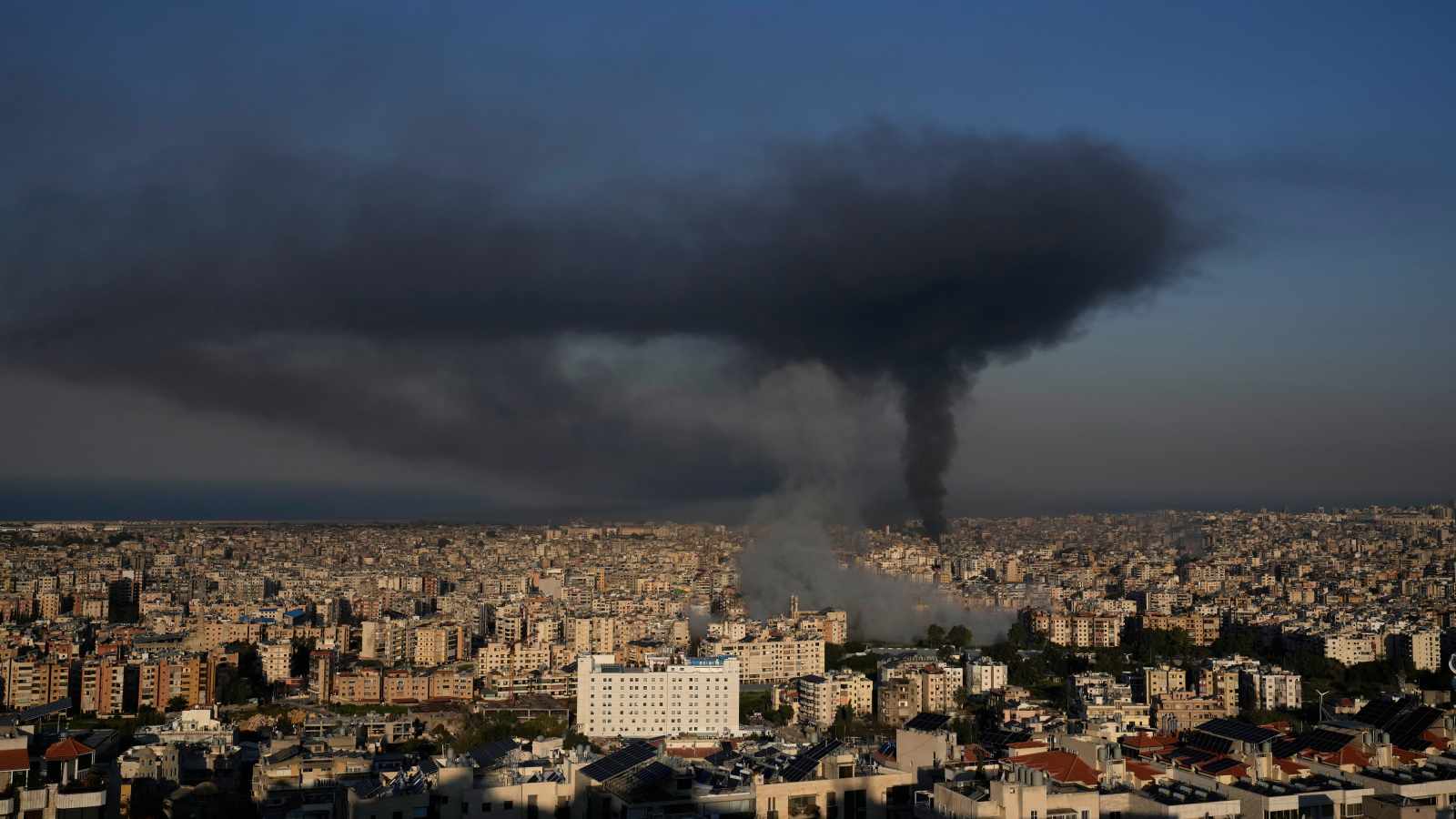
The March 3, 2026, strike on the Sheikh Isa Air Base in Bahrain marks a structural shift in Iranian retaliatory doctrine. While official Iranian state media claims the "demolition" of the command headquarters via 20 drones and three missiles, the operational reality reflects a calculated use of precision-guided munitions (PGMs) to impose a "sovereignty cost" on Gulf Cooperation Council (GCC) states hosting U.S. assets. This engagement, part of the broader "Honest Promise 4" operation, serves as the primary Iranian mechanism for horizontal escalation following the February 28 U.S.-Israeli strikes on Tehran.
The Triad of Iranian Strategic Objectives
The targeting of Bahrain is not an isolated act of aggression but a move within a defined three-part framework designed to degrade U.S. regional posture while maintaining domestic regime continuity.
- Host-Nation Deterrence: By striking facilities in Juffair and the Sheikh Isa area, Iran aims to create a political friction point between the Bahraini government and the U.S. military. The message is clear: hosting U.S. Fifth Fleet assets converts sovereign territory into a legitimate combat zone.
- Command and Control (C2) Disruption: The specific targeting of headquarters buildings suggests an intent to degrade the "OODA loop" (Observe-Orient-Decide-Act) of U.S. Naval Forces Central Command (NAVCENT). Even if structural damage is localized, the electromagnetic and psychological impact forces a transition to distributed command, which inherently slows response times.
- Economic Attrition: The secondary targeting of fuel tanks and maritime infrastructure around the Juffair area aims to increase the insurance and security premiums for regional energy exports, effectively weaponizing the geography of the Persian Gulf without a formal blockade of the Strait of Hormuz.
Kinetic Analysis: The Asymmetric Delivery Function
The reported use of a 20-to-3 ratio between Unmanned Aerial Vehicles (UAVs) and ballistic missiles reveals the tactical blueprint of the Islamic Revolutionary Guard Corps (IRGC). This ratio is optimized to saturate Integrated Air and Missile Defense (IAMD) systems.
The drones, characterized by witnesses as sounding like "mopeds," function as low-cost saturation decoys. Their primary purpose is to force the expenditure of high-cost interceptors—such as the MIM-104 Patriot—and to fix the attention of radar arrays. This creates a "detection gap" that the three ballistic missiles, traveling at higher terminal velocities, exploit to reach hardened targets like the command headquarters.
The Vulnerability of Fixed Infrastructure
The strike exposes a critical bottleneck in U.S. regional defense: the reliance on deep-water ports and fixed airfields in high-density urban or near-urban environments. Unlike carrier strike groups, which utilize mobility as their primary defense, the Fifth Fleet’s infrastructure in Manama is a stationary target.
The proximity of these facilities to civilian centers—evidenced by the strike on the Crowne Plaza Hotel—creates a "collateral damage trap." If the U.S. retaliates from these bases, it risks further Iranian strikes that inevitably cause civilian casualties, thereby straining the U.S.-Bahraini bilateral security agreement. This creates a strategic paralysis where the U.S. is functionally constrained in how it utilizes its most advanced regional hubs.
Regional Chain Reactions
The Bahrain incident is the 14th wave of a coordinated regional response. The data from February 28 to March 3 indicates a high-intensity fire volume:
- UAE: 165 missiles, 541 drones.
- Kuwait: 97 missiles, 283 drones.
- Bahrain: 45 missiles, 9 drones (initial wave), followed by the March 3 escalation.
This volume of fire indicates that Iran’s "retaliation capacity" was not neutralized during the initial U.S.-Israeli strikes. The continued availability of mobile Transporter Erector Launchers (TELs) inside Iran allows the IRGC to maintain a steady state of fire despite losing "local air superiority" to U.S. B-1 bombers and Israeli F-35s.
The immediate strategic priority for U.S. forces in Bahrain must be the transition from "Centralized Command" to "Agile Combat Employment." This involves the rapid dispersal of aircraft and personnel to austere or secondary landing strips across the peninsula to negate the IRGC's targeting coordinates. Failure to decentralize C2 functions within the next 48 hours will likely result in higher casualty rates as Iran refined its "Honest Promise" targeting packages.
Review the deployment of mobile IAMD assets to secondary Bahraini ports to secure logistics lines before the next anticipated wave of Shahed-series drone strikes.