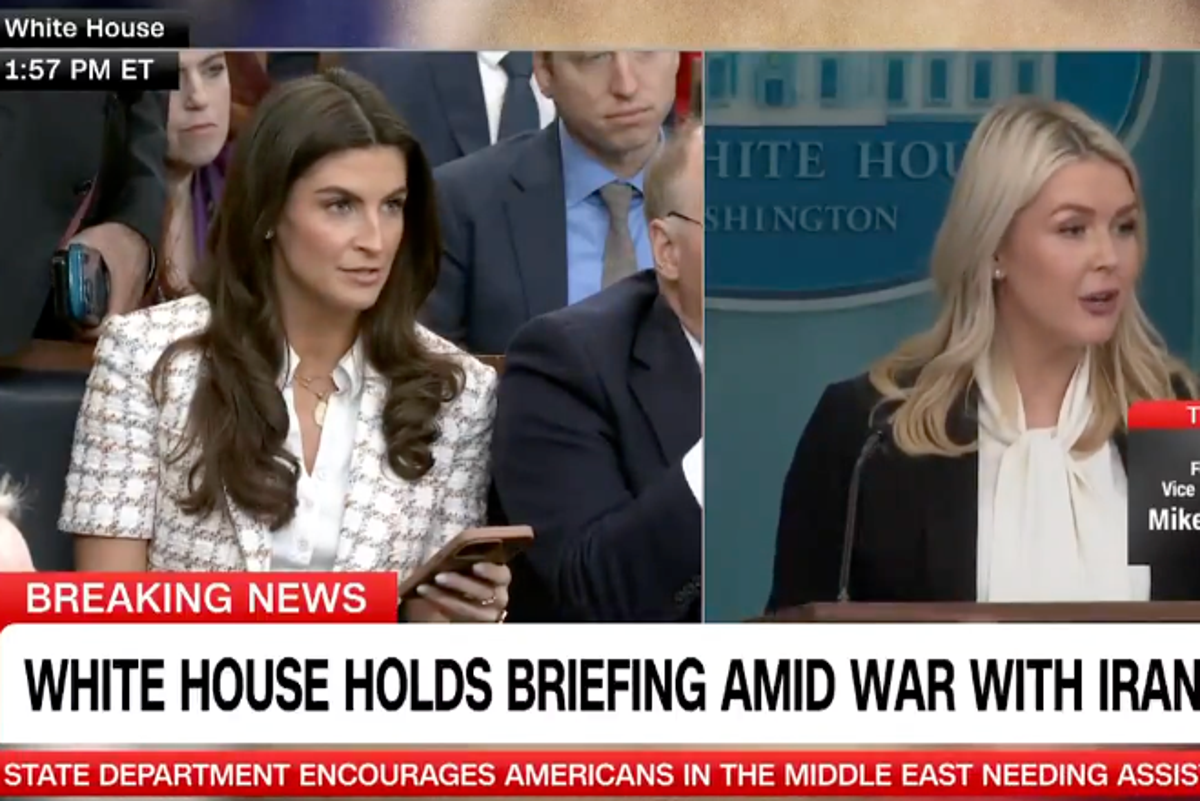
The media is currently obsessing over a "tense exchange" between Karoline Leavitt and Kaitlan Collins. Pundits are dissecting the body language. They are counting the interruptions. They are pearl-clutching over Leavitt’s "Listen to me, especially you!" command. Most analysts see this as a breakdown in civil discourse or a masterclass in political messaging.
They are all wrong.
What you witnessed wasn't a debate or even a confrontation. It was a symbiotic performance where both parties got exactly what they needed. To understand the Iran conflict—and the media's role in it—you have to stop looking at the sparks and start looking at the furnace.
The Death of the "Gotcha" Moment
The standard critique of the CNN segment suggests that Leavitt was "scolding" Collins to deflect from uncomfortable truths about US deaths and foreign policy. Conversely, the other side claims Collins was "harassing" a spokesperson to push a narrative.
Both views assume that the goal of a cable news interview is to exchange information. It isn't. The interview is a resource-extraction operation.
- For the Spokesperson: The goal is to create a viral clip for the base that signals dominance over the "elite media."
- For the Anchor: The goal is to demonstrate "toughness" to maintain institutional credibility among a skeptical audience.
When Leavitt tells Collins to "listen to me," she isn't trying to educate the anchor. She is signaling to millions of viewers that the traditional hierarchy of the press-briefing-as-interrogation is dead. I have watched political operatives spend years perfecting this specific brand of calibrated aggression. It is a calculated move designed to bypass the interviewer entirely.
The Iran Calculus is Not About Ethics
The debate over US deaths and Iran is frequently framed in the media as a moral binary. One side argues for restraint to save lives; the other argues for "strength" to deter future attacks.
This is a middle-management way of looking at geopolitics. In reality, the state operates on a cold, mathematical logic that neither Collins nor Leavitt will ever admit on air. Foreign policy isn't about "winning" or "losing" in the way a sports fan understands it. It is about the management of credible threats.
The "lazy consensus" in the reporting of this exchange is that there is a "correct" way to tally the cost of war. There isn't.
Consider the $Expected Loss$ formula in strategic risk:
$$E = P \times L$$
Where $P$ is the probability of an event and $L$ is the magnitude of the loss.
The disagreement between the Trump administration’s surrogates and the media establishment isn't about whether deaths are tragic. It’s a fundamental disagreement over $P$. The media argues that aggressive posturing increases $P$; the administration argues that passivity increases $P$ to a near certainty. By shouting over each other about "scolding" and "tone," they avoid discussing the actual variables of the equation.
Why Your Outrage is a Product
If you felt a surge of adrenaline watching that clip, you are the product.
Cable news has pivoted from being a "first draft of history" to a "high-resolution mirror of tribalism." When a segment is framed as a "clash," it triggers a dopamine response. The substance—in this case, the complex and terrifying reality of Iranian regional influence and US military exposure—is treated as mere set dressing.
I’ve been in the rooms where these segments are produced. The "tensions" are often discussed in pre-production not as risks to be avoided, but as metrics to be hit. If an interview is "civil," it is a failure. If it is "tense," it is a win for the social media team.
Dismantling the Victim Narrative
The most annoying part of the fallout is the immediate rush to claim victimhood.
The media claims Collins was "attacked" for doing her job. The political camp claims Leavitt was "disrespected" by a biased host.
Stop.
These are two of the most powerful communicators in the world. They are both highly paid, highly trained professionals playing a game they understand better than you do.
- Collins knows that being scolded by a polarizing figure increases her "street cred" with the anti-Trump demographic.
- Leavitt knows that "standing her ground" against a CNN star is the fastest way to solidify her standing in the MAGA hierarchy.
They aren't victims of a broken system; they are the chief architects of it.
The Nuance You Aren't Allowed to See
The actual tragedy buried under this shouting match is the total erasure of the strategic reality in the Middle East. While the internet argues about whether Leavitt was "rude," the actual mechanics of the Iran-US relationship are ignored.
We aren't talking about:
- The shifting alliances between the IRGC and non-state actors.
- The failure of various sanction regimes to actually curb nuclear ambitions.
- The logistical reality of what a full-scale kinetic conflict with Iran would actually look like—a scenario that would make the Iraq War look like a skirmish.
Instead, we get a linguistic analysis of the word "listen."
The Death of Expertise in the Age of "Vibe"
We have entered an era where "vibes" outweigh data. The competitor article focuses on the feeling of the exchange. This is a symptom of a broader intellectual rot. We no longer care if a spokesperson is factually correct about a drone strike; we care if she "owned" the reporter. We no longer care if a reporter’s question is logically sound; we care if she "held their feet to the fire."
When you prioritize the performance of conflict over the substance of the issue, you lose the ability to govern. You lose the ability to have a foreign policy that lasts longer than a news cycle.
I’ve seen this play out in corporate boardrooms and political war rooms alike. Once the goal shifts from "solving the problem" to "winning the clip," the problem becomes permanent. It becomes a permanent feature of the business model because solving it would remove the source of the conflict—and the revenue.
Stop Asking if They Like Each Other
People often ask me, "Do these people actually hate each other when the cameras go off?"
The answer is: It doesn't matter.
Whether they share a drink or a blood feud is irrelevant. Their professional incentives are perfectly aligned to keep the "clash" going. The "scolding" will continue because it works. The "tense exchanges" will be promoted because they get clicks.
If you want to understand the truth about Iran, or US deaths, or the future of American power, you have to stop watching the screen and start watching the money. Follow the incentives, not the insults.
The next time you see a headline about a "star" being "scolded," realize you aren't watching news. You are watching a highly efficient machine convert your anger into equity.
Turn off the clip. Read the white papers. Look at the maps. Everything else is just noise designed to keep you from noticing how little they are actually saying.
Stop being a spectator in a theater designed to keep you blind.