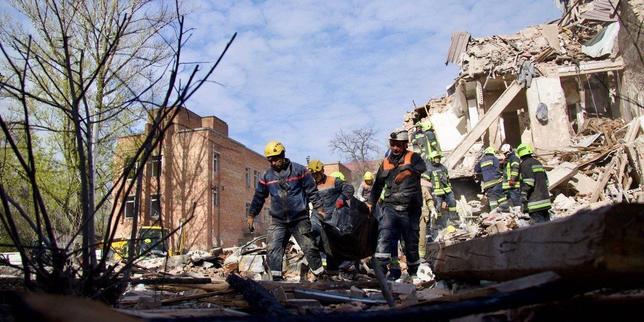
Standard media reporting on the strike in Dnipro is a masterclass in missing the point. We see the headlines every day: another barrage, another tragic tally of civilian casualties, another map showing a few meters of shifted dirt. The press treats these events like an isolated scoreboard. Eight dead here, twenty wounded there. This hyper-focus on individual tragedies—while humanly significant—is a strategic failure. It feeds a narrative of "Russian brutality" without examining the cold, mechanical logic of industrial warfare that the West is currently losing.
If you think these strikes are just random acts of cruelty by a desperate regime, you aren't paying attention to the math. We are stuck in a loop of moral outrage while the Russian military apparatus operates on a logic of resource exhaustion. This isn't about the victims in Dnipro; it's about the air defense batteries that had to fire million-dollar interceptors to stop the rest of the salvo.
The Myth of the Precision Victory
Military analysts often fall into the trap of measuring success through tactical efficiency. They look at a Russian strike that hits a residential block and label it a failure or a "terror tactic." From a strictly kinetic standpoint, it might be a miss. From an attritional standpoint, it is a win.
Every time a major Ukrainian city is targeted, Kyiv faces a brutal choice. Do they protect the front lines, where the glide bombs are pulverizing their infantry, or do they pull those scarce S-300 and Patriot systems back to protect the energy grid and civilian centers? By striking Dnipro, Moscow isn't just hitting a building; they are stress-testing the inventory of the entire Western defense industrial base.
The math is ugly. An Iskander missile costs a fraction of the total economic damage it causes, even if it is shot down. If it hits, it forces the West to dump billions more into reconstruction and defensive hardware that simply cannot be manufactured fast enough. We are witnessing the first high-intensity industrial war of the 21st century, and the "experts" are still talking about it like it's a regional police action.
Stop Asking if Ukraine Can Win and Start Asking How They Can Survive
The "People Also Ask" sections of the internet are filled with questions like "When will the war end?" or "Can Ukraine reclaim its borders?" These are the wrong questions. They assume a binary outcome based on territory.
Territory is a lagging indicator. The leading indicator is the "burn rate" of specialized labor and high-end munitions.
- Munition Disparity: Russia has transitioned to a war economy. Their factories are running 24/7. The West is still debating "joint procurement" and "supply chain bottlenecks."
- The Glide Bomb Problem: While the media focuses on high-profile cruise missile strikes in Dnipro, the real carnage is happening via UMPK-equipped FAB bombs. These are cheap, dumb bombs turned into precision weapons. They outrange most tactical air defenses and are too numerous to intercept with expensive missiles.
- Personnel Rotations: You cannot "out-tech" a shortage of boots. Ukraine’s mobilization struggles are a direct result of an attritional strategy designed to bleed their demographic future dry.
The contrarian truth? Russia doesn't need to take Kyiv to win. They just need to make the cost of defending it so high that the social and economic fabric of Ukraine collapses. The strikes on Dnipro are psychological markers in that long-term project.
The Humanitarian Outrage Industrial Complex
I have watched policy shops in D.C. and Brussels spend millions on "impact reports" that detail the horror of these strikes. They are correct about the horror. They are catastrophically wrong about the utility of their response.
Sanctions were supposed to cripple the Russian missile program. Instead, we see wreckage in Dnipro containing Western-made microchips manufactured in 2023. The "unprecedented" sanctions regime has more holes than a screen door. Why? Because the global market is agnostic. If Russia wants a chip, they get it through Kyrgyzstan or the UAE.
By pretending the sanctions are working, Western leaders are lying to their constituents and themselves. This false sense of security prevents the hard pivot toward a real industrial mobilization. We are fighting a 1940s-style production war with 1990s-style "just-in-time" logistics.
The Failure of the Defensive Shield
The Patriot system is a marvel of engineering. It is also a financial black hole in an attritional war.
Imagine a scenario where an adversary launches a $20,000 Shahed drone. You shoot it down with a $2 million interceptor. You did your job. You protected the target. You also just lost the economic engagement by a factor of 100. Multiply that by thousands of drones and missiles over three years.
This is the "Interceptor Gap." The West cannot build missiles as fast as Russia and its partners can build delivery vehicles. The strike on Dnipro proves that even with the best air defenses in the world, saturation works. Probability dictates that if you throw enough metal at a city, something will get through.
The Real Escalation is Economic
We keep hearing about "red lines" and "escalation." The real escalation isn't a nuclear weapon or a NATO troop deployment. The real escalation is the total integration of the Russian, Iranian, and North Korean defense sectors.
While we treat the Dnipro strike as a local news story, it is actually a product of a globalized anti-Western supply chain. The North Korean artillery and Iranian drone tech are being refined on the Ukrainian battlefield in real-time. This is a R&D lab for the next generation of global conflict.
The status quo strategy of "as long as it takes" is a death sentence. It assumes time is on Ukraine's side. It isn't. Time favors the side with the larger industrial base and the lower value placed on human life.
Rebuilding is a Fantasy Until the Sky is Closed
Every time a strike hits Dnipro or Kharkiv, Western leaders pledge "recovery funds." This is a grift. You cannot rebuild a bridge that is still in the crosshairs of a hypersonic missile.
The fixation on reconstruction before the kinetic war is settled is a way for politicians to look busy without making the hard decisions regarding deep-strike capabilities. If Ukraine cannot hit the factories and airfields where these missiles originate, the strikes on Dnipro will never stop.
The Western "consensus" is terrified of "instability" inside Russia. They would rather see a Ukrainian city leveled every week than risk a regime collapse in Moscow. This isn't support; it's managed decline.
The Cold Reality of the 2026 Map
By 2026, the maps won't look like a clear victory for anyone. They will look like a jagged scar. The tragedy of Dnipro isn't just the loss of life; it's the realization that the international order has no mechanism to stop it other than "thoughts and prayers" and a trickle of hardware that arrives six months too late.
We are watching the slow-motion dismantling of the post-WWII security architecture. Every missile that lands in a Ukrainian courtyard is a hammer blow to the idea that "never again" meant anything.
Stop looking at the casualties as a statistic. Look at them as a countdown. The West is running out of time to realize that this isn't a "conflict" to be managed. It is a war that must be won on the factory floor, or not at all.
The people of Dnipro are paying the price for a Western elite that prefers comfortable lies about "depleted Russian stocks" over the hard, mechanical reality of a mobilized enemy. Every time you read a headline about a "desperate" Russian strike, remember: they aren't desperate. They are deliberate.
If you aren't prepared to out-produce the enemy, you have already lost the war. The rest is just noise.