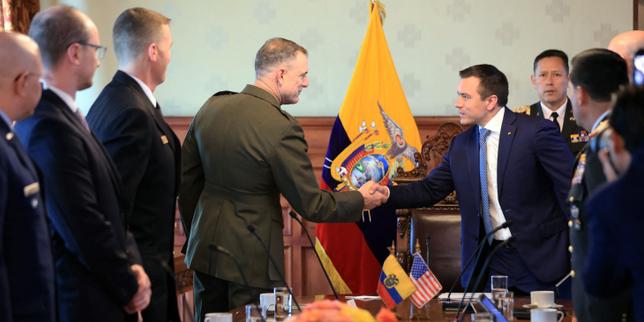
Ecuador has officially abandoned its posture of sovereign isolation to embrace a military partnership with the United States that would have been unthinkable five years ago. This shift comes as the country morphs from a peaceful transit point into a primary staging ground for global cocaine distribution. The new "joint operations" framework allows American personnel and assets to work directly with Ecuadorian forces to intercept shipments, disrupt financing, and stabilize a port system that has fallen under the control of Albanian and Mexican cartels.
The transformation of Ecuador from a quiet Andean neighbor into a combat zone is not an accident of geography. It is the result of a massive displacement of criminal power following the 2016 FARC peace deal in Colombia. As traditional routes shifted, the dollarized economy of Ecuador became the perfect laundry for illicit cash. Today, the Guayaquil docks are the most important logistical hubs for cocaine headed to Europe. You might also find this similar coverage insightful: Strategic Asymmetry and the Kinetic Deconstruction of Iranian Integrated Air Defense.
The Logistics of a Failed Port System
The primary reason Ecuador is losing the war on drugs is not a lack of soldiers, but a lack of control over its own infrastructure. International shipping containers are the preferred vessel for the modern narco-state. By the time a box reaches the Port of Guayaquil, it has often been "contaminated"—a polite industry term for drug traffickers breaking the seal, loading hundreds of kilos of cocaine, and replacing the seal with a counterfeit.
The joint operations with the U.S. focus heavily on maritime domain awareness. This isn't just about fast boats chasing narco-subs. It involves high-altitude surveillance and the integration of P-8 Poseidon aircraft to track "dark targets"—vessels that have turned off their transponders to vanish from global tracking systems. As reported in detailed coverage by Associated Press, the results are worth noting.
Washington is providing the eyes, but Quito must provide the hands. The current administration under Daniel Noboa is attempting to purge a judicial system that has historically operated as a revolving door for gang leaders. Without a clean court system, every high-seas seizure is merely a temporary business loss for the cartels, rather than a permanent blow to their operations.
The Invisible Presence of the Balkan Cartel
While the media often focuses on Mexican players like Sinaloa or the Jalisco New Generation Cartel, the real power in Ecuador often speaks with an Eastern European accent. Investigative trails consistently lead back to the Balkan Cartel, specifically groups from Albania that have established a permanent presence in Guayaquil and Manta.
These groups do not operate like the street gangs that terrorize Ecuadorian neighborhoods. They are "clean" operatives who live in gated communities and manage the logistics of moving tons of product to Rotterdam and Antwerp. Their presence has changed the math of the drug trade. They pay in cash and they pay upfront, which has flooded the local economy with liquidity that the government cannot track.
The U.S. involvement brings a level of intelligence sharing that targets these high-level financiers. By tracking the digital trail of "dead drops" and encrypted communication devices, joint task forces are trying to move beyond the foot soldiers and hit the architects of the supply chain. It is a slow, grinding process that requires more than just hardware; it requires a level of internal trust that the Ecuadorian military is still struggling to build.
Why Dollarization is a Double Edged Sword
Ecuador’s greatest economic strength is also its greatest security vulnerability. Because the country uses the U.S. dollar, there is no exchange rate risk for international criminal organizations. A million dollars brought into the country is a million dollars that can be spent or moved immediately without triggering the alarms that usually accompany large-scale currency exchanges.
This makes money laundering exceptionally easy. Construction projects, luxury car dealerships, and even large-scale agricultural exports serve as fronts. The joint operations agreement includes a heavy emphasis on financial intelligence units (FIUs). The goal is to "follow the paper" to the point where the cost of doing business in Ecuador outweighs the convenience of the currency.
Critics of the U.S. presence argue that this is a return to the "Plan Colombia" era, a strategy that many believe merely pushed the violence into new territories rather than ending it. There is truth to this concern. When you squeeze the balloon in one area, the air moves to another. However, the current level of violence in Ecuador—marked by prison massacres and the assassination of presidential candidates—suggests that the country has already reached a point of no return.
The Breakdown of Internal Security
The Ecuadorian police and military are currently outgunned. The cartels use industrial-grade explosives and automatic weapons that often exceed the capabilities of local precincts.
- Equipment Gap: Local forces often lack basic night vision and secure communication channels.
- Corruption: Low wages make officers susceptible to "plata o plomo" (silver or lead) tactics.
- Intelligence Vacuum: Without U.S. satellite and signal intercepts, the government is essentially flying blind.
The "joint operations" include a significant training component. This isn't just about teaching soldiers how to shoot; it’s about tactical intelligence and human rights compliance. The latter is crucial. If the military becomes as lawless as the gangs they are fighting, they lose the support of the population, which is the only thing standing between Ecuador and total state failure.
The Pivot to the Pacific
The South Pacific corridor has become the most active drug thoroughfare on the planet. Small fishing vessels, known as pangas, carry fuel and supplies to the mid-ocean, acting as gas stations for the go-fast boats heading north.
The U.S. Coast Guard, under the new agreements, has increased its "shiprider" program. This allows Ecuadorian law enforcement officers to ride on American vessels, providing the legal authority to board and search suspect ships in international waters. This bypasses the bureaucratic delays that often allow traffickers to dump their cargo before a search can be legally initiated.
It is a high-speed game of cat and mouse. The traffickers are now using "parasite" containers—torpedo-shaped tubes attached to the hull of legitimate cargo ships below the waterline. These can only be detected by divers or specialized sonar. This is where the American technical edge becomes the deciding factor.
The Cost of Failure
If these joint operations fail to stabilize the country, the implications reach far beyond the borders of Ecuador. We are looking at the potential emergence of a narco-state on the Pacific coast that could destabilize the entire region. Migration flows from Ecuador have already spiked as citizens flee the violence, adding pressure to the already strained borders of neighboring countries and the United States.
The current strategy is a gamble. It bets that a combination of American technology and Ecuadorian resolve can dismantle an infrastructure that has been decades in the making. It ignores the reality that as long as the demand in the U.S. and Europe remains at record highs, there will always be someone willing to move the product.
But for the person living in Guayaquil who cannot walk to the grocery store without fear of a stray bullet, the "why" of the drug trade matters less than the "how" of stopping it. The U.S. presence provides a temporary shield, but the permanent solution requires a total overhaul of the Ecuadorian state.
The government must decide if it is willing to pursue the kingpins who sit in the boardrooms of Quito, not just the kids with pistols in the slums. Without that internal purge, the joint operations are just a very expensive band-aid on a gaping wound.
Demand that the government provide a clear timeline for the implementation of port-wide scanning technology. Until every container leaving Guayaquil is X-rayed, the "joint operations" are merely scratching the surface of a multi-billion dollar problem.