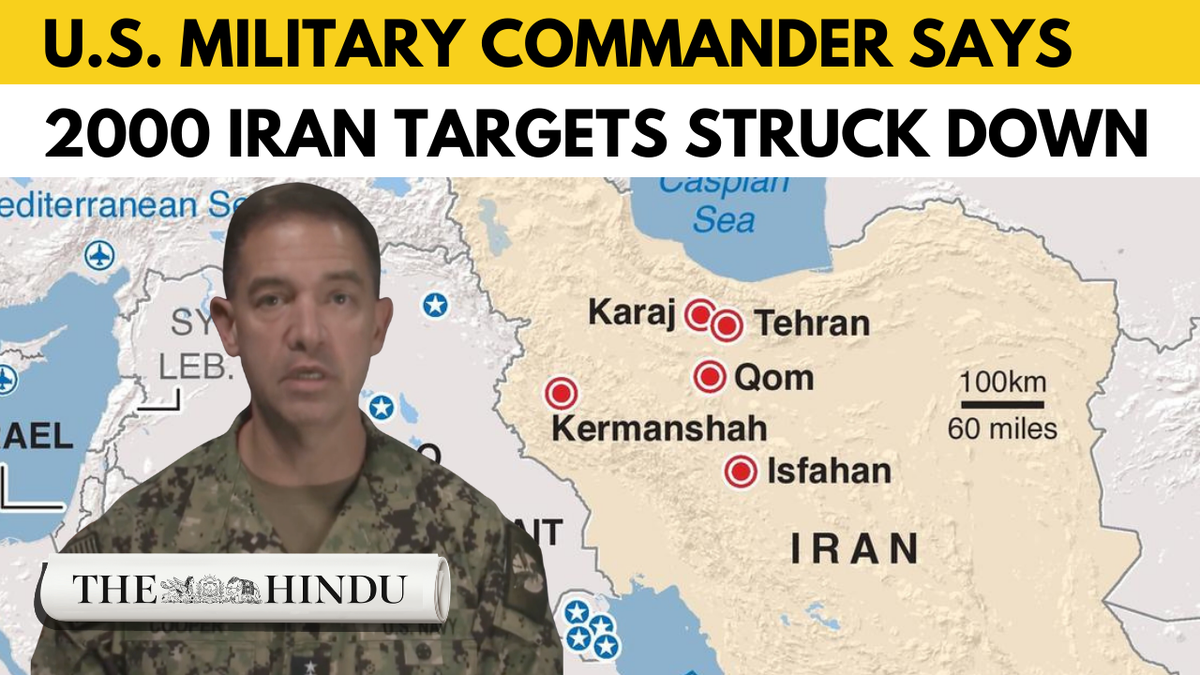
The briefing room in the Pentagon doesn’t smell like heroism. It smells like industrial carpet cleaner, stale coffee, and the ionizing hum of too many high-end processors packed into a space meant for human lungs. When the commander stepped to the lectern to outline the parameters of Operation Epic Fury, he didn't lead with a call to arms. He led with a map. It was a digital sprawl of the Indo-Pacific, a blue-black expanse where the distance between safety and catastrophe is measured in milliseconds and Mach numbers.
War, in the modern imagination, is often a sequence of explosions. We think of the kinetic—the fire, the smoke, the thunder. But as the briefing unfolded, it became clear that Epic Fury is less about the noise of battle and more about the terrifyingly sophisticated silence that precedes it.
The Invisible Net
Imagine a young sailor named Elias. He is twenty-two, three thousand miles from his home in Ohio, standing watch on the deck of a guided-missile destroyer. The air is thick with salt and humidity. To Elias, the ocean looks empty. To the sensors integrated into the Epic Fury framework, that same horizon is a crowded, screaming riot of data.
The core of this operation isn’t just about moving ships or positioning jets. It is about "Joint All-Domain Command and Control," a term that sounds like a textbook but functions like a nervous system. In the past, the Army, Navy, and Air Force operated like three different people trying to build a house while speaking three different languages. One had the hammer, one had the nails, and the third had the blueprints, but they only checked in with each other once an hour.
Epic Fury changes the dialect. It creates a singular, flickering consciousness where a satellite in low earth orbit can see a threat and, within heartbeats, transmit that precise coordinate to a submarine or a terrestrial battery. The "Fury" isn't just in the firepower; it’s in the speed of the thought.
The Chessboard of Atoms and Bits
The commander spoke of "interoperability" as if it were a physical shield. It isn’t. It’s a gamble on mathematics. The U.S. military is betting that by weaving every sensor—from the camera on a high-altitude drone to the sonar on a sub—into a unified web, they can create a "kill web" rather than a "kill chain."
A chain is linear. You break one link, and the whole thing falls apart. A web is resilient. You can cut ten strands, and the structure still holds its prey.
This is the hidden reality of modern deterrence. We are no longer in an era where having the biggest gun wins the day. We are in an era where the person who can process the most information the fastest dictates the reality of the battlefield. If the adversary believes that any move they make will be detected and countered before their own missiles even clear the silos, the war never starts. That is the ultimate goal of Epic Fury: a conflict won by being so prepared that the first shot is never fired.
The Human Cost of Automation
There is a hollow feeling that comes when you realize how much of our survival is being outsourced to algorithms. During the briefing, the technical jargon often masked the visceral truth that these systems are designed to make decisions at a speed no human brain can match.
Consider the hypothetical moment of escalation. A swarm of low-cost, high-speed "attritable" drones—disposable machines meant to overwhelm defenses—appears on the radar. Elias, our sailor in the Pacific, cannot track five hundred incoming targets at once. He can't even perceive them. His eyes see the sunset; his monitors see a swarm of digital ghosts.
The software within the Epic Fury architecture has to decide which targets are real, which are decoys, and which interceptor is the most cost-effective to launch. It is a cold, binary logic applied to the most feverish human experience imaginable. The commander’s tone remained steady, but the stakes were written in the lines around his eyes. If the logic fails, the human cost is total.
The military calls this "the edge." It’s a double entendre. It refers to the physical edge of the battlefield—the remote sensors and forward-deployed units—but it also refers to the psychological edge. How far can you push a system before the complexity becomes its own enemy?
The Geography of Tension
The Indo-Pacific is not a flat map. It is a jagged collection of sovereign interests, underwater mountain ranges, and invisible boundaries. Operation Epic Fury is specifically calibrated for this terrain. In the desert, you have line-of-sight. In the jungle, you have cover. But in the vastness of the Pacific, you have nothing but distance.
The commander detailed how the operation utilizes "distributed lethality." This is the military’s way of saying "don't put all your eggs in one basket." Instead of one massive aircraft carrier acting as the sole target for an enemy, the force is spread out. Small, agile units are tucked into islands and hidden in the swells of the sea. They are quiet. They are waiting.
They are connected by the same invisible threads of data that the briefing focused on so heavily. This decentralization makes the U.S. presence harder to hit, but infinitely harder to manage. It requires a level of trust in the technology that would have been unthinkable twenty years ago. You are asking a commander on a remote atoll to trust data coming from a pilot he has never met, flying a plane he cannot see, based on a satellite feed managed by a technician in Colorado.
The Paradox of Peace
We often view military exercises as aggressive posturing. In the context of Epic Fury, the narrative is more nuanced. It is a display of "integrated deterrence." The logic is circular: we show that we can fight a lightning-fast, high-tech war so that we don't have to.
But the friction lies in the perception. To an observer, a "kill web" looks a lot like a noose. As the commander clicked through slides of logistical hubs and strike packages, the atmosphere in the room felt heavy with the realization that we are entering a period of history where the margin for error has effectively vanished.
In the old days, a stray ship or a misunderstood signal could be rectified with a radio call and a few hours of diplomacy. Today, when systems are programmed to react in seconds, a "glitch" can look like an act of war. The commander didn't say this explicitly—generals rarely do—but the subtext was there in every mention of "latency" and "data integrity."
The Ghost in the Machine
Behind every fact presented in the briefing was an unasked question: What happens when the lights go out?
Epic Fury relies on the sanctity of the electromagnetic spectrum. It relies on the idea that our data will flow as freely as water. But the very first move in a modern conflict isn't a bomb; it’s a hack. It’s a burst of noise that jams communications and turns our sophisticated sensors into blind, screaming piles of hardware.
The commander touched on "resilience," a word that has become a mantra in the halls of the Pentagon. It means having a backup for the backup. It means training sailors like Elias to use a sextant and a paper map when the GPS satellites are deactivated. It is the strange intersection of the 21st century and the 18th—a high-tech shield backed by a low-tech grit.
This is the "invisible stake." We aren't just competing in terms of who has the faster jet; we are competing in terms of whose society can survive the sudden loss of its digital nervous system. Epic Fury is an attempt to harden that system, to make it so robust that it becomes an unappealing target.
The Silent Watch
As the briefing concluded, the lights in the room came up, washing out the blue glow of the Pacific map. The journalists packed their laptops, and the commander folded his notes. Outside, the world continued its frantic, uncoordinated dance.
Operation Epic Fury isn't a single event. It isn't a battle with a start and end date. It is a permanent state of being. It is the sound of a million processors humming in the dark, the invisible pulse of data jumping from satellite to ship, and the steady breath of thousands of young men and women standing watch on the edge of the world.
We live in a time where peace is maintained by the terrifying perfection of our machines. We hope the web holds. We hope the data is true. We hope that by preparing for the fury, we never have to feel its heat.
The sailor on the deck looks out at the water, seeing only the moon’s reflection on the waves, unaware that he is a single, vital node in a digital consciousness that spans half the globe, waiting for a signal that everyone prays will never come.