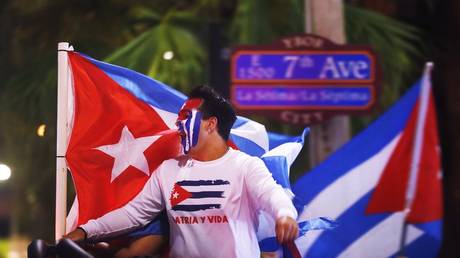
Havana isn't just angry; it's practically screaming. Following a deadly shootout on the high seas this week, the Cuban government is once again pointing a finger at Washington, claiming the U.S. is a safe haven for "militants" hell-bent on regime change. If you think this is just the same old Cold War rhetoric, you're missing the bigger picture. The stakes in early 2026 have shifted from ideological bickering to a high-pressure survival game.
The recent incident involved a boat, reportedly stolen from the Florida Keys, that was intercepted by the Cuban coast guard. The ensuing firefight left four people dead. Havana’s Deputy Foreign Minister, Carlos Fernandez de Cossio, wasted no time in calling out the U.S. for what he describes as a decades-long policy of financing and ignoring anti-government groups operating out of Florida.
This isn't a new accusation, but the context is different now. The island is currently suffocating under a renewed "oil blockade" and a national emergency declared by the Trump administration. With fuel shortages causing massive blackouts and food supplies dwindling, the Cuban government sees these maritime incursions not just as isolated criminal acts, but as a deliberate attempt to spark a collapse from within.
The list that keeps the conflict alive
A major point of contention right now is the "terrorist list." Back in late 2023, Cuba published its own list of dozens of individuals and organizations it claims are responsible for planning attacks. Two of the men involved in this week's shootout were reportedly on that list, which Havana says it shared with U.S. law enforcement in 2023 and 2025.
The Cuban argument is simple: why are these people walking free in Miami if the U.S. is serious about counter-terrorism?
From Washington’s perspective, it’s a matter of free speech and lack of evidence. The U.S. hasn't traditionally treated anti-communist activists as "terrorists" unless they’re caught red-handed with explosives on American soil. This massive gap in how both sides define "militancy" vs. "political activism" is exactly why we're seeing this cycle of violence.
The Biden administration briefly tried to walk things back in early 2025, notifying Congress of plans to remove Cuba from the State Sponsors of Terrorism (SST) list. But that move was essentially a "lame duck" gesture. As soon as Donald Trump returned to office, he rescinded the decision on his first day. Today, Cuba remains on that list alongside Iran, North Korea, and Syria.
Economic warfare disguised as security policy
You can't talk about expat militancy without talking about the "Donroe Doctrine"—the aggressive petro-politics currently strangling the island. The U.S. has intensified the economic blockade to a level we haven't seen in years. It’s not just about trade anymore; it’s about physically stopping oil from reaching Cuban shores.
- The Oil Blockade: U.S. officials are now reportedly following tankers bound for Cuba, threatening tariffs on any nation—specifically aiming at Mexico and remaining Venezuelan supplies—that helps the island with fuel.
- The Fuel Crisis: Cuba only produces about 40% of the fuel it needs. The lack of imports has led to blackouts that last for days, making it impossible for the government to maintain basic services.
- The "Friendly Takeover" Rhetoric: President Trump has openly discussed a "friendly takeover" of Cuba, a phrase that sounds like corporate jargon but carries heavy military undertones for those in Havana.
Ambassador Rodrigo Malmierca Diaz recently told a Canadian committee that this is "collective punishment." He’s not wrong about the impact. When a country's power grid fails, people can't pump water, store food, or run hospitals. For the Cuban government, the "militants" in Florida are just the tip of the spear in a broader strategy to make the island uninhabitable.
The Miami connection and the "insurgency" narrative
There's a lot of noise coming out of Miami, and some of it is genuinely radical. Activists like Roberto Azcorra Consuegra—whom the Cuban government mistakenly named as being on the boat this week—have been vocal. Azcorra Consuegra openly admitted to the New York Times that he wants to topple the regime using methods beyond "picket signs and slogans."
This is the "gray zone" that makes this situation so dangerous. You have individuals who are US-based, deeply angry about the state of their homeland, and seemingly willing to take high-stakes risks.
Havana claims the group on the boat was part of a Florida-based insurgency. Meanwhile, some US media reports suggest the group might have been infiltrated or even set up by Cuban security forces to create a pretext for the current crackdown. Honestly, given the history of the G2 (Cuban intelligence), both things could be true at once.
Why 2026 is different from 1961
During the Bay of Pigs era, the U.S. was looking for a military win. In 2026, they're looking for an economic collapse. The Trump-Rubio strategy isn't about landing troops; it’s about waiting for the lights to go out and staying out of the way when the pressure cooker finally explodes.
Secretary of State Marco Rubio has been clear: the administration wants the government to fall but isn't necessarily going to be the one to push it. They’ll just pull the plug on the life support.
The real tragedy is that ordinary Cubans are caught in the middle of this high-stakes poker game. If you're a family in Havana, you don't care about the SST list or the Monroe Doctrine. You care that you haven't had electricity for 18 hours and there’s no bread at the bodega.
What to watch for in the coming months
- Canadian and Mexican Intervention: Canada has expressed that the Cuban regime is "quite stable" despite the pressure. Look for Ottawa and Mexico City to potentially defy U.S. sanctions by sending "humanitarian" fuel shipments, which could lead to a diplomatic rift with Washington.
- The "Wet Foot, Dry Foot" Ghost: While that policy is officially dead, the desperation in Cuba is driving people back to the sea. Expect more "stolen boats" and maritime skirmishes as people try to get in or out.
- Internal Unrest: If the blackouts continue through the summer heat, the 2021 protests will look like a rehearsal. Havana will likely use the "U.S.-backed militancy" narrative to justify even harsher internal crackdowns.
Keep a close eye on the Florida Keys. If the "stolen boat" incidents become a weekly occurrence, we're looking at a flashpoint that could easily spiral into a direct naval confrontation. For now, the best thing you can do is look past the headlines and recognize that this isn't just a spat between neighbors—it's a deliberate, systematic attempt to force a nation to its knees.


