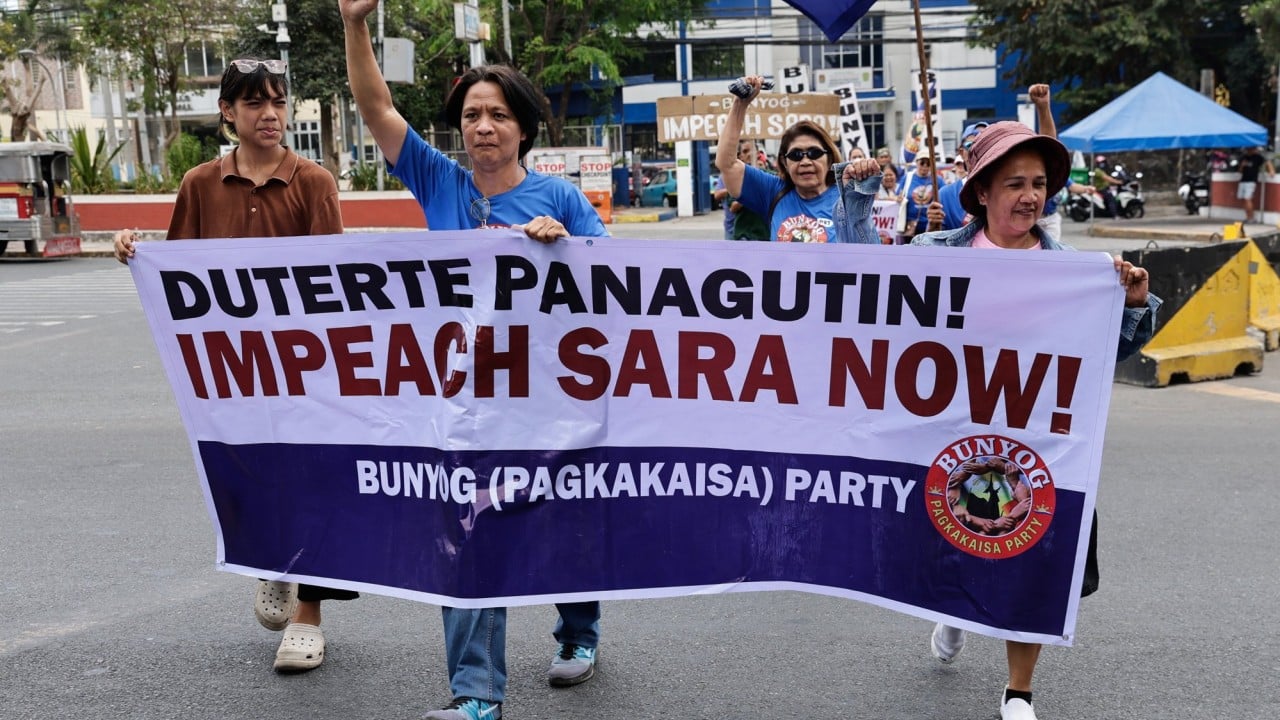
The political marriage of convenience that reshaped the Philippines is officially dead. Vice President Sara Duterte now faces a plenary vote in the House of Representatives that could strip her of office, a move that signals the complete collapse of the "UniTeam" alliance that swept the 2022 elections. This isn’t just a procedural hurdle or a simple case of legislative oversight. It is a full-scale demolition of the Duterte family's national influence, orchestrated by a Congress that has pivoted its loyalty toward President Ferdinand Marcos Jr. and House Speaker Martin Romualdez.
The impeachment articles center on the alleged misuse of confidential funds and claims of coercion, but the underlying mechanics are far more complex. At the heart of the crisis is a struggle over the 2028 presidency. By moving to impeach the Vice President now, her opponents are attempting to neutralize the most significant threat to the current administration's long-term hold on Malacañang.
The Money Trail and the Confidential Fund Trap
The primary catalyst for this impeachment remains the swift and controversial disbursement of 125 million pesos in confidential funds in late 2022. Critics argue these funds were spent in just 11 days without a clear legal basis in the national budget. For a veteran journalist covering the Commission on Audit (COA), the red flags are not just about the speed of the spending, but the lack of transparency in the liquidation process.
In the Philippines, confidential and intelligence funds (CIF) are the third rail of government spending. They are notoriously difficult to track, designed for national security and surveillance. When the Office of the Vice President (OVP) requested and spent these amounts, it opened a flank that the House of Representatives was all too eager to exploit. The House Committee on Appropriations, once a rubber stamp for the Vice President’s requests, suddenly found its spine. This shift was not accidental. It followed a public falling out between the Vice President and Speaker Romualdez, the President’s cousin.
The audit reports leaked to the media suggest a pattern of spending that the committee describes as "irregular." Duterte’s refusal to attend several hearings or provide detailed explanations under oath gave her detractors the ammunition they needed. They framed her silence as defiance, and her defiance as an admission of guilt.
Coercion Claims and the Breaking of the Silence
Beyond the financial allegations, a more personal and damaging narrative emerged involving claims of coercion. Witnesses, including some government officials, have alleged that pressure was applied to facilitate the rapid movement of funds and to silence dissent within the bureaucracy. These testimonies transformed a technical budget dispute into a moral and legal crusade.
When a government official is accused of using the weight of their office to bypass standard operating procedures, it touches on the constitutional definition of "betrayal of public trust." This is a broad, catch-all category for impeachment in the Philippines, and it is precisely where the prosecution intends to hit hardest. They are building a case that paints the Vice President not as a victim of political persecution, but as an official who believed she was above the very rules she was sworn to uphold.
The optics are devastating. For years, the Duterte brand was built on the image of the "strongman"—a family that gets things done by cutting through red tape. Now, that same reputation is being used against Sara Duterte. The "strongman" tactics are being rebranded as "authoritarian overreach" in the halls of the Batasang Pambansa.
The Great Realignment of 2026
The Philippine legislature operates on a system of patronage and shifting alliances. To understand why the impeachment is moving to a plenary vote now, one must look at the local political map. With the 2025 midterm elections recently concluded and the 2028 presidential race looming, local kingpins are choosing sides.
The Duterte family, once the undisputed sun around which Philippine politics revolved, is seeing its gravity weaken. The alliance with the Marcoses was always a tactical truce rather than a genuine partnership. It was a deal between the North and the South to consolidate power. Once that power was secured, the internal competition for the future became inevitable.
The House of Representatives is currently dominated by the "Lakas-CMD" party and other factions loyal to the Speaker. For these lawmakers, voting for impeachment is a way to signal their loyalty to the current administration and secure their own budgetary allocations for their districts. It is a cold, calculated survival instinct.
Defending the Indefensible or Political Martyrdom
Sara Duterte’s defense strategy has been unconventional. Instead of engaging with the legal minutiae of the audit reports, she has taken her case to the public. She portrays the impeachment as a "dirty power play" by a "hungry" political elite. This is a classic populist play: if you cannot win in the courtroom or the boardroom, win in the streets.
However, the effectiveness of this strategy is waning. The "Davao Magic" that protected her father, former President Rodrigo Duterte, does not seem to carry the same weight in the face of specific, documented allegations of fund mismanagement. The public is weary. High inflation and economic concerns have made the sight of millions of pesos being spent in "confidential" ways a bitter pill to swallow for the average Filipino.
The Vice President’s legal team argues that the impeachment is a "fishing expedition" and that the House has already pre-judged the case. They aren't entirely wrong. Impeachment is, by design, a political process. It is the ultimate expression of the legislature's power over the executive. In the Philippines, the truth often matters less than the number of votes you can whip in the plenary.
The International Dimension and the ICC Shadow
One cannot discuss the downfall of the Duterte-Marcos alliance without mentioning the International Criminal Court (ICC). The elder Duterte’s "War on Drugs" remains under international scrutiny. For a long time, the Marcos administration provided a shield against ICC investigators.
As the rift between the families widened, that shield began to crack. The President has shifted his rhetoric, suggesting that cooperation with international bodies is not entirely off the table if "sovereignty is respected." This subtle shift is a sword of Damocles hanging over the Duterte family. The impeachment of Sara is the domestic front of a two-pronged attack; the ICC represents the international front. If she is removed from office, she loses the immunity and the institutional platform that currently protects her family’s interests.
The Plenary Vote and the Threshold of Power
The move to the plenary is a significant escalation. It means the committee believes it has enough "substance" to force every member of the House to go on the record. Each congressman will have to cast a vote that will define their relationship with both the current President and the former First Family.
To impeach the Vice President, the House needs a one-third vote of all its members. Given the current composition of the chamber, that threshold is well within reach for the administration. From there, the case moves to the Senate, which acts as an impeachment court. The Senate is a different beast entirely. It is smaller, more independent, and its members often have their own presidential ambitions.
While the House might be a landslide, the Senate trial will be a grind. It will be a televised spectacle that could last months, dominating the national conversation and paralyzing other legislative agendas. This is the risk for the Marcos administration: if the trial drags on, it could turn Sara Duterte into a martyr, fueling a backlash among her core supporters in Mindanao.
The Cost of Political Warfare
The real tragedy of this impeachment is the diversion of national resources and attention. While the elite in Manila trade blows over confidential funds and constitutional interpretations, the country faces pressing issues. Power shortages, agricultural inefficiencies, and a precarious South China Sea situation require a unified government.
Instead, the Philippines is witnessing a return to the "politics of subtraction." This is the cycle where each administration spends its first three years consolidating power and its last three years trying to destroy the opposition to ensure a favorable succession. The impeachment of Sara Duterte is the latest chapter in this exhausted playbook.
It is a high-stakes gamble for President Marcos. If the impeachment succeeds, he removes his greatest rival. If it fails, or if the Senate acquits her, he will have created a vengeful and energized opponent with nothing left to lose.
The plenary vote is not just about a 125-million-peso budget discrepancy. It is a referendum on whether the Duterte era is truly over or if this is merely the beginning of a much more volatile phase of Philippine democracy. The lawmakers walking onto the floor of the House are not just voting on articles of impeachment; they are voting on the new hierarchy of power in Southeast Asia.
The result of the plenary will be felt far beyond the halls of Congress. It will determine the investment climate, the stability of the military-police establishment, and the very structure of the 2028 elections. The era of the UniTeam is buried; what rises from its grave remains to be seen.