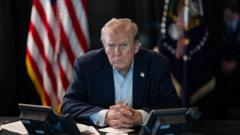
Wall Street isn't used to this kind of volatility anymore. For years, investors grew fat and happy on predictable central bank interventions and the "Fed Put." That era is dead. Donald Trump’s recent "whatever it takes" stance on trade and currency has sent a lightning bolt through global markets, and if you're still playing by the 2010s rulebook, you’re going to get burned.
The phrase "whatever it takes" usually belongs to central bankers like Mario Draghi. When a politician says it, the meaning shifts from stability to disruption. Trump isn't looking to calm the waters. He’s looking to move the shorelines. This isn't just about tariffs or a specific trade deal with a single country. It’s a total overhaul of how the United States interacts with the global economy.
Why the markets are actually panicking
Markets hate uncertainty. They hate it more than bad news. Right now, the uncertainty is coming from the sheer scale of the proposed shifts. When the White House signals it will use every tool in the shed—tariffs, currency devaluation, and tax incentives—to force manufacturing back to U.S. soil, the global supply chain feels the floor drop away.
Most analysts focus on the 10% or 20% across-the-board tariff ideas. That’s the surface level. The deeper issue is the "whatever it takes" rhetoric implies a willingness to endure short-term domestic pain to achieve long-term geopolitical dominance. If you're a fund manager in London or Tokyo, that sounds like a recipe for a stronger dollar, higher inflation, and a lot of sleepless nights.
Historically, the U.S. government tried to stay out of the way of the dollar’s natural market value. No more. The current sentiment suggests a move toward a weaker dollar to make American exports cheaper. But you can't just flip a switch on the world's reserve currency without breaking a few things.
The myth of the controlled trade war
Don't believe the talking heads who say this will be a "controlled" transition. Trade wars are messy. They're chaotic. When you slap a tariff on steel, the guy making washing machines in Ohio pays more. Then he raises prices for you.
The "whatever it takes" approach assumes that the U.S. consumer can stomach these price hikes long enough for factories to actually be built. That takes years. It doesn't happen in a single fiscal quarter. In the meantime, we see what's happening in the bond markets. Yields are jumping because investors are pricing in a reality where the "Transitory Inflation" lie is replaced by "Permanent Policy Inflation."
Breaking down the impact by region
The pain isn't distributed equally. Some sectors are getting hammered while others are quietly licking their chops.
The European Struggle
Germany is already on the brink of a multi-year recession. Their business model—buy cheap Russian energy, sell expensive cars to China—is completely broken. Trump’s aggressive stance on NATO spending and auto tariffs puts the Eurozone in a vice. If the U.S. goes full protectionist, the Euro loses its primary escape hatch.
The Mexican Near-Shoring Gamble
Mexico should be the winner here. It’s right next door. But the "whatever it takes" rhetoric includes threats about border security and drug cartels that could easily spill into trade sanctions. It’s a high-risk, high-reward play for companies moving operations out of Asia.
The Chinese Decoupling
This is the big one. We’re moving past "de-risking" into total "decoupling." China’s economy is already struggling with a massive property debt bubble. A fresh round of aggressive U.S. trade policy might be the thing that finally forces Beijing to devalue the Yuan significantly. If that happens, expect a deflationary wave to hit global commodities.
What most people get wrong about inflation 2.0
You’ll hear people say that tariffs are just a tax on the consumer. That’s true, but it’s also a narrow view. The bigger inflationary pressure comes from the "whatever it takes" fiscal side. If the administration pushes for massive infrastructure spending while simultaneously cutting off cheap foreign labor and goods, the math only goes one way. Up.
I’ve seen people argue that the Fed will just lower rates to compensate. They can’t. If the Fed lowers rates while the White House is pushing protectionist policies, the dollar would collapse too fast, causing a different kind of crisis. We’re looking at a period where the government and the central bank might be pulling in opposite directions.
How to position yourself when the rules change
Stop looking at the S&P 500 as a single entity. It's not. It’s a collection of companies with vastly different exposures to this "whatever it takes" doctrine.
- Check the supply chain. Any company that relies on "Just-in-Time" delivery from Shenzhen is a ticking time bomb. You want companies with "Just-in-Case" inventories and domestic sourcing.
- Watch the small caps. The Russell 2000 often does better in a protectionist environment because these companies are mostly domestic. They don't care as much about a trade spat with the EU.
- Hard assets are back. If the goal is to weaken the dollar to boost exports, you don't want to be holding only cash. Gold, land, and even certain industrial commodities will act as the hedge they were meant to be.
The volatility isn't a bug. It’s a feature. The goal of this policy shift is to keep competitors off balance. If you're a retail investor, the best thing you can do is reduce your leverage. You don't want to be forced out of a good position just because of a 3:00 AM post that moves the market 4% in the wrong direction.
The reality of the new world order
The globalized world of the 1990s is a museum piece. It’s gone. We’re moving into a fractured, multi-polar world where trade is used as a weapon, not just a tool for prosperity. Trump’s "whatever it takes" isn't a temporary tantrum. It’s the new baseline.
You need to audit your brokerage account today. Look at your international exposure. If you're heavy in emerging markets that rely on U.S. consumption, you're standing in the path of a steamroller. Move toward sectors that provide essential services within the U.S. borders. Think energy, defense, and specialized tech.
Don't wait for the next headline to react. The "whatever it takes" doctrine means the reaction will always be too late for the slow-footed. Simplify your holdings. Focus on quality. Stay liquid enough to take advantage of the dips that this rhetoric will inevitably create. The chaos is coming. Make sure you’re the one buying the fear, not selling it.
Look at your portfolio's exposure to Chinese manufacturing and cut it by half. Reallocate that capital into U.S. automation and robotics firms. These are the companies that will actually build the "Made in America" future that this policy demands. If the labor is too expensive here, the machines will have to do the work. That’s where the real money will be made in the next four years.