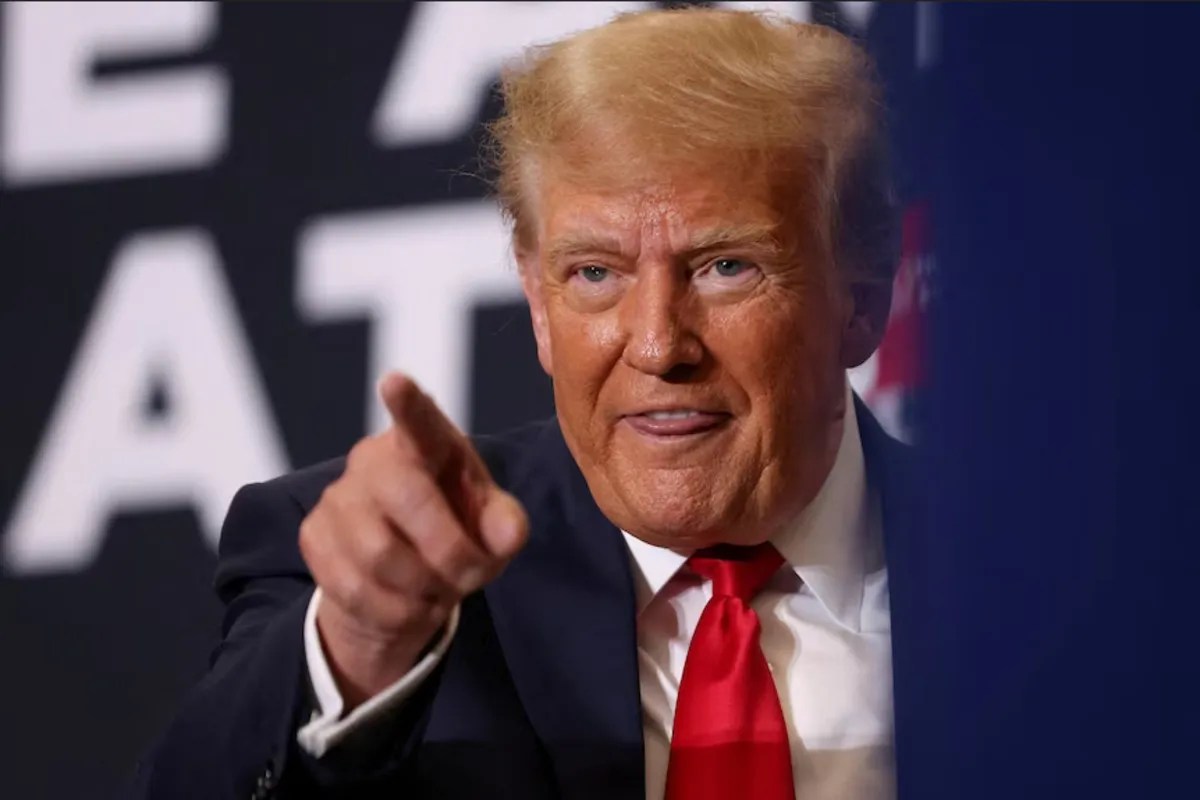
The global energy market just received a cold reminder of who holds the keys to the world's most vital maritime choke point. Donald Trump has declared that the United States military blockade of the Strait of Hormuz will remain absolute until Tehran signs a comprehensive new deal that strips away its regional influence and nuclear ambitions. This is not just another round of sanctions. It is a deliberate, surgical attempt to disconnect Iran from the global economy by physically obstructing its primary export artery.
By targeting the Strait, Trump is hitting the Iranian regime where it is most vulnerable. Roughly one-fifth of the world’s total oil consumption passes through this narrow waterway every single day. For Iran, the Strait is a lifeline; for the rest of the world, it is a potential flashpoint that could send crude prices into a vertical climb. The administration’s gamble relies on the belief that the Iranian economy, already reeling from years of isolation, will buckle under the pressure of a total maritime freeze before the global market finds a way to bypass the Gulf entirely.
The Arithmetic of a Maritime Siege
To understand the scale of this confrontation, one must look at the geography. At its narrowest point, the Strait of Hormuz is only 21 miles wide, with shipping lanes in each direction spanning just two miles. It is a geographic bottleneck that allows a dominant naval power to dictate terms to every nation involved in the Persian Gulf trade. By maintaining a blockade, the U.S. is not merely stopping Iranian tankers. It is creating a "risk premium" so high that international insurance firms are refusing to cover any vessel attempting to dock at Iranian terminals like Kharg Island.
The strategy is simple. If the oil cannot be insured, it cannot be shipped. If it cannot be shipped, the Iranian government loses its primary source of hard currency. This creates a domestic crisis for Tehran, as the value of the rial plummets and the cost of basic imported goods skyrockets. We are seeing a transition from "maximum pressure" via paper sanctions to "maximum physical denial" via naval presence.
The Failure of Shadow Fleets
For years, Iran managed to skirt international restrictions using a "shadow fleet" of aging tankers that turned off their transponders and engaged in ship-to-ship transfers in the middle of the night. This cat-and-mouse game worked when the enforcement was primarily bureaucratic. However, a physical blockade changes the math. U.S. Fifth Fleet assets, supported by satellite intelligence and drone surveillance, are now identifying these vessels in real-time.
The era of the "ghost tanker" is ending. When a destroyer sits at the mouth of the Gulf, the technicalities of which flag a ship is flying matter far less than the reality of a boarding party or a forced redirection. Industry insiders report that the volume of Iranian crude reaching Chinese "teapots"—the small, independent refineries that were Tehran's biggest customers—has dropped by more than 60 percent since the blockade intensified.
Impact on the Global Energy Grid
The immediate fear in Western capitals is a spike in the price of Brent crude. Logically, removing millions of barrels of oil from the market should cause a supply shock. Yet, the reaction has been strangely muted. This is because the U.S. has timed this move to coincide with record-breaking domestic production and a slowdown in industrial demand from Europe.
Texas and New Mexico are currently pumping oil at rates that would have been unthinkable a decade ago. This American surplus acts as a buffer. While the blockade creates tension, it hasn't yet triggered $150-a-barrel oil because the market knows that Saudi Arabia and the UAE hold significant spare capacity that they can release to prevent a global recession. The blockade is a targeted strike on Iranian revenue, not a war on the global consumer.
The Role of Regional Power Brokers
Riyadh and Abu Dhabi are watching this play out with a mix of satisfaction and anxiety. On one hand, a weakened Iran reduces the threat of regional proxy wars. On the other, any military escalation in the Strait puts their own desalination plants and export terminals at risk of retaliatory strikes. The U.S. has reportedly provided private guarantees to these Gulf allies, promising advanced missile defense intercepts and direct naval escorts for their own fleets.
This creates a split reality in the Gulf. Tankers carrying Saudi or Emirati crude move under the protection of the very same warships that are turning back vessels bound for Iranian ports. It is a controlled environment designed to keep the world fueled while starving a single specific actor.
Technical Barriers to an Iranian Response
Tehran has long threatened to "close" the Strait of Hormuz if they were ever backed into a corner. In reality, they lack the conventional naval power to hold the waterway against a modern carrier strike group. Their strategy relies instead on asymmetric warfare: fast-attack boats, sea mines, and shore-based anti-ship missiles.
$$F = \frac{1}{2} \rho v^2 C_d A$$
The physics of naval defense favor the U.S. in this scenario. Advanced Aegis combat systems are designed to track and neutralize dozens of incoming targets simultaneously. While a "swarm" of small boats could theoretically overwhelm a single vessel, it cannot clear a path for oil exports. Iran can cause chaos, but it cannot restore its own commerce through force. This realization is likely what is driving the internal debate within the Iranian leadership between the hardline Revolutionary Guard and the more pragmatic elements of the foreign ministry.
The Chinese Dilemma
Beijing is the wild card. As the world’s largest oil importer, China has a vested interest in keeping the Gulf open and prices low. However, China is also wary of getting dragged into a direct maritime confrontation with the U.S. over Iranian oil. Currently, Beijing is engaging in a delicate balancing act—publicly criticizing the "unilateral" blockade while privately seeking alternative supplies from Russia and Central Asia.
The U.S. is betting that China’s need for a stable relationship with the American consumer market outweighs its desire for cheap Iranian crude. If China decides to challenge the blockade by sending its own naval escorts for Iranian tankers, the situation escalates from a regional trade dispute to a global superpower standoff. So far, there is no evidence that Beijing is willing to take that leap.
The Infrastructure of Economic Warfare
Modern warfare is not just about kinetic energy; it is about the flow of data and dollars. The blockade is supported by a sophisticated web of financial surveillance. Every vessel has a Unique Vessel Identification (UVI) number, and its movements are tracked via AIS (Automatic Identification System) data integrated with high-resolution synthetic aperture radar (SAR) imagery.
If a ship attempts to obscure its origin or destination, the discrepancy is flagged within seconds. The U.S. Treasury Department then follows the money trail, freezing the assets of any brokerage or port authority that facilitates the trade. This multi-layered approach ensures that even if a ship physically makes it through the Strait, the owners will find it impossible to spend the resulting profit in the legitimate banking system.
Domestic Pressure Inside Iran
The human cost of this policy is becoming impossible to ignore. In Tehran and Mashhad, the price of meat and medicine has doubled in the last six months. The regime faces a choice: continue funding regional proxies and a nuclear program while the population slides into poverty, or come to the table and surrender the very things they claim define their national sovereignty.
History suggests that regimes of this nature rarely collapse quickly. They tend to harden their grip, using the external threat to justify internal crackdowns. However, the scale of this economic strangulation is unprecedented. Unlike previous embargoes, there is no "exit valve" through which the regime can vent the pressure.
Naval Logistics and the Long Game
Maintaining a blockade is an exhausting logistical feat. It requires constant rotation of crews, immense fuel consumption, and a high state of readiness. The U.S. is leveraging its base in Bahrain and its logistical hub in Djibouti to keep the pressure constant. This is a display of endurance. The administration is signaling that it can stay in the Strait longer than the Iranian central bank can stay solvent.
Critics argue that this approach pushes Iran closer to Russia, creating a "bloc of the sanctioned" that operates entirely outside Western influence. While there is truth to this, the practical reality is that Russia is a competitor to Iran in the oil market, not a customer. Moscow wants higher oil prices and more market share for its own Urals blend; it has little incentive to help Iran sell its oil.
The blockade of the Strait of Hormuz is the ultimate test of American maritime hegemony. It is a high-stakes play that assumes the global economy is resilient enough to handle the exclusion of one major producer. If Trump succeeds, he will have redefined how superpower influence is projected in the 21st century without firing a shot in a full-scale war. If he fails, he risks a localized conflict that could ignite the entire Middle East.
The pressure is now on the Iranian leadership to blink. They are watching their primary source of wealth vanish into the blue waters of the Gulf, blocked by a wall of steel that shows no sign of moving. The silence from the Iranian oil terminals is the loudest signal in the market today.