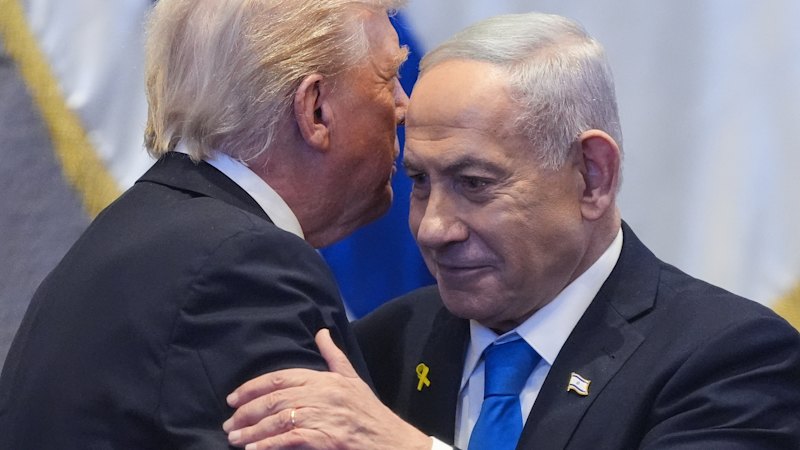
Donald Trump and Benjamin Netanyahu don't just share a political base; they share a survival instinct. It's a bond forged in high-stakes legal battles and a mutual disdain for the traditional diplomatic playbook. If you've been watching the escalating tensions in the Middle East and wondering why the brakes aren't being tapped, the answer is simple. Both men have calculated that a state of permanent or expanded conflict serves their domestic interests better than any ceasefire ever could. This isn't just about regional security anymore. It's about an alliance that puts personal political longevity above every other geopolitical consideration.
The reality on the ground in 2026 reflects this perfectly. We aren't looking at a localized skirmish. We're looking at a fundamental shift in how the U.S. and Israel project power. Netanyahu needs the "forever war" to keep his coalition intact and his legal troubles at bay. Trump needs a strongman image and a clear-cut "us versus them" narrative to fuel his base. Together, they've created a feedback loop where escalation is the only logical move.
The End of Strategic Patience
For decades, U.S. policy in the Middle East relied on the idea of "strategic patience" and the "two-state solution" as a North Star, even if that star was fading. That's dead. Trump’s return to power didn't just revive the Abraham Accords; it weaponized them against any remaining hopes for Palestinian statehood. Netanyahu saw this as a green light. He isn't just managing a conflict now. He's trying to settle it on his terms through sheer force.
The shift moved from containment to total victory. That's a dangerous pivot. When you tell a nation that only "total victory" is acceptable, you remove the possibility of a diplomatic exit ramp. Netanyahu has leaned into this rhetoric because it makes him indispensable. As long as the threat is existential, he's the only one who can lead. Trump backs this because it mirrors his own "America First" or "Winning" brand. It's performative strength that has real-world, bloody consequences.
Why the Domestic Front Drives the War Machine
You can't understand the current military stance without looking at the courtroom. Both leaders have spent years fighting off investigations. In Israel, Netanyahu's survival depends on his far-right ministers, people like Itamar Ben-Gvir and Bezalel Smotrich. These guys don't want peace. They want annexation. If Netanyahu stops the war, his government falls. If his government falls, he loses his immunity shield.
Trump operates on a similar frequency. His support for Netanyahu's most aggressive moves isn't just about foreign policy. It's about signaling to his evangelical base and wealthy donors that he's the ultimate protector of Israel. He doesn't care about the nuances of Lebanese border disputes or the humanitarian catastrophe in Gaza. He cares about the optics of being a "tough guy" who doesn't let international organizations like the UN or the ICC tell him—or his allies—what to do.
The Iran Obsession and the New Map
The biggest piece of this puzzle is Iran. Both leaders have essentially decided that the only way to "fix" the Middle East is to break Tehran. We've seen a massive uptick in shadow war tactics turning into direct confrontations. By framing every regional proxy—be it Hezbollah in Lebanon or the Houthis in Yemen—as a direct extension of the Iranian "octopus," they've justified an infinite expansion of the battlefield.
This strategy ignores a basic fact. You can't bomb an ideology out of existence. But from the perspective of the Trump-Netanyahu alliance, that doesn't matter. The goal is disruption. They want to redraw the map of the Middle East to exclude Iranian influence entirely, even if it means dragging the U.S. into a direct regional war that could last a decade. They've bet the house on the idea that the American public is too tired or too distracted to stop them.
The Cost of Bypassing Traditional Diplomacy
We used to have "red lines." Now we have "suggestions." The State Department and the traditional diplomatic corps have been sidelined. Trump has always preferred back-channeling through family members or loyalist billionaires. Netanyahu prefers speaking directly to the American public or Congress, bypassing the White House when it doesn't suit him.
This erosion of institutional oversight means decisions about airstrikes or ground invasions are made in small, echo-chamber circles. There’s no one in the room saying "Wait, what's the day-after plan?" because the "day after" isn't the priority. The priority is the "now." The priority is the next news cycle, the next poll, and the next court date.
- Intelligence sharing has become more transactional.
- Military aid is used as a political cudgel rather than a strategic tool.
- International law is treated as an optional suggestion for "weak" nations.
What Happens When the Pressure Reaches a Breaking Point
The world is waiting for a de-escalation that isn't coming. If you're expecting a "grand bargain" or a sudden return to the status quo, you're misreading the players. Trump and Netanyahu aren't looking for a return to 2015. They're looking for a total reset. That usually requires a massive fire to clear the brush.
The risk of a miscalculation is at an all-time high. When you have two leaders who view compromise as a sign of weakness and legal vulnerability, they will always choose to double down. We've seen this in the West Bank, where settlement expansion has hit record speeds. We've seen it in the skies over Damascus and Beirut. The alliance isn't just a political agreement. It's a pact that says "your enemies are my enemies," and right now, they have a lot of enemies.
Stop looking at the official press releases. Look at the budget allocations. Look at the troop movements. The infrastructure for a much larger conflict is being built right in front of us. Both men have decided that the political price of peace is too high for them personally.
If you want to understand where this goes next, stop listening to the talk about "defense." Start looking at the maps being drawn in the offices of the far-right in Jerusalem and the Mar-a-Lago war rooms. The plan isn't to end the war. The plan is to win it so completely that there's nothing left to negotiate. That’s a recipe for a generation of instability. If you’re tracking your investments or your safety, start diversifying your risks. The "stability" of the old world order isn't just cracked; it's been discarded by the very people tasked with maintaining it. Keep your eyes on the Mediterranean and the Persian Gulf—the next move won't be a handshake; it'll be a launch.


