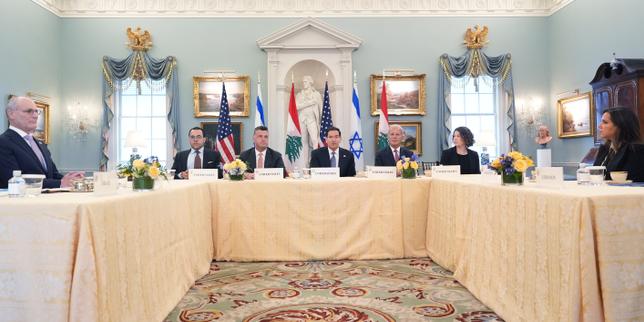
Diplomatic theater is a comfortable drug. Right now, the media is obsessed with the latest rounds of talks in Washington aimed at stretching a fragile truce between Lebanon and Israel. They call it progress. They call it de-escalation. They are wrong.
What we are witnessing isn't the groundwork for peace; it is the strategic reloading of weapons under the guise of "stability." The conventional wisdom suggests that every day without a missile launch is a victory for diplomacy. In reality, these pauses are the most dangerous periods of a conflict because they provide the oxygen for a more catastrophic explosion later. I have spent years analyzing Middle Eastern procurement cycles and border skirmish data. The pattern is clear: these high-level summits don't solve structural grievances; they merely formalize a temporary stalemate that both sides use to fix their logistical failures.
The Myth of the Diplomatic Buffer
The prevailing narrative focuses on the 1701 Resolution or some revamped version of it. The "experts" argue that if we can just get both parties into a room in D.C., we can create a sustainable buffer zone. This ignores the physical reality on the ground.
A truce in the Middle East is not a ceasefire in the Western sense. It is a tactical pivot. While diplomats argue over the phrasing of a communiqué, the actual actors on the border are busy. They are recalibrating drone frequencies. They are digging deeper into the limestone of Southern Lebanon. They are refining the target coordinates for critical infrastructure in Haifa and Beirut.
By pushing for a "prolongation" of the truce, Washington is effectively subsidizing the preparation for a total war. When you stop a fight midway through, you don't end the grudge. You just give the fighters time to sharpen their knives.
Why Washington is the Wrong Venue
There is a fundamental arrogance in thinking a boardroom on the Potomac can dictate the security architecture of the Galilee or the Litani. The negotiators in Washington are operating on a four-year election cycle. The combatants in the Levant are operating on a forty-year ideological arc.
- Misaligned Incentives: The U.S. wants a "win" to show its electorate that it can still manage global hotspots.
- The Sunk Cost Fallacy: Billions have been poured into the Lebanese Armed Forces (LAF) under the assumption they can act as a counterweight to non-state actors. They can't.
- Intelligence Gaps: D.C. relies on satellite imagery and signals intelligence, which often misses the granular, human-level shifts in intent that drive border escalations.
If you want to understand the failure of these talks, look at the currency. While the diplomats talk, the Lebanese Lira continues its death spiral, and the Israeli economy bleeds from the cost of mobilizing reserves. A truce does nothing to address the economic rot that makes war an attractive distraction for failing political classes.
The "Stability" Trap
People often ask: "Isn't a temporary peace better than an immediate war?"
It sounds logical. It's also a trap. This is the "Stability Trap." When you artificially prolong a truce without addressing the underlying cause—the presence of massive, unauthorized arsenals and the total lack of a sovereign border—you create a pressure cooker.
Imagine a scenario where a boiler is over-pressurized. The "diplomatic" solution is to tape the cracks and tell everyone to keep quiet. The "contrarian" solution is to vent the pressure, even if it’s loud and messy, before the whole building levels itself.
By preventing a limited kinetic resolution now, Washington is ensuring a total regional conflagration in eighteen months. We are trading a series of manageable skirmishes for a single, unmanageable catastrophe.
The Failure of International Oversight
The competitor article likely lauds the role of UNIFIL or international observers. Let’s be blunt: international observers in Southern Lebanon are essentially high-priced tourists with blue helmets. They have no mandate to disarm, no power to intervene, and no ability to report anything that hasn't already been seen on TikTok.
Relying on "international guarantees" is a proven recipe for disaster. Ask the residents of the Galilee who have lived under the shadow of Kornet missiles for two decades. Ask the civilians in Southern Lebanon who see their villages turned into tactical assets. The D.C. talks are trying to fix a hardware problem with a software update. It doesn't work.
The Uncomfortable Truth About "Negotiated Settlements"
True peace in this region has never come from a signed piece of paper in a foreign capital. It comes from a shift in the local balance of power that makes the cost of conflict higher than the cost of compromise.
Currently, the cost of conflict is subsidized.
- Lebanon receives aid despite failing to meet any security benchmarks.
- Israel receives military support that allows it to maintain a high-intensity posture indefinitely.
When you subsidize a behavior, you get more of it. These negotiations are a subsidy for the status quo.
The Logic of the Brink
We need to stop asking "How do we extend the truce?" and start asking "What does a sustainable border actually look like?"
A sustainable border requires:
- Direct Communication: Not through a series of "special envoys" who have to translate every nuance into State Department-speak.
- Economic Interdependence: Which is currently impossible given the political climate, but is the only historical metric that has ever prevented war.
- Hard Demarcation: Not "lines of withdrawal" that shift based on who is holding the megaphone that day.
The current talks ignore these pillars. They are focused on the optics of the next 72 hours, not the reality of the next decade.
The Hidden Cost of the Pause
Every day this "truce" is extended through D.C. meddling, the barrier to a real solution grows higher. Why? Because it allows the radical elements on both sides to claim that the "moderate" path of negotiation is a sham. They pointedly show that while the suits are talking in Washington, nothing changes on the ground.
The radicalization of the border populations is the direct result of "successful" diplomatic interventions that leave the actual threat intact. We are breeding a generation of combatants who see diplomacy not as a tool for resolution, but as a tactic for deception.
Stop Trying to Save the Truce
The obsession with saving the truce is a symptom of a broader foreign policy failure: the inability to accept that some conflicts cannot be "managed" away. They must be resolved. Resolution is painful. It requires making choices that will make you unpopular at a dinner party in Georgetown.
If the U.S. actually wanted to prevent a war, it would stop hosting these performative summits. It would stop pretending that the current Lebanese government has the agency to enforce anything. It would force a direct confrontation with the reality of the border rather than smoothing it over with vague promises of future aid.
The downside to my approach? It's volatile. It risks immediate escalation. But the alternative is a guaranteed, much larger war that will draw in the entire region. I’ve seen this play out in 2006, in 2012, and in 2021. The "truce extension" is the prelude to the graveyard.
Stop praising the negotiators. Start watching the munitions. The talk in Washington is just background noise for the sound of boots hitting the dirt. Diplomacy isn't failing; it's being used as a smokescreen. And we are all falling for the theater.
Remove the subsidies. Force the local actors to own their security. Stop treating the symptoms while the infection turns gangrenous.
The truce isn't a bridge to peace. It’s a countdown.