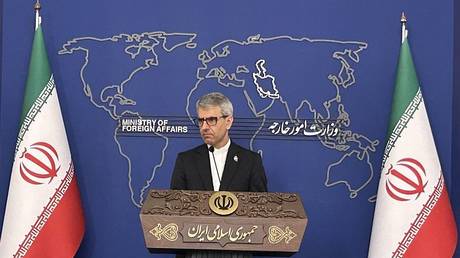
The international media is currently obsessed with a tennis match of accusations where the ball doesn't actually exist. On one side, we have Donald Trump’s camp claiming Iran is weeks away from a "nuclear breakout." On the other, Tehran dismisses these claims as "big lies" and Zionist propaganda.
Both sides are lying. But they aren't lying about the facts; they are lying about the stakes.
The lazy consensus among foreign policy "experts" is that we are witnessing a binary struggle between a rogue state seeking a bomb and a global superpower trying to prevent Armageddon. This is a fairy tale. The reality is far more cynical. The nuclear program isn't a weapon-in-waiting; it is a permanent diplomatic hostage.
The Myth of the "Breakout Clock"
Every time a politician mentions a "breakout time"—the duration required to produce enough weapons-grade uranium for a single device—they are performing a magic trick. They want you to look at the centrifuge, not the delivery system.
Building a nuclear weapon requires three distinct pillars:
- Fissile Material: Enrichment of Uranium-235 to roughly 90%.
- Weaponization: Shrinking a physics package to fit inside a nosecone.
- Delivery: A reliable Intercontinental Ballistic Missile (ICBM).
Iran has mastered the first. They are "threshold" capable. This means they have the keys to the car, the gas in the tank, and the engine is idling. But they have intentionally stalled on the second and third pillars. Why? Because actually having a bomb is a strategic nightmare for the Islamic Republic. Once you test a device, your leverage evaporates. You go from being a "threatening mystery" to a "target."
I have watched analysts for two decades move the goalposts on Iran’s nuclear timeline. It’s always "six months away." In the early 2000s, it was six months. In 2015, it was six months. In 2024, it’s apparently six minutes. If the intelligence was ever as accurate as the headlines claim, the explosion would have happened during the Bush administration.
Why Tehran Needs the "Lie"
When Iranian officials call Trump’s claims "big lies," they are playing a specific character in a long-running theater piece. They need the West to believe they are the rational victims of "Maximum Pressure" because victimhood is the only currency that buys them space at the negotiating table.
If Iran admits they are pursuing a weapon, they face a unified global blockade, including China and Russia. If they admit they have no intention of building a weapon, they lose their only piece of leverage to get sanctions lifted. They must exist in a permanent state of "maybe."
The "big lie" isn't that they aren't working on a bomb. The big lie is that they are a peaceful civilian energy program. No country on earth spends billions of dollars and endures decades of soul-crushing economic isolation just to keep the lights on in Tehran with nuclear power—especially not a country sitting on the world's fourth-largest oil reserves and second-largest gas reserves.
The Trump Paradox
Trump’s rhetoric is equally hollow, though for different reasons. By shouting about "big lies" and "nuclear secrets," he creates a high-stakes environment where he can eventually claim to be the only person capable of "making the deal."
The 2018 withdrawal from the JCPOA (Joint Comprehensive Plan of Action) didn't stop the Iranian program; it accelerated it. This isn't a partisan take; it’s a mathematical one. Before the withdrawal, Iran’s enrichment was capped at 3.67%. Today, they are hitting 60% purity at the Fordow plant.
The irony is that Trump’s aggression provides the hardliners in Tehran with exactly what they need: an external enemy to justify the suffering of their own people. The more the U.S. screams "Wolf!", the more the Iranian Revolutionary Guard Corps (IRGC) can tighten its grip on the domestic economy under the guise of "national security."
Stop Asking If They Want the Bomb
People always ask: "Will Iran build the bomb?"
This is the wrong question. It’s a 20th-century question.
In the 21st century, the threat of the bomb is more powerful than the bomb itself. Look at North Korea. They have the bomb. Are they more integrated into the global economy? No. Are they more secure? Arguably, they are more of a target than ever.
Iran is pursuing the "Japan Model" (with a darker twist). Japan has the technology, the material, and the expertise to build a nuclear weapon in a matter of months. They don’t do it because the alliance with the U.S. makes it unnecessary. Iran wants the same capability—to be a "turnkey" nuclear power—to ensure that no one ever dares to attempt a regime change.
The moment Iran assembles a warhead, they lose. The moment they stop trying to assemble a warhead, they lose. Their entire survival strategy depends on being in the middle of that sentence forever.
The Intelligence Failure of Certainty
We see "leaked" intelligence reports every week. One says Iran is pausing. One says they are moving components to underground facilities near Natanz.
I’ve spent enough time around defense contractors and "Beltway bandits" to know how these reports are generated. They are built on "signatures"—satellite imagery of moving trucks, increased power consumption, or intercepted communications that are often intentionally "leaked" by the Iranians themselves.
We are making the same mistake we made in 2003 with Iraq’s WMDs, but in reverse. Back then, we assumed the presence of a program based on shadow-play. Now, we are ignoring the fact that the shadow-play is the program. ### The Brutal Reality of Sanctions
The media loves to talk about how sanctions are "crippling" the Iranian nuclear effort. This is a fundamental misunderstanding of how autocratic regimes function.
Sanctions do not stop nuclear programs. They consolidate them.
When you cut off a country from the global banking system, the only entities capable of smuggling goods and managing "off-book" wealth are the military and the intelligence services. In Iran, that is the IRGC. By "punishing" Iran, we have effectively handed the entire national economy to the very people running the centrifuges.
The nuclear program isn't just a point of pride; it’s a massive money-laundering operation. It justifies "security" budgets that are never audited. It allows for the "emergency" seizure of assets. If the nuclear issue were settled tomorrow, the IRGC would lose its primary reason for existing.
The "Zionist Plot" Rhetoric
Tehran’s insistence that these claims are "Zionist lies" is a tired trope used to deflect from their own technical advancements. It’s a dog whistle for their regional proxies (Hezbollah, Houthis, PMF).
But here is the nuance: Israel does benefit from the exaggeration. By keeping the world in a state of constant panic about an "existential threat," the Israeli security establishment ensures a steady flow of U.S. aid and a "blank check" for regional operations.
It is a symbiotic relationship of mutual escalation. Tehran needs the "Great Satan" and the "Zionist Entity" to stay in power. The hardliners in the West and Israel need the "Mullahs with Nukes" to keep their defense budgets bloated.
The Actionable Truth
If you want to understand what is actually happening, stop reading the official statements from the Iranian Foreign Ministry or the campaign trail in the U.S.
Look at the International Atomic Energy Agency (IAEA) reports on "unexplained particles."
When the IAEA finds traces of uranium at sites like Marivan or Turquzabad that shouldn't be there, that isn't a "big lie." That is physics. You cannot "lie" about isotopes. However, those particles are often decades old—ghosts of a program that was mothballed in 2003 and is being used as a bogeyman today.
The real danger isn't a mushroom cloud over Tel Aviv or Riyadh. The danger is a miscalculation where one side starts believing their own propaganda. If Trump believes his own hype about a "breakout" and launches a "preventative" strike, he hits empty tunnels and triggers a regional war that doubles the price of oil overnight.
If Tehran believes their own "big lie" that the West is too weak to act, they might actually cross the threshold and find themselves facing a coalition they can't bribe or bluster their way out of.
Stop looking for the "truth" in the headlines. Both sides have a vested interest in you being terrified and confused. The nuclear program is a ghost. It is a tool for domestic control in Tehran and a tool for electoral posturing in Washington.
The most dangerous thing in the Middle East isn't a bomb. It's the fact that the people in charge are more interested in the theater of war than the reality of peace.
Throw away the "breakout clock." It’s a toy for people who don't understand how power actually works. Iran isn't building a bomb; they are building an insurance policy. And like all insurance policies, it’s only valuable if you never have to use it.
The "big lie" isn't what they are doing. It's why they are doing it.
Stop falling for the performance.