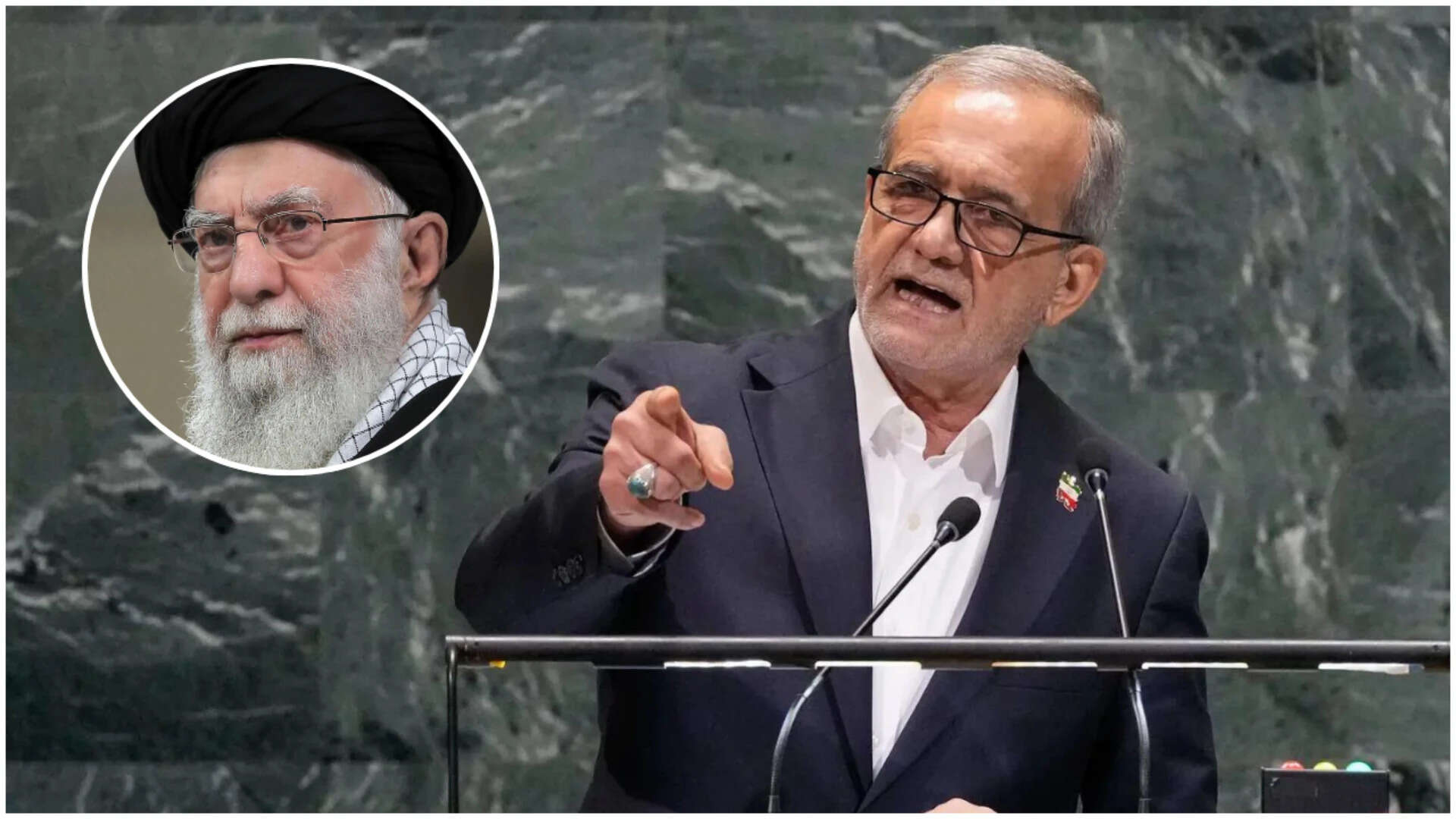
The assassination of a high-ranking state figure on sovereign soil is more than a security breach. It is a mathematical problem for the victimized regime. When Iranian President Masoud Pezeshkian stood before his parliament to declare that avenging the death of a guest—in this case, a figure under the protection of the Supreme Leader—was a "legitimate duty," he wasn't just speaking to his domestic base. He was signaling the start of a calibrated, high-stakes escalation cycle designed to restore a shattered deterrent.
The immediate reality is stark. Iran’s security apparatus failed at its most basic task: protecting a high-profile asset during a period of maximum sensitivity. For Pezeshkian, a relative moderate who entered office with the promise of economic reform and potential diplomatic de-escalation, this crisis is an early, brutal litmus test. He is now forced to balance the hardliners' demand for blood with the logistical reality that a full-scale regional war would likely dismantle the very economic recovery he was elected to facilitate.
The Infrastructure of a State Response
Retaliation in the Middle East is rarely a matter of raw emotion. It is a bureaucratic process. When a leader of Pezeshkian’s standing uses the language of "right and duty," he is activating a specific set of military and intelligence protocols. The Iranian response is likely to be tiered, utilizing a mix of kinetic strikes and asymmetric digital warfare.
We have seen this script before. After the 2020 killing of Qasem Soleimani, the response was a synchronized ballistic missile barrage on the Al-Asad airbase in Iraq. It was loud, it was telegraphed, and it was designed to satisfy the public’s need for "revenge" without forcing the United States into a total war. However, the current atmosphere is different. The target this time was hit in the heart of Tehran, not a foreign battlefield. This proximity changes the "humiliation index" that the Iranian leadership must satisfy.
The technical execution of such a response involves the Islamic Revolutionary Guard Corps (IRGC) Aerospace Force. They rely on a sophisticated inventory of medium-range ballistic missiles, such as the Kheibar Shekan, which boasts a reported range of 1,450 kilometers. These systems are not just tubes of explosives. They are instruments of foreign policy. By choosing specific coordinates, Iran communicates exactly how much risk it is willing to tolerate.
The Failure of the Protective Shield
To understand why Pezeshkian is so adamant about the "duty" of revenge, one must look at the catastrophic failure of Iran's internal security. The assassination suggests a level of penetration by foreign intelligence—likely Mossad—that should be impossible in a high-security zone.
Intelligence experts look for "indicators and warnings" (I&W). In this instance, the indicator was a precision strike that bypassed several layers of electronic and physical surveillance. This implies either a significant technological gap or, more likely, an "inside-out" operation where local assets provided the final-mile tracking data. Pezeshkian’s rhetoric acts as a smoke screen for the internal purges that are almost certainly happening within the IRGC's counter-intelligence wings right now.
If the state cannot protect its guests, it cannot project power. The "revenge" being promised is as much about convincing domestic dissidents that the state is still in control as it is about punishing the external enemy.
The Role of Asymmetric Assets
While the world watches for missiles, the real "revenge" might happen in the dark. Iran has spent two decades building a formidable cyber warfare capability. For a regime that wants to hurt its opponent without triggering a rain of F-35s on its oil refineries, the digital realm is the ideal playground.
- Critical Infrastructure Attacks: Targeting water treatment plants or electrical grids.
- Data Exfiltration: Releasing sensitive documents to embarrass the opposing government.
- Proxy Activation: Coordinating with groups in Lebanon, Yemen, and Iraq to create a multi-front pressure point.
These methods allow for "plausible deniability," a luxury that a direct ballistic missile strike from Iranian soil does not afford.
Economic Fragility vs. Military Pride
Pezeshkian’s greatest challenge is the Iranian Rial. Every time a missile is fueled, the currency feels the heat. The Iranian public is exhausted by decades of sanctions and double-digit inflation. There is a quiet but persistent segment of the population that views these foreign entanglements as a waste of national treasure.
If Pezeshkian overreaches, he risks a domestic blowback that could dwarf the protests of recent years. If he under-responds, he loses the support of the security establishment that actually holds the keys to the country. This is the "Goldilocks" problem of modern Middle Eastern geopolitics: the response must be "just right"—harsh enough to deter, but controlled enough to avoid a collapse of the status quo.
The Proxy Entanglement
The "Axis of Resistance" is not a monolith. While Tehran provides the funding and the hardware, groups like Hezbollah and the Houthis have their own domestic agendas. However, an assassination of this magnitude forces a unified front. We are seeing a shift from "strategic patience" to "active deterrence."
This transition is dangerous because it relies on the assumption that the other side will accurately read your signals. In intelligence circles, this is known as "signal-to-noise" ratio. If Iran sends a "message" strike that accidentally kills a high-ranking civilian or a foreign diplomat, the escalation ladder loses its rungs, and the region slides into the abyss.
Precision Over Power
Modern warfare has moved away from the "carpet bombing" mentalities of the 20th century. Iran’s military leaders are obsessed with circular error probable (CEP)—the measure of a weapon system's precision.
$$CEP = 0.59 \times (R_x + R_y)$$
Where $R_x$ and $R_y$ represent the standard deviations of errors. By reducing the CEP, Iran can claim to be a modern military power capable of surgical strikes, mimicking the very tactics used against them. This pursuit of precision is a psychological tool. It tells the adversary: "We can see you, and we can touch you, anywhere."
The rhetoric coming out of the President's office is the first stage of the launch sequence. It prepares the international community for the inevitable "response" so that when it happens, it is viewed as a forecasted event rather than a random act of terror. This normalization of state-on-state violence is perhaps the most concerning trend of the current decade.
The Intelligence Gap
The most uncomfortable truth for the Pezeshkian administration is the realization that their communication channels are compromised. You don't hit a target in a "secure" guesthouse in the middle of a capital city without knowing exactly which window to aim for.
This suggests that the "revenge" Pezeshkian promises must also be internal. We should expect a series of "accidental" deaths or public trials within the Iranian security services over the coming months. The state needs a scapegoat for the lapse in protection just as much as it needs a target for its missiles.
The cycle of violence in the region has moved beyond the point of simple grievances. It is now an algorithmic exchange of blows where each side feels compelled to have the last word. Pezeshkian, despite his moderate leanings, is now a prisoner of this logic. He cannot negotiate from a position of perceived weakness, and he cannot find strength without risking everything he was elected to fix.
The "legitimate duty" he speaks of is a trap. It is a commitment to a path where the exit ramps are disappearing, leaving only the momentum of the next strike to dictate the future of the Iranian state.
Monitor the movement of mobile missile launchers in the western provinces; they speak more clearly than any press release from Tehran.