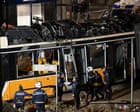
The derailment of a high-capacity transit vehicle in an urban core is rarely the result of a single mechanical fluke; it is the catastrophic intersection of kinetic energy management, aging infrastructure, and a breakdown in automated signaling protocols. In the recent incident in Milan, where a tram derailment resulted in two fatalities and 38 injuries, the primary investigative focus must shift from the immediate wreckage to the "Swiss Cheese Model" of accident causation. This framework posits that a disaster occurs only when the holes in multiple layers of defense—mechanical, human, and systemic—align perfectly. To understand why this occurred in one of Europe’s most sophisticated light-rail environments, one must analyze the mechanical stressors inherent in Milan’s specific rail geometry and the failure of the "dead man’s switch" or Automatic Train Protection (ATP) systems.
The Mechanics of Derailment Physics
Derailment occurs when the lateral forces acting on a wheelset exceed the vertical forces holding it to the rail, a relationship defined by the Nadal formula. In urban tram systems, this equilibrium is most fragile at three specific "risk nodes."
- Switch Point Divergence: The most common point of failure is the "frog" or the switch point where tracks split. If a switch is not fully locked or if a "gap" exists due to debris or thermal expansion, the wheel flange can climb the rail.
- The Centrifugal Vector: As a tram enters a curve, momentum dictates that the vehicle wants to continue in a straight line. If the speed exceeds the "critical cant deficiency"—the limit of how much the track’s inward tilt can compensate for speed—the outer wheel flange will eventually hurdle the rail head.
- Wheel-Rail Interface Degradation: Milan’s historic center utilizes track segments that have undergone decades of "work hardening." When the rail head becomes too flat or the wheel flange becomes too thin (a condition known as "hollow wear"), the geometric security of the system is compromised.
The severity of the 38 injuries reported suggests a "secondary impact" scenario. In many derailments, the initial jump from the tracks is survivable; the fatalities occur when the vehicle’s remaining kinetic energy carries it into "unyielding infrastructure" such as utility poles, building facades, or, most lethally, oncoming traffic. The mass of a standard ATM (Azienda Trasporti Milanesi) tram, often exceeding 30 tonnes when loaded, means that even at a relatively low speed of 30 km/h, the momentum is sufficient to shear through reinforced concrete.
Automated Redundancy and the Human Element
Modern transit safety relies on the decoupling of human reflex from braking action. When a tram derails and continues to move until it strikes a terminal object, it indicates a failure in the Emergency Braking Logic.
In most light-rail systems, safety is governed by the Active Monitoring Loop:
- Dead Man’s Control: A pedal or handle that the operator must physically engage. If the operator suffers a medical emergency (e.g., a heart attack or seizure), the release of this pressure should trigger an immediate pneumatic brake application.
- Overspeed Protection: Inductive loops in the track (transponders) communicate with the vehicle. If the tram enters a 15 km/h zone at 25 km/h, the system should automatically override the traction motor and apply the magnetic track brakes.
- Magnetic Track Brakes: Unlike traditional disc brakes that rely on wheel-to-rail friction, these are electromagnetic skids that drop directly onto the rail. They are the final line of defense against derailment-induced slides.
The high injury count in Milan points to a failure of these systems to activate pre-impact. If the tram derailed due to an overspeed condition, the ATP should have logged a fault seconds before the event. If the derailment was caused by a mechanical "split switch," the instantaneous loss of circuit continuity in the signaling system should have locked all surrounding blocks. The investigation must determine if these safety layers were bypassed or if the latency in the system's response time was too high for the urban density of the crash site.
Infrastructure Stress and Urban Density Constraints
Milan’s transit network is a hybrid of 19th-century street layouts and 21st-century rolling stock. This creates a "geometric mismatch." Modern trams are longer and heavier, yet they must navigate the same tight radii designed for horse-drawn carriages or much smaller "Ventotto" (Class 1500) cars.
This mismatch creates Accelerated Wear Cycles.
The tighter the curve, the more "flange squeal" and friction occur. This friction isn't just noise; it is the literal shaving away of steel. In a high-density environment like Milan, the frequency of service means the rails have less time to "rest" and cool, leading to thermal stress. Furthermore, the presence of "pave" (cobblestones) around the tracks complicates visual inspections. A hairline fracture in a rail sleeper or a loose tie-bar may remain hidden beneath the stone surface until the lateral force of a passing tram causes a catastrophic snap.
Quantifying the Survivability Gap
The two fatalities in this incident highlight the "Interior Ballistics" of transit accidents. When a tram derails, the passengers inside become unconstrained projectiles. Unlike automobiles, trams lack seatbelts or airbags.
The Injury Matrix in this event likely followed a predictable pattern of kinetic transfer:
- The Primary Jerk: The moment the wheels leave the track, the deceleration is non-linear. Passengers are thrown forward or sideways depending on the angle of the derailment.
- The Lateral Roll: If the tram tips, the vertical grab bars—designed for stability during transit—become lethal obstacles that cause blunt force trauma to the cranium and ribcage.
- Structural Intrusion: The most common cause of death in derailments is when the "envelope" of the passenger cabin is breached by external objects.
To mitigate this in future urban planning, transit authorities must implement Passive Safety Envelopes. This includes the use of "crumple zones" in tram chassis and the replacement of rigid interior fixtures with energy-absorbing polymers. However, the legacy nature of Milan's fleet means that many active vehicles lack these modern dissipative structures.
The Strategic Response for Municipal Transit
The immediate reaction to a derailment of this scale is usually focused on "operator error," but a data-driven approach requires a "Systems Audit."
The first priority is the implementation of Predictive Maintenance via Acoustic Monitoring. By placing sensors along high-risk curves and switches, transit authorities can "hear" the signature of a failing bearing or a misaligned rail before it results in a flange climb. This moves the maintenance model from "Reactive" (fixing what broke) to "Proactive" (fixing what is vibrating at an irregular frequency).
Secondly, the "Signal-to-Brake" latency must be audited across the entire ATM fleet. If the 38 injuries were exacerbated by the tram traveling more than five meters after the initial derailment, the braking logic is insufficiently aggressive. The magnetic track brakes should be wired to trigger not just on operator command, but on any detected "vertical displacement" of the wheelset.
Finally, the city must address the Infrastructure-Vehicle Delta. If the rolling stock is too heavy for the historic track geometry, either the speed limits must be reduced through hard-coded software limiters or the track beds must be reinforced with high-strength composite sleepers.
The Milan derailment is a stark reminder that in the friction between a 30-tonne vehicle and a 19th-century city, the margins for error are measured in millimeters. The transition from manual oversight to automated, sensor-driven safety is no longer an upgrade; it is a fundamental requirement for urban densification. Any transit system operating without real-time "Health and Usage Monitoring Systems" (HUMS) is essentially operating on borrowed time, relying on the hope that the "Swiss Cheese" holes never align.
The investigation must now pivot to the "Black Box" data. We need to see the exact millisecond the traction power was cut relative to the moment of impact. If the power remained active during the slide, the systemic failure is not just mechanical—it is a catastrophic logic error in the vehicle's central processing unit. Move to mandate that all light-rail operators integrate high-frequency LiDAR on tram fronts to detect track misalignments 50 meters ahead of the vehicle's position, effectively creating a "digital lookout" that outpaces human reaction time.