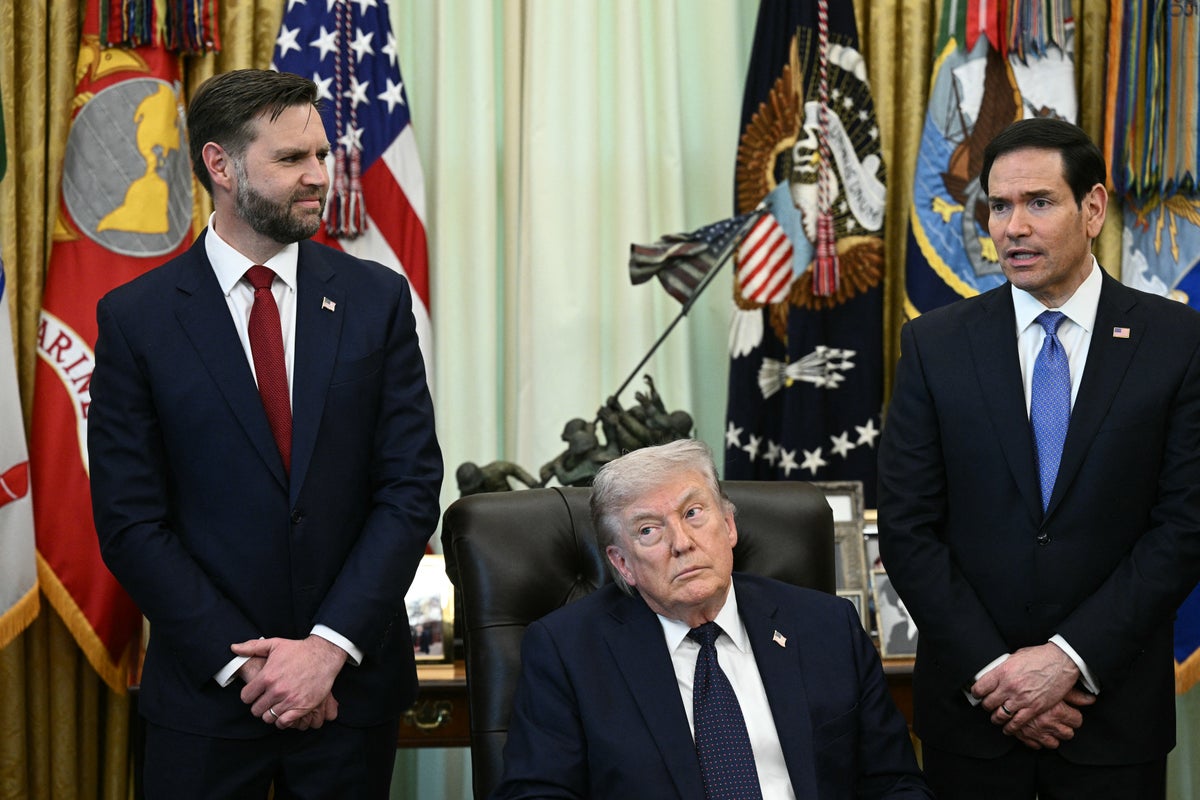
The political press is obsessed with a horse race that doesn't exist. They spend thousands of words dissecting the "rivalry" between JD Vance and Marco Rubio, treating the MAGA movement like a standard corporate entity with a clear line of succession. They look at Mar-a-Lago and see a boardroom. They should be looking at a solar system where only one star matters, and everything else is just cold rock caught in its gravity.
The lazy consensus suggests that Donald Trump is "fueling a debate" over his successor. That implies Trump cares about what happens to the GOP after he leaves the stage. He doesn't. He never has. To understand the future of American populism, you have to stop asking who the next "Trump" is and start realizing that the movement is fundamentally non-transferable.
The Rubio Fallacy: Why Longevity is a Liability
Marco Rubio is the ultimate "safe" bet for people who still think it’s 2012. The argument for Rubio usually centers on his foreign policy credentials and his ability to bridge the gap between the old-school GOP donor class and the new-age populist base.
This is a fundamental misunderstanding of the current Republican electorate. In the MAGA era, "credentials" are scars, not assets. Every year Rubio spent being a "serious" senator is a year he spent being part of the machine the base wants to dismantle. You cannot be the heir to a revolutionary movement when you were the guy the revolution was originally aimed at.
Rubio represents the "Return to Normalcy" wing of the party that is currently hiding in plain sight. If Trump picks Rubio for a major role or signals him as a favorite, it isn't a hand-off of the movement; it’s a neutralization of a former rival. Rubio’s utility to Trump is as a loyalist who brings a veneer of institutional respectability to a chaotic administration. That makes him a tool, not an heir.
The Vance Illusion: Right Message, Wrong Messenger
Then there is JD Vance. The media loves the Vance narrative because it feels like a movie script: the hillbilly-turned-intellectual who provides the "philosophical backbone" for Trumpism. They see his youth and his mastery of New Right rhetoric and assume he is the natural evolution of the brand.
They are wrong.
Vance is an intellectual. Trump is a force of nature. You cannot replace a force of nature with an intellectual. The MAGA base doesn’t show up to rallies to hear about "post-liberalism" or the intricate failures of the neoliberal order. They show up for the raw, unscripted defiance of the man at the podium.
Vance’s problem is that he is too coherent. He tries to make Trumpism make sense. But the power of Trumpism lies in its internal contradictions—the ability to be pro-worker and anti-union, isolationist and aggressive, populist and billionaire-friendly all at once. When Vance tries to codify this into a rigorous political philosophy, he loses the magic. He becomes just another politician with a platform.
I’ve watched political consultants blow millions of dollars trying to "package" populism. It always fails. You can’t manufacture the grievance-driven charisma that defines the current GOP. Vance is a high-functioning deputy, but in a movement built on a cult of personality, there is no room for a Vice-Prophet.
The "Successor" Question is a Category Error
The reason the debate between Marco and JD is so misguided is that it assumes Trumpism is a set of ideas. It’s not. It’s a relationship.
In a traditional political party, you have a platform. If the leader retires, the next person takes the platform and runs with it. But the GOP is no longer a traditional party. It is a personality-driven vehicle. When the personality is gone, the vehicle stops moving.
Imagine a scenario where Trump exits the stage tomorrow. Does the base go to Vance because he has the most "MAGA-aligned" voting record? Does it go to Rubio because he has "experience"?
No. The base fractures.
The mistake the "insider" pundits make is believing the voters are loyal to the brand. They aren't. They are loyal to the man. Without Trump, the coalition of disaffected blue-collar workers, rural voters, and anti-establishment firebrands has no glue. Rubio and Vance aren't competing to be the next King; they are competing for the right to manage the ruins.
The Donor Class Delusion
Inside Mar-a-Lago, the chatter about succession is mostly driven by the people who write the checks. They are desperate for a "Trump with a filter." They want the tax cuts and the deregulation without the 3:00 AM social media posts.
Rubio is their dream candidate. Vance is their necessary evil.
But the donors have lost their veto power. In the 2000s, a candidate like Rubio would have been a juggernaut because he checks every box on a spreadsheet. Today, those boxes are irrelevant. The donors are the last people to realize that the GOP base doesn't want a refined version of Trump. They want the chaos. The chaos is the point.
If you are looking for the "next" Trump, you shouldn't be looking at the Senate floor. You should be looking at the fringes of media and entertainment. The next leader of this movement won't be a career politician who learned to speak MAGA as a second language. It will be someone who doesn't speak the language of Washington at all.
The High Cost of Loyalty
There is a dark side to this "succession" game that Rubio and Vance both know, even if they won't admit it. To be in Trump’s orbit is to be constantly tested. The moment a potential successor starts looking too much like an heir, they become a threat.
Look at the history of those who were once touted as the "future" of the MAGA movement. From Ron DeSantis to Mike Pence, the path to the top is littered with the political corpses of people who thought they could inherit the crown. Trump doesn't build bridges; he builds moats.
Rubio and Vance are currently in a "Goldilocks" zone—useful enough to be kept close, but not yet powerful enough to be seen as replacements. The moment one of them pulls ahead in the "successor" talk, they will find themselves on the outside looking in.
Stop Asking Who is Next
The "Marco or JD" debate is a distraction. It allows the media to pretend that American politics is still functioning under the old rules of succession and party building. It isn't.
We are in an era of political entropy. The structures that used to sustain parties—local committees, ideological consistency, clear leadership pipelines—have been incinerated. In their place is a single, towering figure.
To ask "who comes after Trump" is to ask "what comes after the hurricane?" The answer isn't another hurricane. It’s a different weather system entirely.
Rubio is a relic of a party that no longer exists. Vance is an architect of a party that hasn't been built yet. Neither of them is the "successor" because the position they are auditioning for is being deleted in real-time.
Stop looking at the heirs. Look at the void they are trying to fill.
The GOP isn't deciding on a new leader. It’s watching the clock. And when the clock runs out, the "debate" between Rubio and Vance will matter about as much as a fight over who gets the best seat on a plane with no engines.