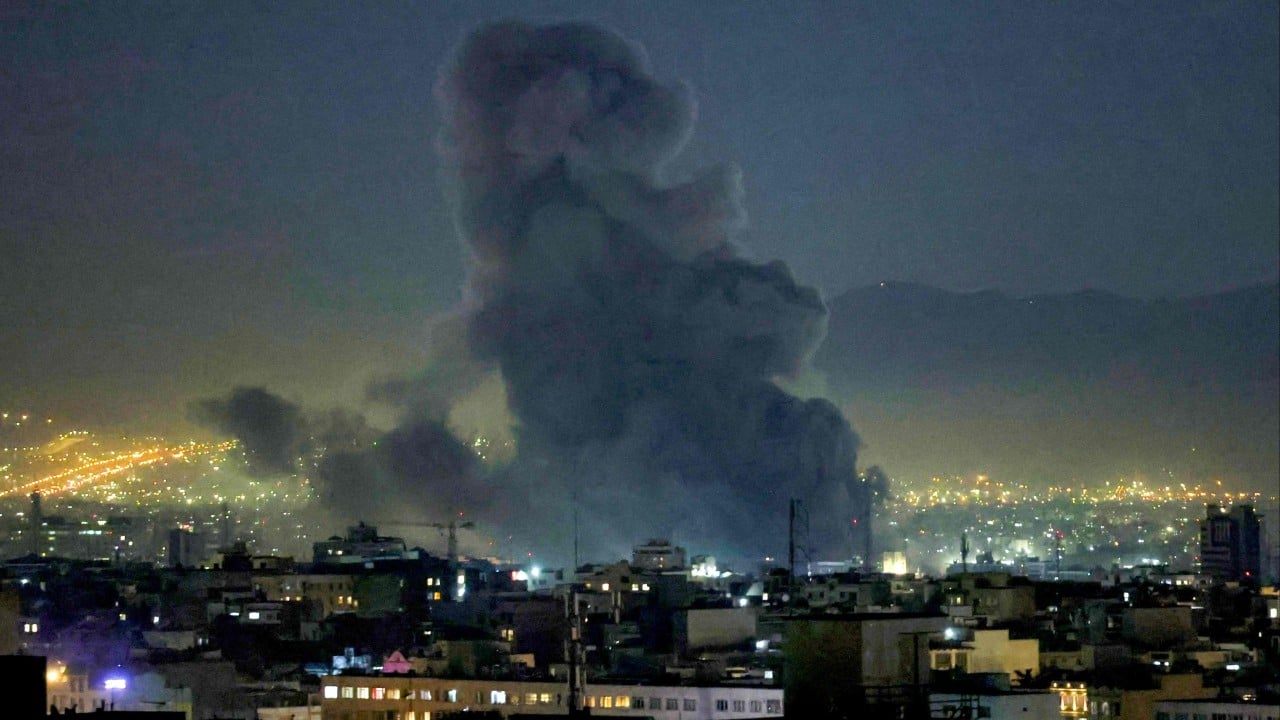
Western analysts have a terminal case of wishful thinking. For decades, the "Tehran-ology" industry has recycled the same tired script: the Islamic Republic is a brittle house of cards, and the death of Supreme Leader Ali Khamenei is the gust of wind that topples it. They call it "survival mode." They talk about power vacuums, civil war, and the inevitable triumph of secular liberalism.
They are dead wrong.
The death of a Supreme Leader isn't the beginning of the end; it’s the completion of a long-planned institutional pivot. If you think the disappearance of the figurehead triggers a collapse, you don’t understand how modern autocracies professionalize. Iran isn't a monarchy waiting for a prince; it is a sprawling, multi-billion dollar conglomerate managed by the Islamic Revolutionary Guard Corps (IRGC). Khamenei’s departure doesn't create a vacuum—it removes the final friction point for a full-scale military-industrial takeover.
The Myth of the Power Vacuum
The "vacuum" theory assumes that the Office of the Supreme Leader (the Beit-e Rahbari) is a one-man show. It isn't. Over thirty years, Khamenei didn't just rule; he curated an ecosystem of loyalty that transcends his own heartbeat. The Assembly of Experts—the 88 clerics tasked with choosing his successor—is often portrayed as a battlefield of rival factions.
In reality, it is a rubber stamp for a decision already made in the barracks of the IRGC and the backrooms of the bonyads (shadowy charitable foundations). The IRGC doesn't want a chaotic succession. Chaos is bad for business, and the IRGC is the Iranian economy. They control everything from dam construction and telecommunications to oil smuggling and automotive manufacturing.
When the "king" dies, the "corporation" takes over the board.
Survival Mode is a Tactical Lie
The term "survival mode" implies a regime cowering in a bunker, waiting for the inevitable. This is a fundamental misunderstanding of Iranian strategic depth. What the West perceives as desperation is actually a calculated consolidation.
By framing the current state as "survival," analysts ignore that the regime has spent the last decade recession-proofing its power. They have moved from a populist-clerical model to a technocratic-repressive model.
- The Internet Kill Switch: They didn't just build a firewall; they built a National Information Network. They can sever the country from the global web while keeping domestic banking and logistics humming.
- The Pivot to Asia: While the U.S. discusses "crippling sanctions," Tehran has integrated itself into the SCO (Shanghai Cooperation Organization) and BRICS. They aren't surviving; they are diversifying their patronage.
- Internal Purges: The recent disqualifications of "moderate" heavyweights like Hassan Rouhani from the Assembly of Experts weren't signs of fear. They were housekeeping.
The IRGC as the New Clergy
The most significant misconception is that the next Supreme Leader needs to be a charismatic religious authority. He doesn't. He needs to be a compliant bureaucrat.
The IRGC has spent years hollowing out the religious legitimacy of the clergy to replace it with a nationalist-militarist cult. They don't need a Grand Ayatollah; they need a placeholder who provides a thin veneer of "Velayat-e Faqih" (Guardianship of the Jurist) while the generals call the shots.
Imagine a scenario where the Assembly selects a low-profile cleric, someone like Mojtaba Khamenei or a mid-tier jurist with zero independent base. This isn't a sign of regime weakness. It’s a coup by proxy. The "Supreme Leader" becomes a CEO Emeritus, while the IRGC operates as the active management.
The "Protest Equals Collapse" Delusion
"But the people hate them!" is the standard retort. Yes, they do. The "Woman, Life, Freedom" movement proved that the regime’s social contract is incinerated. But hatred does not equal a change in government.
History is littered with regimes that were loathed by 90% of their population but stayed in power for decades because they maintained a monopoly on violence and high-calorie logistics. The IRGC and the Basij militia are not just soldiers; they are a socio-economic class. They have cars, subsidized housing, and career paths that disappear if the regime falls.
When the Supreme Leader dies, these millions of stakeholders don't flee. They dig in. They know that in a post-Islamic Republic Iran, they aren't just out of a job—they are likely headed for a lamppost. Fear of the gallows is a more powerful motivator than the desire for democratic reform.
Why the Succession Actually Stabilizes the Market
From a cold-blooded geopolitical risk perspective, a post-Khamenei Iran might actually be more predictable. Khamenei is a product of the 1979 Revolution—driven by ideological fervor and a personal grudge against "the Great Satan."
The rising generation of IRGC commanders and "Principlist" technocrats are different. They are pragmatists. They don't want to destroy the world; they want to own their piece of it. A military-led Iran is more likely to engage in "transactional tension." They will keep the nuclear program as leverage and the regional proxies as defense depth, but they are far more interested in normalizing trade with China and Russia than in a final apocalyptic showdown.
The transition doesn't invite "collapse." It invites "clarification." The ambiguity of the clerical system disappears, replaced by the brutal, efficient logic of a military junta.
The Wrong Questions
The media keeps asking: "Who will be the next Supreme Leader?"
The real question is: "How much of the Iranian economy does the IRGC need to seize before the title of Supreme Leader becomes irrelevant?"
We are watching the transition from a theocracy to a praetorian state. The clerics are the past. The generals are the future. And the generals have no intention of going into "survival mode." They are going into expansion mode.
If you are waiting for the regime to melt away the moment the old man breathes his last, you are going to be waiting for a very long time. The machine is built to outlive the man.
Stop looking for cracks in the facade and start looking at the reinforced concrete being poured behind it. The succession isn't a crisis for the regime; it's their rebranding.