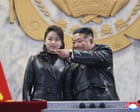
The visibility of Kim Ju-ae, the daughter of Kim Jong-un, is not a sentimental branding exercise but a calculated deployment of the "Paektu Bloodline" logic to preemptively stabilize a fourth-generation transition. In North Korean political theology, the legitimacy of the Supreme Leader is not derived from democratic consensus or meritocratic achievement, but from a biological and ideological continuity that dates back to the 1940s. By integrating Ju-ae into high-level military and state functions, the regime is solving for a specific historical failure: the compressed and unstable transition periods experienced by Kim Jong-il and Kim Jong-un.
The Three Pillars of Hereditary Legitimacy
The North Korean state operates on a Triad of Authority that necessitates early public grooming to ensure the survival of the Kim family.
- The Biological Imperative: The "Paektu Bloodline" is the only recognized source of sovereign power. Without a visible heir, the risk of a military or bureaucratic faction filling a perceived power vacuum increases during a health crisis.
- Military Validation: The Korean People’s Army (KPA) is the primary power broker. A successor must be seen directing strategic assets—such as the Hwasong-17 and Hwasong-18 ICBMs—to signal that the "commander-in-chief" function is transferable to the next generation.
- The Mother of Korea Iconography: In North Korean history, the elevation of a female figure often serves as a proxy for the future leader's legitimacy. Just as Ko Yong-hui (Kim Jong-un’s mother) was mythologized to solidify his claim, Ju-ae’s presence serves to establish her as the focal point of future state devotion.
The Strategic Shift from Stealth to Exposure
Historically, North Korean successors were kept in total seclusion until they reached adulthood. Kim Jong-il was not officially confirmed as the successor until 1980, decades into his father's reign. Kim Jong-un was only revealed to the world in 2010, roughly a year before he took power. The decision to reveal Ju-ae as a child represents a fundamental shift in the regime’s risk management strategy.
This "Early Integration Model" addresses three systemic vulnerabilities:
- The Recognition Gap: By the time a formal transition occurs, the North Korean public and the military elite will have spent over a decade acclimatizing to her presence. This eliminates the "who is this?" shock that could lead to internal instability.
- The Gender Barrier: While North Korea remains a deeply patriarchal society, the Kim family has consistently used female relatives (like Kim Yo-jong) in high-stakes diplomatic and administrative roles. Constant exposure softens the cultural resistance to a female supreme leader by framing her status as transcendent of gender, defined instead by the "Bloodline."
- External Deterrence: Ju-ae’s presence at missile launches binds the future of the nation to its nuclear program. It communicates to the United States and South Korea that the nuclear path is not a Kim Jong-un policy, but a multi-generational Kim family commitment that will outlast the current leader.
The Cost Function of Visible Succession
High-visibility succession carries significant political overhead. Each public appearance by Ju-ae is a resource-intensive operation that requires precise choreography. The regime must balance her "sacred" status with the need to appear relatable to the "jangmadang" generation—the younger North Koreans who grew up with informal markets and have less ideological attachment to the state.
The primary risk is The Target Effect. By identifying a successor early, the regime inadvertently creates a focal point for internal dissent or external intelligence operations. If Ju-ae is the definitive choice, any perceived weakness in her or her standing becomes a weakness in the state's long-term viability. To mitigate this, the state media has transitioned her titles from "beloved daughter" to "respected daughter" and "noble daughter," linguistic escalations that mirror the titles given to Kim Jong-un before his official ascension.
Military-Industrial Integration as a Successor Litmus Test
Analysis of state media imagery reveals that Ju-ae is rarely shown in civilian contexts. Her appearances are almost exclusively tied to the North Korean military-industrial complex. This is a deliberate choice to align her with the "Byungjin" policy—the simultaneous development of the economy and nuclear weapons.
The logistical framework of these appearances follows a consistent pattern:
- Spatial Dominance: She is often positioned in the center of the frame, frequently eclipsing high-ranking generals who have decades of service. This reinforces the absolute supremacy of the bloodline over military rank.
- Operational Proximity: She is shown looking at maps, holding binoculars, and standing near launch control centers. These are visual metaphors for "Guidance," the specific theological term used for the leader's oversight.
This creates a "Path Dependency" for the North Korean elite. By participating in these ceremonies, the military leadership is publicly and irrevocably pledging their loyalty to her. The cost of reneging on this loyalty later is execution, as demonstrated by the purge of Jang Song-thaek in 2013.
The Role of Kim Yo-jong: Protector or Competitor?
A critical variable in the succession calculus is Kim Yo-jong, Kim Jong-un’s sister. While some analysts view her as a potential rival, the structural logic of the regime suggests her role is that of a "Regent-in-Waiting."
In the event of Kim Jong-un’s sudden death or incapacitation before Ju-ae reaches maturity, a regency council would be necessary. Kim Yo-jong possesses the political capital and the bloodline status to manage the state during a transition, but she lacks the "direct descendant" status required for long-term supreme leadership under the current ideological framework. Her role is to serve as the "shield" for the "sun," absorbing the domestic and international friction of governance while the successor remains in a protected, idealized state.
Informational Control and the Generation Gap
The regime faces a growing "Information Asymmetry." As foreign media leaks into North Korea via smuggled USB drives and Chinese cellular networks, the myth of the Kim family is under constant pressure. The Ju-ae strategy is part of an "Ideological Fortification" effort.
By presenting a young, modern, and well-dressed successor, the regime is attempting to co-opt the aspirations of the younger generation. They are selling a "Nuclear Monarchy" that is both traditional and sophisticated. This is a move toward a more "monarchical" style of governance, similar to a royal family, rather than a traditional Marxist-Leninist party structure.
The Logic of the Seventh Party Congress and Beyond
The recent party congresses and legislative changes have codified the "pre-emptive nuclear strike" doctrine. This legal framework is inextricably linked to the succession plan. The regime has essentially written into law that the nuclear deterrent must be protected at all costs to ensure the survival of the leadership.
The structural reality is that the North Korean state has ceased to be a socialist republic in anything but name. It is now a hereditary nuclear absolute monarchy. The elevation of Ju-ae is the final piece of the architectural overhaul required to ensure that the transition from the third to the fourth generation is not just a family hand-off, but a reinforced state evolution.
The strategic play for external observers is to stop viewing Ju-ae as a propaganda prop and start viewing her as the focal point of North Korea's long-term stability model. Diplomatic and military strategies must account for the fact that Kim Jong-un is building a system designed to outlive him by at least fifty years. Engaging with North Korea now requires an understanding that the person standing next to the ICBM today will likely be the one making the decisions regarding that ICBM in 2050.
Would you like me to analyze the specific economic shifts within the North Korean "Jangmadang" markets that could influence this transition's success?