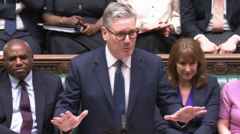
Keir Starmer’s recent signal that he intends to make the student loan system "fairer" is a calculated attempt to patch a sinking ship without actually fixing the hull. The core issue isn't just a lack of fairness. It is a fundamental breakdown of the economic contract between the state, the university, and the graduate. For years, the UK higher education sector has operated on a high-fee, high-debt model that assumes a lifetime of high earnings will naturally follow a degree. That assumption is dead.
Currently, the government faces a massive "RAB charge"—the portion of student loans that is never expected to be repaid. When Starmer talks about making things fairer, he is balancing on a wire between a generation of graduates crushed by 6% or 7% interest rates and a Treasury that cannot afford to write off billions in existing debt. The primary query for every student and parent today is simple: will these changes actually lower the monthly bill? The answer depends entirely on whether the government chooses to lower interest rates or extend the repayment period, the latter of which actually increases the total cost over a lifetime.
The Hidden Mechanics of Debt Inflation
To understand why the system is broken, you have to look at the interest rate mechanism. Unlike a standard mortgage or a car loan, student loan interest in the UK is often pegged to the Retail Price Index (RPI). When inflation spiked, the interest rates on these loans followed suit, sometimes hitting double digits before temporary government caps were applied.
This creates a "negative amortization" effect for many middle-income earners. They make their monthly payments, but those payments don't even cover the interest being added to the balance. The debt grows even as they pay it. It’s a psychological and financial weight that keeps graduates from entering the housing market or starting businesses. By the time a nurse or a teacher reaches the 30-year or 40-year write-off point, they may have paid back their original loan twice over and still "owe" more than they borrowed.
The Graduate Tax in All But Name
Politicians avoid the term "tax" because it’s electoral poison. However, the current repayment system functions as a marginal tax rate that disproportionately hits those who can least afford it. A graduate earning £35,000 is currently paying 9% of their income above the threshold. When you add that to income tax and National Insurance, the effective tax rate for a young professional is often higher than that of a millionaire living off capital gains.
Starmer’s team is reportedly looking at a "step-down" model. This would involve lower repayment rates for lower earners and a sliding scale that increases as income rises. While this sounds equitable, it doesn't solve the underlying problem of the total debt burden. If you lower the monthly payment, you simply extend the amount of time the interest has to compound. It is a temporary relief that leads to a permanent debt trap.
The Problem with University Funding
You cannot talk about student loans without talking about how universities spend the money. Since the 2012 hike to £9,000 fees, we have seen an explosion in campus real estate and administrative bloat. Vice-chancellor salaries have ballooned, while the actual "unit of resource"—the amount of money spent on teaching a single student—has remained relatively stagnant or even declined in real terms due to inflation.
Universities are now reliant on international students who pay triple the domestic rate just to keep the lights on. This is a precarious business model. If international recruitment dips due to visa changes or global competition, the domestic fee cap will have to rise, or the government will have to step in with a direct bailout. Starmer’s "fairer" system has to account for this massive hole in university finances. If he lowers the fees or the interest, the money has to come from somewhere else.
The Myth of the Graduate Premium
For decades, the selling point of a degree was the "graduate premium"—the idea that you would earn significantly more over your lifetime than someone who didn't go to university. This premium is shrinking. In many sectors, particularly the arts and humanities, the cost of the degree now outweighs the projected earnings increase.
We are seeing a surplus of graduates in fields where the economy doesn't have enough high-paying roles. Meanwhile, we have a desperate shortage of people in technical trades and healthcare. The loan system doesn't differentiate between a degree in neurosurgery and a degree in a subject with no clear career path. Both students take out the same loans. Both face the same interest rates. This "one size fits all" approach is failing both the individual and the economy.
Real Reform vs Political Posturing
If the government were serious about reform, they would look at three specific levers that actually move the needle for graduates:
- Scrapping RPI-linked interest: Moving to a flat, low interest rate that merely covers the cost of administration would stop the balance from spiraling out of control.
- Reintroducing maintenance grants: A significant portion of student debt isn't tuition; it’s the money borrowed just to eat and pay rent. Moving back to a grant-based system for lower-income students would drastically reduce the starting debt.
- Employer contributions: In some European models, employers who benefit from a highly skilled workforce contribute to the cost of that education. This shifts the burden away from the individual graduate and the general taxpayer.
Starmer hasn't committed to any of these. Instead, the rhetoric suggests a tweak to the repayment thresholds or a slight adjustment to the interest cap. These are cosmetic changes. They are designed to win votes from worried parents without upsetting the Treasury’s long-term balance sheet.
The Generational Wealth Gap
The student loan crisis is a primary driver of the widening wealth gap between generations. If you graduated in 1995, you likely had your tuition paid and received a grant. You entered the housing market with no debt. If you graduate in 2025, you enter the workforce with £50,000 in debt and an interest rate that outpaces your salary growth.
This isn't just a "student issue." It’s a macroeconomic drag. When a massive cohort of the population is spending £200 to £400 a month on debt servicing, that is money not being spent in the local economy, not being saved for a deposit, and not being invested in pensions.
The Accountability Gap
There is a shocking lack of accountability for institutions that provide low-value degrees. Under the current system, the university gets its money upfront from the Student Loans Company. They have no "skin in the game" if the graduate fails to find a high-paying job. The risk is entirely socialized (the taxpayer picks up the unpaid debt) and individualized (the student carries the credit burden).
A truly fairer system would tie university funding to graduate outcomes. If a course consistently fails to produce graduates who earn enough to repay their loans, that course should not be eligible for government-backed lending. This would force universities to focus on quality and employability rather than just "bums on seats."
The Reality of the "Write-Off"
The government often points to the 30-year or 40-year write-off as a safety net. "Don't worry," they say, "you'll never have to pay it all back." This is a dishonest argument. Living with a debt that you know you can never repay is a form of financial indentured servitude. It affects your ability to get a mortgage, as lenders increasingly look at student loan obligations as a committed monthly expenditure.
Furthermore, the "write-off" is a massive future liability for the taxpayer. We are currently accounting for money on the books that we know we will never see. It is a fiction that masks the true state of the national debt. Starmer’s promise to look at the system must address this accounting fantasy.
The political difficulty is that any genuine fix—like lowering fees or reinstating grants—requires an immediate increase in public spending. In a "fiscal responsibility" environment, that is a hard sell. But the alternative is to continue a system that is mathematically unsustainable and socially corrosive.
We are reaching a tipping point where the perceived value of a degree is being eclipsed by the very real cost of the debt. If the government continues to offer minor adjustments while the core structure remains intact, we will see a continued decline in social mobility. The "fairer" system Starmer mentions cannot just be about the optics of the monthly payment; it must be about the total volume of the debt and the predatory nature of the interest applied to it.
The generation currently entering the workforce is the first in modern history expected to be poorer than their parents. The student loan system is the primary mechanism of that decline. Tweaking the interest rate by half a percent or moving the repayment threshold by a few hundred pounds is like rearranging deck chairs on the Titanic while the iceberg of compound interest looms ahead.
Check your latest statement and calculate the interest added versus the principal paid.