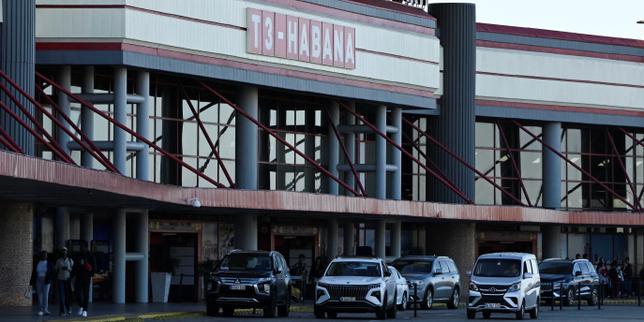
Air France’s decision to suspend operations to Havana starting late March 2026 is not an isolated scheduling adjustment but a rational response to a systemic collapse in aviation logistics. While surface-level reports cite a general "fuel shortage," a rigorous analysis reveals a more complex breakdown of the Aviation Value Chain. For a long-haul carrier, the viability of a route depends on the intersection of fuel energy density, local infrastructure reliability, and the prohibitive cost of "tankering." When a destination can no longer guarantee the basic physical inputs of flight, the route transitions from a strategic asset to a catastrophic operational liability.
The Mechanics of the Fuel-Logistics Bottleneck
The cessation of flights is driven by the failure of the Primary Refueling Infrastructure. In standard international aviation, a wide-body aircraft like the Boeing 777 or Airbus A350—staples of the Air France long-haul fleet—relies on a predictable supply of Jet A-1. This fuel must meet international ASTM D1655 standards for purity and thermal stability.
Cuba’s current energy crisis has fractured the supply chain at three critical nodes:
- Refinery Throughput Deficit: Local processing of heavy crude into lighter distillates like Jet A-1 has slowed due to equipment fatigue and lack of spare parts.
- Import Dependency: The inability to secure reliable shipments from traditional regional partners has forced a reliance on spot-market purchases, which are subject to high volatility and credit risk.
- Distribution Inertia: Even when fuel reaches the island, the internal transport mechanism (tanker trucks and pipeline pressure) is frequently compromised by power outages and hardware failure.
When an airport cannot guarantee fuel availability, an airline faces the Refueling Binary. It must either "tanker" fuel or cancel the flight.
The Economic Failure of Fuel Tankering
Tankering is the practice of carrying enough fuel from the point of origin (Paris-Charles de Gaulle) to fly the return leg without refueling at the destination (Havana). This sounds like a simple workaround, but it is governed by the Law of Diminishing Returns in aerodynamics.
Every kilogram of extra fuel carried increases the total weight of the aircraft. This weight requires more thrust to maintain lift, which in turn burns more fuel. In long-haul segments exceeding 8,000 kilometers, the "cost of carry" becomes exorbitant.
- Weight Penalties: A Boeing 777-300ER carrying an additional 50 tons of fuel to avoid refueling in Havana would burn approximately 3% to 4% of that extra fuel just to transport it.
- Payload Displacement: The aircraft has a Maximum Take-Off Weight (MTOW). Every kilogram of "safety fuel" carried from Paris replaces a kilogram of revenue-generating cargo or a high-margin passenger seat.
- Operational Strain: Heavier landing weights increase wear on landing gear and braking systems, accelerating maintenance cycles and increasing the Long-run Average Incremental Cost (LAIC) of the airframe.
For Air France, the math eventually breaks. If the fuel shortage in Cuba is permanent or unpredictable, the airline cannot sustain a model where it pays to fly its own fuel halfway around the world. The route moves into a negative margin territory that no amount of ticket price hiking can offset.
Macroeconomic Instability and Demand Erosion
The fuel crisis is a lagging indicator of a broader macroeconomic contraction. Air France’s withdrawal reflects a shift in the Demand Elasticity of the Cuba route.
The Cuban economy is currently grappling with a "triple threat" of inflation, currency devaluation, and infrastructure decay. This impacts the airline's revenue mix in two distinct ways:
1. The Death of the High-Yield Business Segment
International airlines rely on a "bell curve" of passenger yields. While economy seats cover the baseline operating costs, the business and premium economy cabins provide the profit. As Cuba’s domestic business environment deteriorates, the volume of corporate travelers, NGO officials, and high-net-worth investors—the primary occupants of these cabins—has plummeted. A flight filled only with budget-conscious tourists cannot sustain the high overhead of a transcontinental European carrier.
2. The Cargo Deficit
Long-haul flights are "combi-models" by nature. The belly hold of a passenger plane typically carries tons of commercial cargo. When a country's internal logistics fail, its export capacity (tobacco, seafood, pharmaceuticals) shrinks. Simultaneously, its ability to pay for imports diminishes. Without a robust cargo revenue stream to subsidize the flight, the passenger load factor must be nearly 100% just to break even—an impossible metric in a volatile market.
The Operational Risk of "AOG" (Aircraft on Ground)
A critical factor that most observers miss is the risk of an AOG Event. If an Air France jet lands in Havana and a mechanical fault is discovered, or if the promised fuel delivery fails to materialize, the aircraft is stranded.
The opportunity cost of an idle wide-body aircraft is measured in tens of thousands of dollars per hour. This includes:
- Rotable Part Logistics: Bringing a spare part into a country with restricted trade and failing transport is a logistical nightmare.
- Crew Expiry: Flight crews have strict legal limits on "duty time." If an aircraft is delayed by 6 hours due to refueling issues, the crew may "time out," requiring the airline to fly in a relief crew and pay for local accommodation—costs that are difficult to recover in the current Cuban economic climate.
- Network Contagion: That specific aircraft is scheduled to fly from Paris to Tokyo or New York the next day. A delay in Havana cascades through the entire global network, causing cancellations and passenger compensation claims across multiple continents.
Air France is essentially performing a Risk Mitigation Maneuver. By exiting now, they protect the integrity of their global schedule from the unpredictable "gravity well" of Havana's failing infrastructure.
Strategic Pivot to High-Efficiency Hubs
The suspension of the Havana route signals a reallocation of capital toward more stable, high-yield markets. In the post-2020 aviation era, legacy carriers are ruthlessly optimizing their fleets. Every flight hour must be spent on routes where:
- Fuel Supply is Guaranteed: Reliable hydrant systems and transparent pricing.
- Hard Currency Flows: Revenue is generated in Euros or Dollars without repatriation risks.
- Infrastructure is Resilient: Airports can provide de-icing, maintenance, and power regardless of local economic shocks.
The exit from Cuba follows a pattern of European carriers focusing on North American expansion and "safe" Caribbean alternatives like the Dominican Republic or Guadeloupe, where fuel logistics are more robust.
Technical Limitations of the Cuban Energy Grid
The fuel shortage is not a temporary dip but a symptom of a Systemic Energy Deficit. The Cuban grid relies on aging thermoelectric plants that are currently operating at a fraction of their nameplate capacity. When the power grid fails, the pumps at the airport fuel farms stop. While backup generators exist, they require diesel—the very fuel that is in the shortest supply.
This creates a Feedback Loop of Failure:
- No electricity means no fuel pumping.
- No fuel means no transport for workers.
- No workers means slower repairs to the electrical grid.
For an airline, this lack of basic utility reliability makes "Safety of Flight" calculations impossible to finalize. International Civil Aviation Organization (ICAO) standards require a high degree of predictability for alternate airports and reserve fuel, which cannot be met when the primary destination is in a state of energy flux.
The strategic play for investors and competitors is to recognize that the Havana exit is a lead indicator for other Caribbean markets facing similar energy constraints. The immediate recommendation for logistics operators is to audit their "single-point-of-failure" dependencies on local utilities. For the traveler and the travel industry, this marks the end of Havana as a primary global hub and its transition into a boutique, niche destination served only by carriers with lower overhead or those willing to accept high-risk "tankering" profiles. Air France’s move is a definitive signal: in modern aviation, fuel reliability is now more valuable than market share.
Would you like me to perform a comparative margin analysis between the Havana route and the newly bolstered North American segments in the Air France-KLM 2026 outlook?