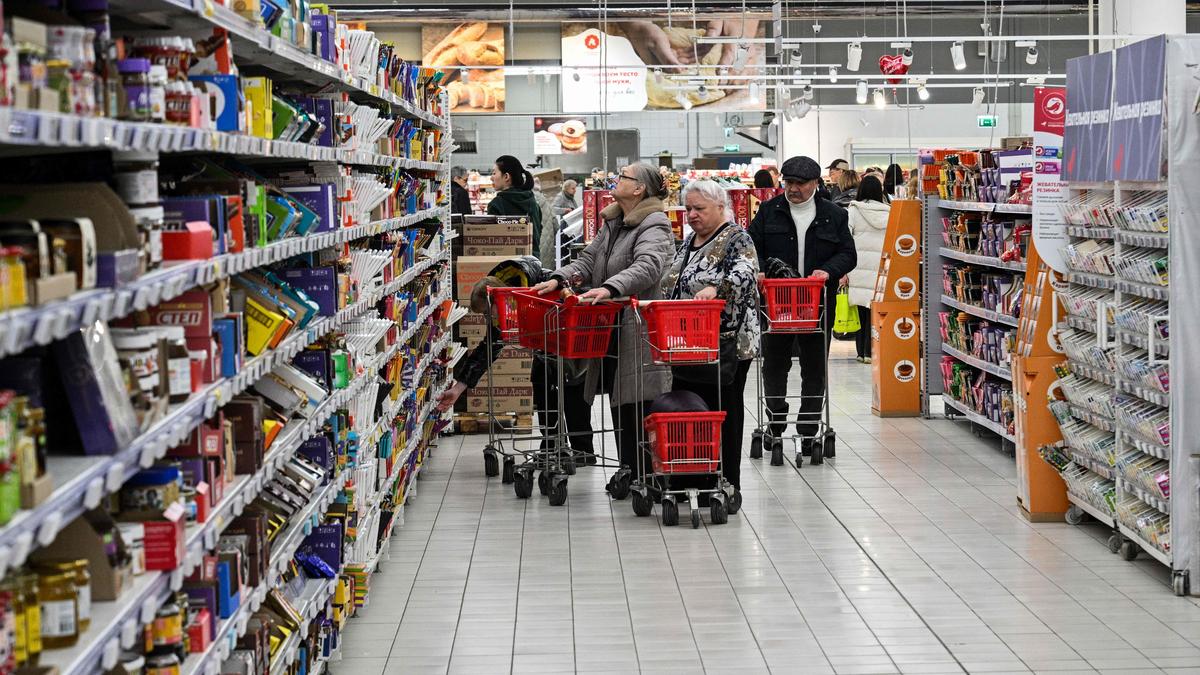
The Russian "home front" is currently defined by a fundamental contradiction: record-low unemployment and headline GDP growth masks a systemic hollow out of the civilian industrial base. This phenomenon, known as "military Keynesianism," creates an illusion of prosperity through massive state injections into the defense sector, yet it simultaneously triggers a three-headed crisis of labor shortages, "imported" inflation, and capital starvation for non-military enterprises. To understand the true cost of the conflict on the Russian population, one must look past the surface-level retail availability and analyze the shifting composition of the national balance sheet.
The Cannibalization of Human Capital
The most immediate and irreversible damage to the domestic economy is the distortion of the labor market. Russia faces its most acute labor deficit in modern history, driven by three distinct pressures that have removed over a million prime-age workers from the productive civilian economy.
- The Mobilization Drain: Direct recruitment and mobilization have extracted hundreds of thousands of physically capable workers from sectors like construction, logistics, and agriculture.
- The Brain Drain: An estimated 500,000 to 800,000 highly skilled professionals—primarily in IT, engineering, and finance—fled the country in 2022 and 2023 to avoid conscription or sanctions-related career stagnation.
- The Defense Pivot: High wages in tank factories and missile plants, funded by the Kremlin’s $140 billion+ annual defense budget, have sucked talent away from consumer goods manufacturing.
This deficit creates a "wage-price spiral." Because firms cannot find workers, they must raise salaries to retain existing staff. However, because productivity is not increasing—and in many cases is falling due to the lack of Western technology—these higher wages simply flow into the economy as excess liquidity, chasing a dwindling supply of consumer goods. This is why the Central Bank of Russia (CBR) has been forced to maintain interest rates as high as 16% to 21%. The civilian sector is effectively being taxed through high borrowing costs to pay for the military sector’s expansion.
The Technology Deficit and "Reverse Industrialization"
While the Russian government touts "import substitution" as a success, the reality on the ground is a process of reverse industrialization. When a nation loses access to global supply chains—specifically high-end semiconductors, precision machine tools, and aerospace components—it does not simply build its own overnight. It regresses to older, less efficient technologies.
The cost to the home front is visible in the degradation of public infrastructure and consumer safety:
- Aviation Safety: Russian airlines are increasingly reliant on "cannibalizing" existing aircraft for parts or sourcing uncertified components via third-party intermediaries, leading to a measurable increase in mid-air technical failures.
- Automotive Regression: Domestic car production, such as the Lada, saw the removal of standard safety features like airbags and anti-lock braking systems (ABS) for extended periods because the necessary microchips were sanctioned.
- Infrastructure Decay: The winter of 2023-2024 saw widespread heating failures across Russian regions. This was not an accident but a structural failure; the capital and specialized labor required to maintain aging municipal heating grids were diverted to the war effort.
The "Cost of Complexity" has risen. Products that were once simple to acquire now require a "sanction premium"—the 20% to 50% markup paid to middlemen in Turkey, Kazakhstan, or the UAE to smuggle goods into the country. This hidden tax erodes the purchasing power of the middle class, even if their nominal ruble wages appear to be rising.
The Fiscal Squeeze and the Erosion of Social Wealth
The Russian state budget has undergone a radical transformation, moving from a surplus-driven model to a deficit-financed war machine. The "National Wealth Fund" (NWF), intended to be a rainy-day fund for pensions and structural reforms, is being depleted to cover budget gaps.
The liquid portion of the NWF—assets that can actually be spent—has dropped by more than half since February 2022. This creates a long-term solvency risk for the Russian social contract. The government is prioritizing "Death Payments" (large lump sums to families of killed soldiers) over long-term investments in healthcare and education.
The shift in spending can be categorized into three pillars of fiscal degradation:
- Direct Military Expenditure: Consuming approximately 6% to 7% of GDP, a level unseen since the late Soviet era.
- Internal Security: Massive increases in funding for the Rosgvardia and police forces to suppress domestic dissent.
- Social Pacification: Targeted subsidies and minimum wage hikes designed to prevent the poorest segments of society from feeling the immediate sting of inflation.
This fiscal structure is unsustainable if oil prices drop. Russia is currently protected by a "war chest" of energy revenue, but the discount it must offer to buyers in India and China (the Urals-Brent spread) means that the margin of error for the domestic budget is razor-thin.
The Logistics of Scarcity
The redirection of the entire Russian logistical network toward the West (for the front lines) and toward the East (for trade with China) has left the internal "Middle Russia" underserved. The Trans-Siberian and Baikal-Amur Mainline railways are at 100% capacity, prioritizing coal, oil, and military hardware.
This creates "logistical bottlenecks" for consumer goods. A container of electronics or household appliances arriving from China may wait weeks for a rail slot. These delays increase the "carrying cost" of inventory for Russian retailers, who pass those costs directly to the consumer. The result is a fragmented internal market where prices for the same goods can vary wildly between Moscow and the Urals, depending on local supply chain resilience.
The Strategic Path Forward for External Observers
Analysts must stop viewing the Russian economy through the lens of GDP growth, which is currently a metric of "destruction-led activity." Instead, the focus should be on the Output Gap and Capital Flight.
The long-term strategic forecast indicates that Russia is transitioning into a "vassal state" economy. By severing ties with the European energy market, it has lost its primary source of high-margin revenue and technological exchange. The domestic "home front" will likely experience a slow, grinding decline in the quality of life—not a sudden collapse, but a "Northernization" where the economy becomes a closed loop of military production and basic subsistence.
The critical variable to monitor is the CBR Interest Rate vs. Corporate Solvency. If the Central Bank keeps rates high to fight war-induced inflation, civilian companies will eventually face a wave of bankruptcies, leading to a "hollowed-out" economy where the only viable employer is the state. For global strategists, the move is to monitor the divergence between Moscow/St. Petersburg and the regional provinces; the "home front" is not a monolith, and the provincial regions bearing the brunt of mobilization are where the structural cracks will first manifest into systemic instability.