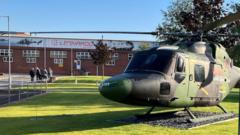
The British Ministry of Defence (MoD) decision to advance the £1bn New Medium Helicopter (NMH) program represents more than a fleet refresh; it is a forced rationalization of a fragmented rotary-wing inventory. By consolidating four distinct airframe types—the Puma HC2, Bell 412, Bell 212, and Airbus Dauphin—into a single platform, the MoD is attempting to solve a chronic logistics and training deficit. However, the success of this £1bn expenditure depends less on the airframe’s flight envelope and more on the long-term cost-of-ownership model and the preservation of domestic industrial capacity.
The Convergence of Requirements
The NMH program targets a "multirole" capability, a term often used loosely but defined here by three specific operational vectors:
- Troop Transport and Rapid Insertion: The requirement to carry approximately 10 to 14 fully equipped personnel in high-altitude, hot-weather environments.
- Special Operations Support: Low-signature ingress and egress capabilities, specifically replacing the niche roles currently filled by the Dauphin fleet.
- Search and Rescue (SAR) and Casualty Evacuation: Integrating medical suites without compromising the primary lift capacity.
The structural tension in this procurement lies in the trade-off between "off-the-shelf" availability and "UK-specific" modifications. While purchasing an existing platform reduces R&D risk, the integration of UK-only defensive aid suites (DAS) and communications encryption often introduces secondary engineering bottlenecks that inflate the final unit price.
The Industrial Sovereignty Variable
The £1bn figure is a baseline for hardware, but the true strategic value is measured in "Social Value" and "Prosperity Ties." This is a weighted metric in UK defense procurement that evaluates how much of the contract value returns to the domestic economy.
The three primary contenders—Airbus Helicopters (offering the H175M), Leonardo (offering the AW149), and Lockheed Martin (offering the S-70M Black Hawk)—each represent a different industrial philosophy.
- Leonardo’s Yeovil Integration: Leonardo positions itself as the incumbent "home of British helicopters." Their strategy relies on utilizing existing production lines in Somerset. From a risk perspective, this minimizes the "Greenfield" facility risk but ties the MoD to a specific geographic industrial base.
- Airbus and the Broughton Cluster: Airbus proposes a new production line in North Wales. This is an "Economic Regeneration" play. While it offers high political utility, the MoD must account for the "Initial Operating Capability" (IOC) lag inherent in spinning up a new assembly line.
- Lockheed Martin’s Global Supply Chain: The Black Hawk is the most battle-proven platform, but its UK industrial footprint is the least mature of the three. Choosing this platform represents a shift toward "Interoperability" with US forces at the expense of "Domestic Design Authority."
The Unit Cost Fallacy
Public discourse focuses on the £1bn headline figure, yet the procurement cost is typically only 20% to 30% of the Total Cost of Ownership (TCO) over a 25-year lifespan. The MoD’s primary fiscal challenge is the "Sustainability Tail."
A single-platform fleet achieves economies of scale through:
- Unified Pilot Training Pipelines: Reducing the number of flight simulators and Type Rating instructors required.
- Spare Parts Fungibility: A part for a helicopter in Brunei is identical to one in RAF Benson, reducing the global inventory "buffer stock" by an estimated 15%.
- Maintenance Man-Hour (MMH) Reduction: Modern airframes like the H175M or AW149 are designed with "Condition-Based Maintenance" (CBM) sensors. This shifts the paradigm from "Fix on Failure" or "Time-Based Overhaul" to "Predictive Intervention."
The risk remains that the MoD's history of "Gold-Plating"—adding bespoke British requirements to a standard airframe—will erode these savings. If the UK insists on a unique rotor head or a non-standard gearbox to meet specific "extreme" performance margins, the global supply chain advantage evaporates.
Operational Constraints and the Puma Gap
The urgency of the deal is dictated by the aging Puma HC2 fleet. The Puma’s out-of-service date (OSD) has been extended multiple times, creating a "Capability Gap" risk. When an airframe exceeds its fatigue life, the maintenance frequency increases exponentially. This is the "Bathtub Curve" of reliability: early "infant mortality" failures, a long period of stable operation, and a sharp rise in wear-out failures.
The MoD is currently in the "Wear-Out" phase. Every month the NMH contract is delayed, the "Availability Ratio" of the current fleet drops, forcing the MoD to spend "Bridge Funding" on life-extension programs that offer zero long-term value.
Strategic Exportability
The UK government views the NMH as an "Export Springboard." For the £1bn investment to be a net positive for the Treasury, the selected helicopter must be sellable to third-party nations. This creates a logical paradox. The more the UK modifies the helicopter for its own niche requirements (e.g., specific cold-weather survival gear or UK-only sensors), the less attractive it becomes to a global market looking for a standardized, low-cost solution.
The winning bidder will be the one that provides the MoD with "Design Authority." This allows the UK to modify the software and hardware without seeking permission from a foreign parent company, a critical requirement for sovereign "Freedom of Action" in conflict zones.
The Logic of Selection
The final decision will likely hinge on the "Production Readiness Level" (PRL). With the Puma fleet nearing structural exhaustion, the MoD cannot afford a five-year development cycle. The evaluation framework will prioritize:
- Time to Field: Can the first squadron be operational by 2027-2028?
- Direct Labor Hours (DLH): The number of high-skilled engineering jobs sustained in the UK.
- Avionics Open Architecture: The ease with which future electronic warfare suites can be integrated without a complete airframe redesign.
The £1bn deal is the catalyst for a decade of rotary-wing doctrine. If the MoD prioritizes the "Social Value" of a UK production line, they accept a higher upfront capital expenditure for long-term regional economic stability. If they prioritize "Interoperability" and "Battle-Hardened Reliability," the Lockheed Martin solution gains weight. However, the Leonardo AW149 currently occupies the "Middle Path"—a balance of existing UK infrastructure and a modernized airframe design.
The immediate strategic requirement is the issuance of the Invitation to Negotiate (ITN) to the final down-selected bidders. This document will contain the "Specific Performance Parameters" that determine whether this is a search for a "Utility Truck" or a "Digital Battlespace Node." The MoD must resist the urge to over-specify the platform; a "Good Enough" helicopter delivered in 2027 is infinitely more valuable than a "Perfect" helicopter delivered in 2032.
The MoD should move to freeze the design requirements by Q3 2026 to prevent "Scope Creep." Any delay beyond this window will necessitate a second, costly life-extension for the Puma fleet, effectively siphoning funds away from the very modernization the NMH program is intended to provide. The focus must remain on the "Flight Hour Cost" rather than the "Sticker Price," ensuring that the £1bn initial investment does not become a £5bn lifecycle liability.