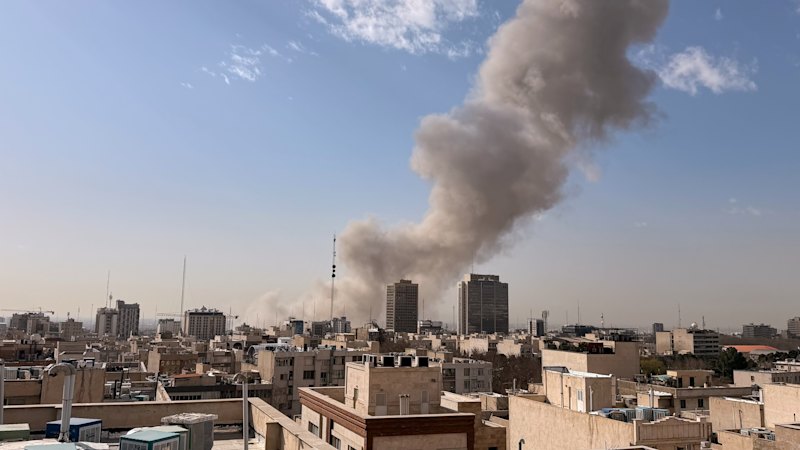
The initiation of a joint "massive and ongoing" kinetic campaign by the United States and Israel against Iranian infrastructure signals a definitive shift from containment to systemic disruption. This operation is not a retaliatory cycle but a structural dismantling of three specific Iranian vectors: regional proxy command-and-control, domestic internal security cohesion, and advanced ballistic manufacturing capacity. While public-facing rhetoric focuses on the immediate "explosions," the true strategic objective is the forced decoupling of the Iranian state from its external military assets while simultaneously inducing a domestic power vacuum.
The Triad of Kinetic Objectives
The current engagement functions through a prioritized targeting matrix designed to create a cascading failure in Iranian defense logic.
- Degradation of Hardened Infrastructure: This involves the precision neutralization of subterranean enrichment facilities and missile assembly plants. Unlike previous "pinprick" strikes, the use of heavy-ordnance bunker busters aims to permanently alter the geological viability of these sites.
- Command Disruption: Targeted strikes on Islamic Revolutionary Guard Corps (IRGC) communication hubs serve to isolate regional proxies like Hezbollah and the Houthis. When the central nervous system in Tehran is deafened, the peripheral limbs become uncoordinated, reducing the threat of a synchronized multi-front counter-attack.
- Psychological Displacement: By explicitly urging Iranian citizens to "take over," the operational strategy incorporates unconventional warfare. The goal is to force the Iranian security apparatus to choose between defending its borders against a high-tech external enemy or suppressing internal dissent. This creates a resource-allocation paradox for the IRGC.
The Logistics of the 'Massive and Ongoing' Mandate
A sustained aerial campaign of this magnitude requires a specific logistical architecture that differentiates it from previous "one-and-done" operations. The "ongoing" nature of the attack implies a shift toward Cumulative Attrition.
The United States utilizes its regional basing architecture—spanning from Al-Udeid in Qatar to Incirlik in Turkey—to provide a continuous flow of sorties. This ensures that the Iranian Air Defense (AD) systems are never allowed to reset. In electronic warfare terms, this is referred to as Saturation Suppression. By keeping the AD radars constantly illuminated or forced into "silent mode" to avoid anti-radiation missiles, the coalition maintains total air superiority.
Israel's role focuses on high-resolution intelligence and local strike precision. Their F-35 "Adir" fleet provides the stealth required to penetrate the dense S-300 and indigenous Bavar-373 missile batteries. The synergy here is clear: the U.S. provides the volume and heavy lifting (B-2 Spirit or B-52 platforms), while Israel provides the surgical penetration.
Economic and Energy Market Volatility
The immediate byproduct of these explosions is a radical shift in the global energy risk premium. Markets do not price in "war"; they price in "uncertainty of flow."
- The Strait of Hormuz Variable: Approximately 20% of the world's total oil consumption passes through this chokepoint. Any Iranian attempt to mine the strait or use fast-attack craft against tankers triggers a "War Risk Insurance" spike that can effectively halt commercial shipping regardless of whether a shot is fired.
- The Petrodollar Feedback Loop: Rapid escalations in the Middle East often lead to a flight to quality in the U.S. Dollar. Paradoxically, as the U.S. spends capital on the conflict, the global demand for the dollar increases as a hedge against regional instability, creating a complex macroeconomic buffer for the American economy.
Structural Failures in Iranian Defensive Doctrine
Iran’s defense strategy has historically relied on Strategic Depth and Asymmetric Deterrence. This current campaign renders both obsolete. Strategic depth—the idea that an enemy must fight through Iraq, Syria, or Lebanon to reach Tehran—is bypassed by 5th-generation aircraft and long-range standoff munitions.
Asymmetric deterrence—the threat of using proxies to cause chaos—fails when those proxies are being systematically decapitated at the leadership level. If Hezbollah's leadership cannot communicate with the IRGC Quds Force, the "ring of fire" becomes a series of isolated, manageable brushfires.
Internal Dynamics: The Citizenry Factor
The call for Iranian citizens to "take over" is a high-risk intelligence play. It assumes a level of "Revolutionary Readiness" among the population that has been tested but not fully realized during the "Woman, Life, Freedom" protests.
For a civilian uprising to succeed during an external invasion, three conditions must be met:
- The Fragmentation of the Enforcers: Portions of the Basij or the regular Iranian Army (Artesh) must refuse to fire on protesters.
- Information Dominance: The state’s ability to shut down the internet must be countered by satellite-based communication systems (e.g., Starlink) provided by the attacking coalition.
- Economic Exhaustion: The state must be unable to pay its internal security forces, leading to desertion.
If the current kinetic strikes successfully target the financial centers of the IRGC, the likelihood of enforcer fragmentation increases exponentially. This is the "internal front" of the war.
Technical Limitations and Friction Points
Despite the technological disparity, several bottlenecks exist for the US-Israeli coalition.
Ordnance Depletion: High-intensity conflict consumes Precision-Guided Munitions (PGMs) at a rate that often outstrips industrial production capacity. If the "ongoing" phase lasts more than 60 days, the coalition may face a choice between using "dumb" bombs—which increase collateral damage—or slowing the pace of the operation.
The "Rally Around the Flag" Effect: Historically, external attacks can unify a fractured population. If the civilian casualties exceed certain thresholds, the very people the U.S. is urging to revolt may instead consolidate around the regime for national survival. This is the Sociological Counter-Force.
Geopolitical Alignment: Russia and China have vested interests in Iranian stability. While Russia is bogged down in Ukraine, they can still provide Iran with satellite intelligence or electronic warfare components. China, as the primary buyer of Iranian oil, may use economic leverage against the U.S. or its allies in the Indo-Pacific to force a de-escalation.
The Mechanism of Escalation Dominance
The concept of Escalation Dominance refers to the ability to control the "rungs" of a conflict ladder. If the U.S. and Israel can escalate to a level that Iran cannot match—specifically in the realms of cyber-kinetic integration and orbital-to-surface intelligence—they dictate the terms of the eventual ceasefire.
Iran’s response options are currently limited to:
- Cyber-Attacks: Targeting Israeli or U.S. critical infrastructure (grids, water, banking).
- Covert Terrorism: International "soft target" attacks to divert attention.
- Nuclear Breakout: The most extreme option—accelerating enrichment to 90% as a final deterrent.
The current strikes are explicitly designed to preempt that third option. By destroying the physical centrifuges and the scientists' ability to congregate, the coalition is attempting to "reset the clock" on Iran's nuclear ambitions without a full-scale ground invasion.
Operational Success Metrics
To determine if this campaign is achieving its objectives, observers must look beyond the "explosions." Success is measured by:
- The Silence of Proxies: If Hezbollah remains largely dormant or focuses solely on border skirmishes, the command-disruption objective is working.
- Regime Defections: High-level military or diplomatic personnel fleeing the country or switching sides.
- Airspace Control: The ability for coalition aircraft to loiter over Iranian cities with zero attrition for extended periods.
This campaign is the first major test of "Network-Centric Warfare" against a peer-level regional power. The integration of artificial intelligence in targeting cycles (to minimize civilian casualties while maximizing structural damage) will likely be the primary differentiator from the 2003 Iraq invasion.
The strategic play now is the management of the post-strike vacuum. Decapitating a regime's military capacity without a clear plan for the ensuing social and political volatility often leads to protracted civil war. The coalition must move from kinetic destruction to institutional support for a transitional body within 72 hours of the primary defense grid's collapse. Failure to provide a viable "Day After" governance framework turns a tactical masterpiece into a regional catastrophe. All intelligence indicates that the focus is currently on the total removal of the IRGC’s ability to govern through fear, leaving the regular military (Artesh) as the only remaining stabilizing force.
I can help you analyze the potential impact of these events on global supply chains or assist in mapping out the specific technological capabilities of the F-35 vs. S-400 defensive systems—would you like me to start with a technical comparison of the electronic warfare suites involved?