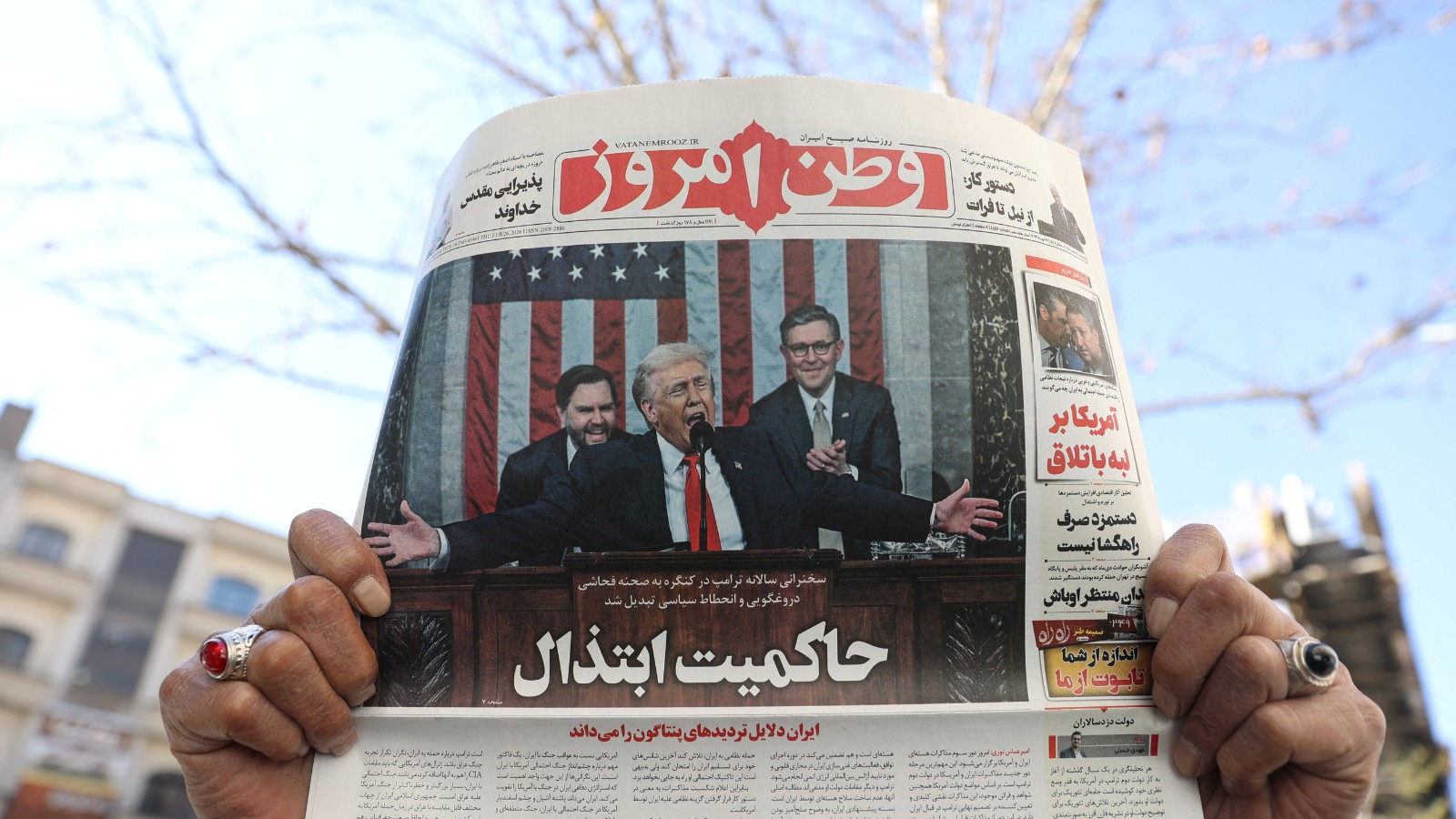
The current escalation in the Middle East represents a classic breakdown in credible signaling, where the United States is attempting to balance the "Cost of Kinetic Engagement" against the "Risk of Proliferation" in real-time. The third round of nuclear talks in Geneva functions not as a traditional diplomatic breakthrough, but as a pressure valve designed to manage the volatility of a dual-track strategy: simultaneous military buildup and diplomatic engagement. To understand the current friction, one must analyze the three structural pillars governing this standoff: the technical latency of Iran’s nuclear program, the logistics of American force projection, and the shifting calculus of regional deterrence.
The Technical Latency of the Joint Comprehensive Plan of Action Framework
The Geneva talks center on the concept of "Breakout Time"—the duration required for a state to produce enough weapons-grade uranium ($U^{235}$) for a single nuclear device. While political discourse often focuses on intent, the strategic reality is dictated by the physical infrastructure of enrichment.
- Enrichment Gradients: Transitioning from 5% (civilian grade) to 20% (medical/research grade) represents roughly 90% of the total work required to reach 90% (weapons grade). Iran’s possession of 60% enriched material significantly compresses the final stage of the enrichment cycle.
- Centrifuge Efficiency: The deployment of IR-6 centrifuges, which are significantly more efficient than the first-generation IR-1 models, reduces the physical footprint required for enrichment. This complicates monitoring efforts, as a smaller facility is harder to detect through satellite imagery or traditional intelligence-gathering methods.
- The Verification Gap: The primary friction point in Geneva is not just the level of enrichment, but the restoration of the International Atomic Energy Agency (IAEA) "Continuity of Knowledge." Without real-time camera access and intrusive inspections, the baseline data for Iran’s stockpile becomes speculative, rendering any future agreement mathematically unverifiable.
Force Projection as a Variable in Diplomatic Leverage
The deployment of additional American assets—specifically carrier strike groups and advanced fighter wings—is often misinterpreted as a preparation for immediate conflict. From a strategic consulting perspective, these deployments function as a "Security Tax" on Iranian decision-making.
The Logic of Presence
The American military posture serves a specific functional role in the negotiation process. By increasing the density of assets in the CENTCOM Area of Responsibility (AOR), the U.S. shifts the "Expected Value" of Iranian escalation. If the cost of a regional strike by Iranian proxies outweighs the perceived benefit of a negotiation stall, the U.S. gains marginal leverage at the table.
Logistics and Sustainability
Force projection is not a static state but a resource-heavy operation with high decay rates.
- Maintenance Cycles: Carrier Strike Groups have finite deployment windows before they require Mid-Life Overhauls or basic maintenance.
- Opportunity Cost: Every asset deployed to the Persian Gulf is an asset withheld from the Indo-Pacific theater. This "Global Force Management" constraint is well-understood by Iranian negotiators, who may perceive the American buildup as a temporary bluff rather than a long-term commitment.
- The Response Threshold: The deployment of Terminal High Altitude Area Defense (THAAD) systems signals a shift from offensive posturing to defensive hardening. This suggests the U.S. is preparing for a "Leaky Deterrence" scenario, where some level of kinetic exchange is expected and must be mitigated.
The Three Pillars of Regional Instability
The Geneva talks do not exist in a vacuum. They are constrained by three external variables that dictate the boundaries of any potential settlement.
1. The Proxy Asymmetry
Iran utilizes a "Network of Networks" approach to warfare, leveraging non-state actors to achieve state-level objectives. This creates a decoupling of responsibility. When a proxy group engages in a strike, Iran maintains "Plausible Deniability," while the U.S. faces the dilemma of whether to retaliate against the agent or the principal. This asymmetry ensures that even if a nuclear agreement is reached in Geneva, the regional kinetic friction remains constant.
2. Economic Attrition vs. Domestic Legitimacy
Sanctions function as a slow-acting metabolic poison on a state’s economy. However, the "Sanctions Evasion Infrastructure" developed by Iran—utilizing a "shadow fleet" of tankers and decentralized financial exchanges—has created a floor for their economic endurance. The Geneva talks are effectively a negotiation over the price of this evasion. Iran seeks the removal of systemic banking restrictions (SWIFT access) in exchange for technical nuclear concessions. The U.S. strategy involves maintaining the "Maximum Pressure" architecture while offering "Sanctions Relief" in narrow, reversible tranches.
3. The Israeli Vector
Israel represents the "External Spoiler" in the US-Iran dynamic. Their strategic doctrine, the Begin Doctrine, dictates that Israel will not allow any regional adversary to attain nuclear capabilities. This creates a "Red Line" that is often more aggressive than the American one. The Geneva talks must account for the fact that a deal acceptable to Washington might be viewed as an existential threat in Jerusalem, potentially triggering a unilateral Israeli kinetic intervention that would render the Geneva diplomatic framework obsolete.
The Mathematical Impossibility of the Status Quo
The current trajectory is unsustainable due to the "Acceleration of Capability." As Iran continues to refine its enrichment techniques and missile delivery systems, the value of the 2015 JCPOA framework diminishes. You cannot "un-learn" the technical expertise gained during periods of non-compliance.
This creates a "Knowledge Ratchet Effect." Even if Iran returns to previous enrichment limits, the R&D gains on advanced centrifuges remain. Consequently, any new agreement must be "Longer and Stronger"—a term used by U.S. officials that Iran views as a breach of previous commitments. This logical impasse is the primary reason the third round of talks in Geneva has yielded "procedural progress" but "substantive deadlock."
Strategic Foresight and Operative Realities
The deployment of American forces acts as a hedge against the total collapse of the Geneva process. However, military presence alone cannot solve the "Verification Dilemma." The U.S. is currently operating under a "Threshold Management" strategy—attempting to keep Iranian enrichment below 90% while keeping regional conflict below the level of a general war.
The limitation of this strategy is its sensitivity to "Black Swan" events—an accidental drone strike, a miscalculation by a proxy commander, or a technical failure in a nuclear facility. In these scenarios, the carefully calibrated "Geneva Equilibrium" evaporates.
The immediate tactical requirement for the United States is the establishment of a "Hotline" or a direct de-confliction channel that operates independently of the nuclear talks. Relying on the Swiss intermediaries in Geneva is insufficient for real-time crisis management when carrier groups and ballistic missile batteries are in high-readiness states. The second requirement involves a pivot from "Sanctions as Punishment" to "Sanctions as a Toggle." The U.S. must demonstrate a credible, rapid mechanism for re-imposing sanctions if Iran utilizes the "Sanctions Relief" window to accelerate its conventional missile program.
The final strategic play involves the formalization of a "Regional Security Architecture" that integrates Gulf Cooperation Council (GCC) air defenses with American and potentially Israeli assets. This creates a "Containment Box" that lowers the utility of Iran’s conventional missile threats, thereby forcing the Iranian leadership to view the nuclear negotiation not as an option, but as a necessity for regime survival. Diplomacy in Geneva only succeeds when the alternative—economic and military isolation—is perceived as an existential certainty.